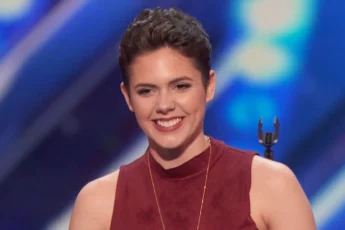

When Rachel Potter stepped onto The X Factor USA stage in 2013, she didn’t arrive like someone trying to sell a spectacle. There was no dramatic entrance or wardrobe that screamed for attention—just a woman who introduced herself plainly as a bartender from Nashville, the sort of tagline that invited an automatic eyebrow raise from people used to flashier backstories. Her voice when she spoke was steady, even a little weary, as if she’d repeated the story so many times she wanted the performance to do the talking for her. She said she’d been overlooked for too long. That confession, quiet and unadorned, already set the mood: this wasn’t about showbiz polish; it was about a person who’d kept working and was ready to be heard.
Choosing “Somebody to Love” by Queen was a bold move. The song carries Freddie Mercury’s immense legacy and a theatricality that could easily swallow a singer who tried to mimic it. Rachel didn’t even attempt a pastiche. Instead, she reimagined the track with a country twist that felt honest to her Nashville roots. Right from the first phrase you could hear the subtle changes: the opening phrasing was less operatic and more conversational; she softened the vibrato in places and let the storytelling side of her voice take the lead. It wasn’t a novelty cover so much as an interpretation—the kind that says, I know where this song comes from, and I’m bringing my own history to it.
That approach did something important: it made the familiar suddenly fresh. Where Mercury might have leaned into flamboyance, Rachel mined the song for quiet, human moments. A line that might be delivered as theatrical bravado became a plea in her hands, and an exuberant chorus felt like a collective breath shared between singer and audience. There were small choices that revealed a lot about her instincts as an artist: a gentle drawl on a particular syllable that rooted the lyric in a Southern cadence, a softer approach on certain runs that allowed the meaning of the words to come through, and a near-whisper on a bridge that made the eventual payoff feel earned rather than shouted.
The visual contrast helped sell the narrative. She walked on with hair pulled back, a simple outfit, and shoes that suggested nights spent on shift behind a bar. When the lights focused on her and the first chorus hit, some viewers probably felt the same double-take you get when someone opens a book with an unassuming cover and reveals a voice that demands attention. The judges’ reactions reflected that surprise. An expression of raised eyebrows, a pen paused mid-note, a lean forward—those little physical cues said more than any canned praise. It wasn’t instant celebrity sheen she earned; it was respect earned by craft and conviction.
Emotion threaded the performance in small but effective ways. There was a palpable sense that this song wasn’t only about romantic longing; for Rachel, it also felt like a testimony to persistence. When she sang, you could almost read the backstory between the lines: late shifts, tips counted in the dim light of a bar, the tiny humiliations of being told you’re talented but not “marketable,” and the stubborn decision to show up anyway. Those real-world textures lent her interpretation depth. In one breathy passage her voice cracked just enough to signal strain, then healed into a full, clear cry that made the chorus land not as spectacle but as proof.
Musically, she made smart, tasteful moves. Instead of trying to out-Mercury Mercury’s range, she used dynamics—pulling back in the verses so the chorus could surge; adding slight rhythmic shifts that hinted at country phrasing; and letting small, plaintive inflections glide over a sustained note to convey sincerity. The backing band, along with the production in the room, seemed to lean into her choices, giving space where she asked for it and filling out the sound when she needed to soar. The result was an arrangement that felt tailor-made in the moment, designed to showcase not just power but personality.
The transformation from bartender to serious contender didn’t happen because of one spectacular high note. It happened because of coherence—between the backstory she briefly offered, the musical choices she made, and the way she inhabited the stage. That coherence made her audition read like a short story: setup, development, and a satisfying, surprising twist. People watching at home and those sitting in the studio felt it: someone who had been overlooked was standing in the light and claiming space with both restraint and authority.
When the last note faded and the applause rose, it had the quality of recognition more than simple approval. The kind of recognition that signals a shift in perception: from “bartender with a dream” to “artist worthy of attention.” Rachel’s performance was not merely a cover; it was a claim. It said that songs with huge shadows can be re-cast in new light, and that authenticity—rooted in where you come from—is often the most compelling way to make yourself known. For a few minutes on that stage, she didn’t just sing—she answered a long-held question: she belonged there.