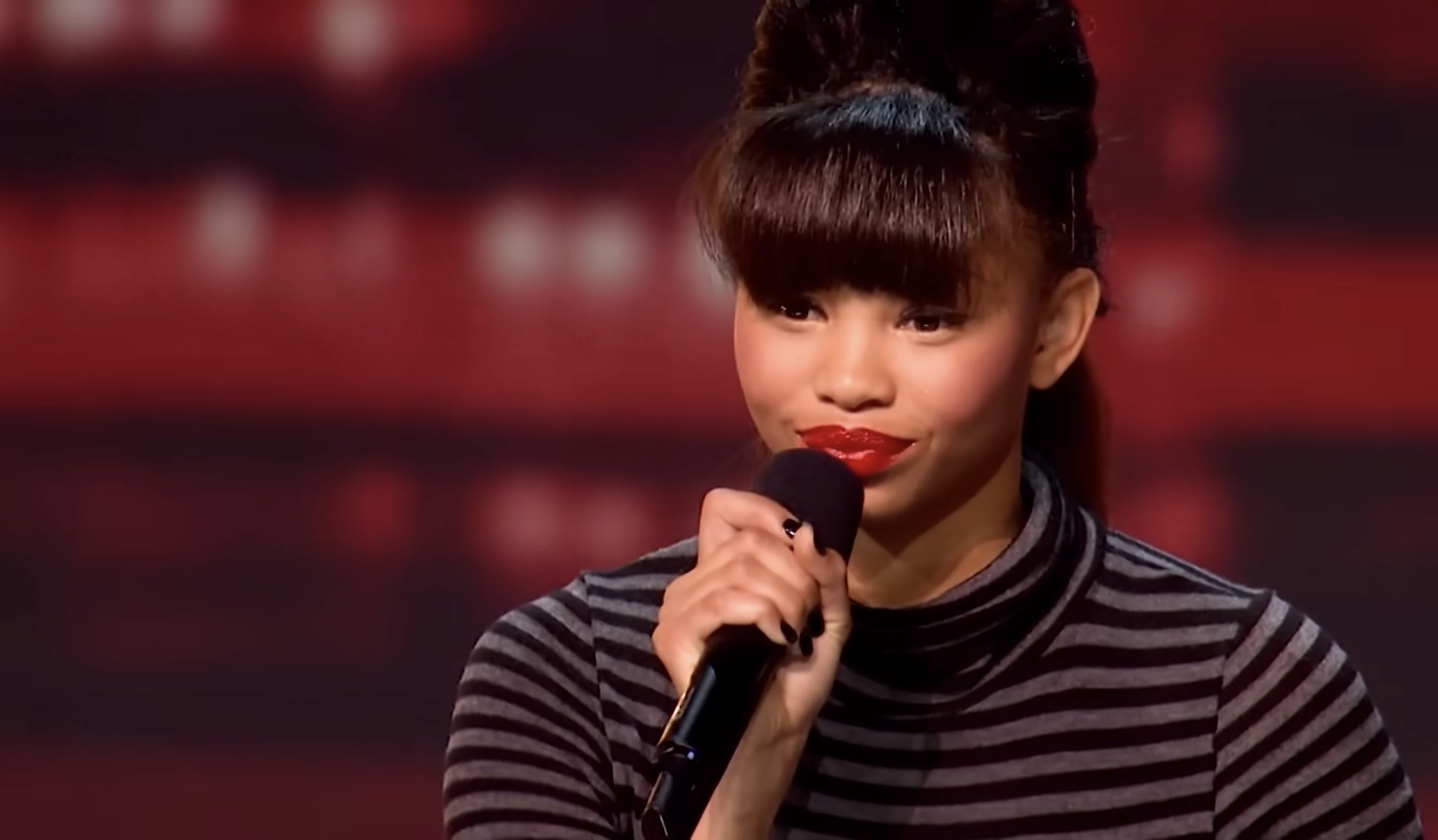
Tiah Toliver, a 19-year-old deli clerk with big dreams of global stardom, stepped onto the stage carrying more than just nerves. There was a spark about her—something in the way she held herself, a mix of excitement and determination—that immediately caught attention. She introduced herself with a bright smile, her voice steady but filled with anticipation. When she spoke about her job and her aspirations, it was clear that this moment meant everything to her. She wasn’t just there to perform; she was there to change her life.
From the very beginning, there was an energy about her that felt different. The phrase “steel in her eyes” wasn’t an exaggeration—it was visible in the way she stood her ground under the bright lights, facing a panel of judges known for their high standards and blunt honesty. Without any music to guide her, she chose to perform an a cappella version of “Impossible” by Shontelle, a song that demands both emotional depth and vocal control.
As she began, the room quieted. Singing without a backing track is always a risk, and it exposed every nuance of her voice. There were moments where she sounded raw and powerful, her tone cutting through the silence in a way that made people lean in. But there were also moments where her pitch wavered slightly, and the lack of instrumental support made those imperfections more noticeable. It was a performance that felt unpolished, but undeniably real.
Simon Cowell seemed intrigued almost immediately. You could see it in his expression—he wasn’t just listening to what Tiah was doing in the moment, but imagining what she could become. However, the other judges didn’t share his enthusiasm. As the final note faded, the atmosphere shifted. What could have been a straightforward critique quickly turned into something much more intense.
LA Reid and Demi Lovato were honest, but firm. They acknowledged Tiah’s passion, but pointed out that her vocals lacked consistency. There were concerns about control, about readiness, and about whether she could handle the demands of the next stage. The absence of a backing track was also brought up, with the implication that it made the performance feel incomplete and, at times, exposed her weaknesses rather than highlighting her strengths.
Tiah stood there listening, trying to process the feedback while keeping her composure. It’s not easy to hear criticism when you’ve just poured your heart into something, especially on such a public stage. Still, she didn’t interrupt. She nodded slightly, holding onto whatever confidence she had left.
Simon, however, wasn’t ready to let it go. He leaned forward, clearly frustrated, and pushed back against the criticism. To him, Tiah wasn’t just another contestant—she was potential. He argued that what she had couldn’t be taught easily: a certain tone, a presence, something intangible that made people pay attention. At one point, he even went as far as calling the other judges “deaf,” insisting that they were missing something obvious.
What followed was a tense back-and-forth that felt less like a typical judging panel and more like a genuine disagreement about what talent really looks like. Was it about polish and technical perfection, or was it about raw ability and the possibility of growth? The room seemed split, and the audience could feel it.
When the votes came in, the outcome looked grim. Two “no” votes were delivered, and just like that, it seemed like Tiah’s journey might be over before it even began. The weight of that moment was heavy. You could see it on her face—the flicker of disappointment, the realization that her dream might be slipping away.
But Simon wasn’t done.
As Tiah prepared to leave the stage, he stopped her. There was a sense of urgency in his voice, as if he knew this was a pivotal moment. He asked her to sing again, giving her one last chance to show something different. It was a bold move, and it shifted the entire atmosphere in the room.
With the pressure now even higher, Tiah took a breath and began her second song: “It Don’t Mean a Thing (If It Ain’t Got That Swing).” This time, everything felt different. The choice of song allowed her to loosen up, to bring out a playful, rhythmic side of her voice that hadn’t been as evident before. Her confidence seemed to grow with each line, and her personality started to shine through in a way that felt natural and engaging.
The audience responded almost instantly. There was clapping, cheering, a sense that something was changing in real time. Even the judges who had been critical before appeared more attentive, reconsidering what they had just witnessed.
Nicole Scherzinger, in particular, seemed torn. You could see her weighing the risk against the possibility. Under the combined pressure of Simon’s persistence and the audience’s encouragement, she paused before making her final decision. Then, trusting her instincts, she changed her vote to a “yes.”
The shift was immediate and emotional. What had started as a near rejection turned into a moment of triumph. Tiah’s face lit up with a mix of disbelief and relief, the kind of reaction that only comes when something you thought was lost suddenly comes back within reach.
In the end, it wasn’t just about talent—it was about resilience, timing, and someone believing in you when it mattered most. Tiah’s audition became a reminder that sometimes, all it takes is one more chance, one more song, and one person willing to fight for you to turn everything around.