
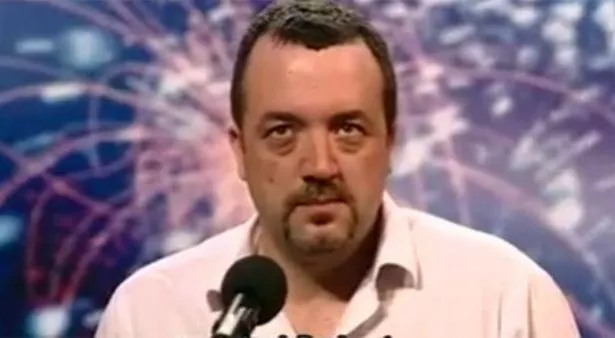
Jamie Pugh walked onto the Britain’s Got Talent stage looking every bit the man out of his element: shoulders slightly hunched, hands clasped together, eyes flicking nervously between the floor and the judges’ table. His clothes were unflashy — a plain jacket, well-worn shoes — the uniform of someone who spends long hours on his feet. He told the judges, in a voice little more than a whisper, that he worked two jobs: delivering pizzas by night and driving a van by day. It was the sort of admission that drew a collective intake of breath; here was a man who had tucked his voice away for years, singing only in the privacy of his own home or in the quiet of a kitchen after a long shift. His reasons for auditioning were simple and honest: curiosity and a quiet wish to find out whether the voice he’d heard in his own head could stand on its own in the spotlight.
Given that humble setup, Jamie’s choice of song felt audacious. He’d picked “Bring Him Home,” the emotional centerpiece from Les Misérables — a piece that demands control, breath, and a depth of feeling that can strip an audience bare. It’s a song big enough to swallow a nervous amateur whole, and you could see the risk written across the judges’ faces. People leaned forward, waiting, perhaps fearing a moment of bravado might tip into embarrassment. But from the first measured note, it was clear everyone’s assumptions were about to be overturned.
The transformation was immediate and breathtaking. The timid, soft-spoken man who had shuffled onto the stage seemed to recede, replaced by a vocalist with a surprising, operatic core. His tone was round and resonant; every phrase rose and fell with impeccable control. You could tell he understood his breath — how long to hold, when to let it flow — even if he had only practiced in tiny, private moments: humming in the van between deliveries, running scales quietly in the kitchen, testing a long note while stirring a pot. Those little habits, repeated under fluorescent lights and humming engines, had somehow formed the backbone of a performance that now sounded like the work of someone who’d trained for years.
What made it so affecting wasn’t just the technical proficiency. The timbre of his voice had a warm, honeyed quality that made the lyrics — a prayer for a loved one’s safety — feel utterly believable. There was tenderness under the power, a vulnerability that pulled at people’s hearts rather than merely impressing them with virtuosity. You could see the effect ripple through the audience: heads bowed, brows furrowed, some people squeezing hands together. It wasn’t acting; it was honesty transmitted through music.
By the time he reached the final phrases, the theatre had already decided. People rose to their feet before the last cadence had even landed — not a polite clap but an immediate, instinctive standing ovation, the kind reserved for moments that touch something deep and true. On stage, Jamie’s composure cracked — not from stage fright but from surprise and gratitude. He blinked as the applause washed over him, the reality of recognition settling in like warm sunlight. For years he’d hidden his ability behind two jobs that paid the bills; in that single, electric moment his talent was acknowledged in a very public and very human way.
The judges’ reactions mirrored the audience’s astonishment. Piers Morgan admitted candidly he had “not expected that kind of performance” from a man who hands out pizzas at night — a comment that mixed surprise with a grudging admiration for the unpredictability of the show. Amanda Holden was effusive, calling Jamie precisely the kind of discovery that makes the judges travel the country: raw, genuine, and transformative. Her words framed him as the embodiment of what the contest promises. Even Simon Cowell, known for his tough critiques, softened. He told Jamie this moment should make him start believing in himself, suggesting that talent like his could carry him far beyond late-night deliveries and into opportunities he might never have dared to imagine.
There was more than praise in their remarks; there was a sense of responsibility. The judges recognized that Jamie had been handed a platform he hadn’t aggressively sought but had been brave enough to accept. Their encouragement felt less like on-air flattery and more like a push toward possibility, a gentle insistence that this was a door worth walking through. Jamie listened with wide, wet eyes, absorbing each syllable as if it were both instruction and blessing. He had come to see if he could sing in front of people; he left with the knowledge that not only could he, but that people wanted to hear more.
When the votes were counted, the studio hummed with a warmth that had nothing to do with the stage lights. All three judges gave him a resounding “Yes,” sealing his passage to the next round. For Jamie, it marked the beginning of more than a competition journey; it was the start of a new chapter. The image of him returning to the quiet of his van or the late-night pizza runs would from then on be shaded by the memory of a theatre rising as one, moved by a voice that had been waiting patiently for its moment. In that sense, Jamie’s audition was quintessentially what talent shows promise: an ordinary person revealing an extraordinary gift, and in doing so, opening the door to a future he may now feel brave enough to imagine.