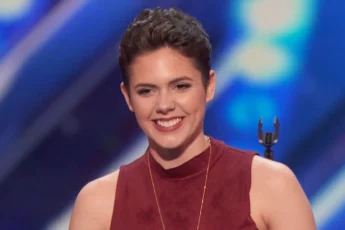

Ed Drewett’s audition on Britain’s Got Talent stood out as one of those rare moments when someone already successful behind the scenes decides to step forward and take a personal risk. At twenty-five, Ed wasn’t an unknown chasing a first break—he had already built a strong career as a songwriter, quietly shaping some of the biggest pop hits of the past decade. So when he casually mentioned to the judges that he had written songs like “Glad You Came” for The Wanted and “Best Song Ever” for One Direction, there was an immediate shift in the room. You could almost feel the surprise ripple through the audience. It wasn’t just impressive—it raised an interesting question: why would someone with that kind of success step onto a stage like this?
As he explained, it became clear that this wasn’t about chasing fame in the traditional sense. For Ed, it was more about stepping out from behind the curtain and proving something to himself as much as to anyone else. Writing songs for global stars had given him credibility and a solid reputation within the industry, but performing them—or even his own material—required a completely different level of exposure. There’s a kind of comfort in staying behind the scenes, where the spotlight isn’t directly on you. But standing on a stage in front of a live audience, knowing every note will be judged in real time, is a very different experience. That vulnerability was part of what made his decision feel so compelling.
When it came time to perform, Ed chose an original song called “Blink.” Before starting, he briefly explained that the song was about finding strength during difficult moments, a theme that felt personal without being overly dramatic. It was a small detail, but it helped ground the performance, giving the audience something emotional to hold onto before the first note even landed.
As the music began, any doubts about whether he could transition from songwriter to performer started to fade. His voice came through with a steady control and a warmth that made the lyrics feel genuine rather than rehearsed. There was a natural ease in the way he carried himself on stage, too. He didn’t seem nervous or overworked in his delivery; instead, he looked like someone who had finally stepped into the role he had been building toward for years. That quiet confidence made a difference—it allowed the performance to breathe.
The song itself had all the hallmarks of a well-crafted pop track, something the judges picked up on almost immediately. The melody was catchy without feeling forced, and the chorus had that subtle lift that tends to stick in your head long after the performance ends. But what really made it stand out wasn’t just its structure or polish—it was the sincerity behind it. You could sense that this wasn’t just another well-written song from a professional songwriter; it was something personal, shaped by real experience. That emotional connection gave the performance weight.
Throughout the auditorium, the audience stayed noticeably engaged. Some people nodded along to the rhythm, while others leaned forward slightly, as if trying not to miss a word. It wasn’t a performance built on big theatrical moments or dramatic vocal runs. Instead, it developed gradually, drawing people in through storytelling and musicality. By the time he reached the final chorus, there was a shared sense of attention in the room—a quiet acknowledgment that something meaningful was happening on stage.
The judges’ reactions reflected that same feeling. They weren’t just reacting to a good voice; they were responding to the full picture. Comments about his songwriting ability came naturally, with praise for how well-structured and memorable the song was. It’s one thing to write hits for established artists, but it’s another to stand on stage and deliver your own work with that level of conviction. That distinction wasn’t lost on them.
Amanda Holden, in particular, seemed genuinely impressed by his presence, noting that he looked and sounded like a star already. It wasn’t an exaggerated compliment—it felt like a recognition that he had crossed an important line, moving from the background into the spotlight in a convincing way. There was also a subtle sense from the judges that someone of his calibre might have easily impressed industry figures like Simon Cowell, reinforcing just how strong the audition was.
What made the moment especially satisfying was the sense of timing behind it. Ed wasn’t a newcomer hoping for a lucky break; he had already put in years of work behind the scenes, refining his craft and contributing to major hits. This felt less like a gamble and more like a natural evolution. Still, it required courage to step forward and reintroduce himself in a completely different role, knowing that the audience might now judge him in a new light.
When the votes came in, the result felt almost expected. Four clear “yeses” sent him through to the next round, but the real impact went beyond the decision itself. The applause that followed wasn’t just for a solid performance—it was for the story behind it, the idea that someone who helps shape the voices of others can also find his own voice in a powerful way.
Ed Drewett’s audition ultimately served as a reminder that talent isn’t limited to a single role. The people who write the songs we hear every day often have their own stories and performances worth sharing. In stepping into the spotlight, Ed didn’t just prove he could sing—he gave the audience a deeper look at the person behind the music, and that made the moment resonate far beyond the stage.