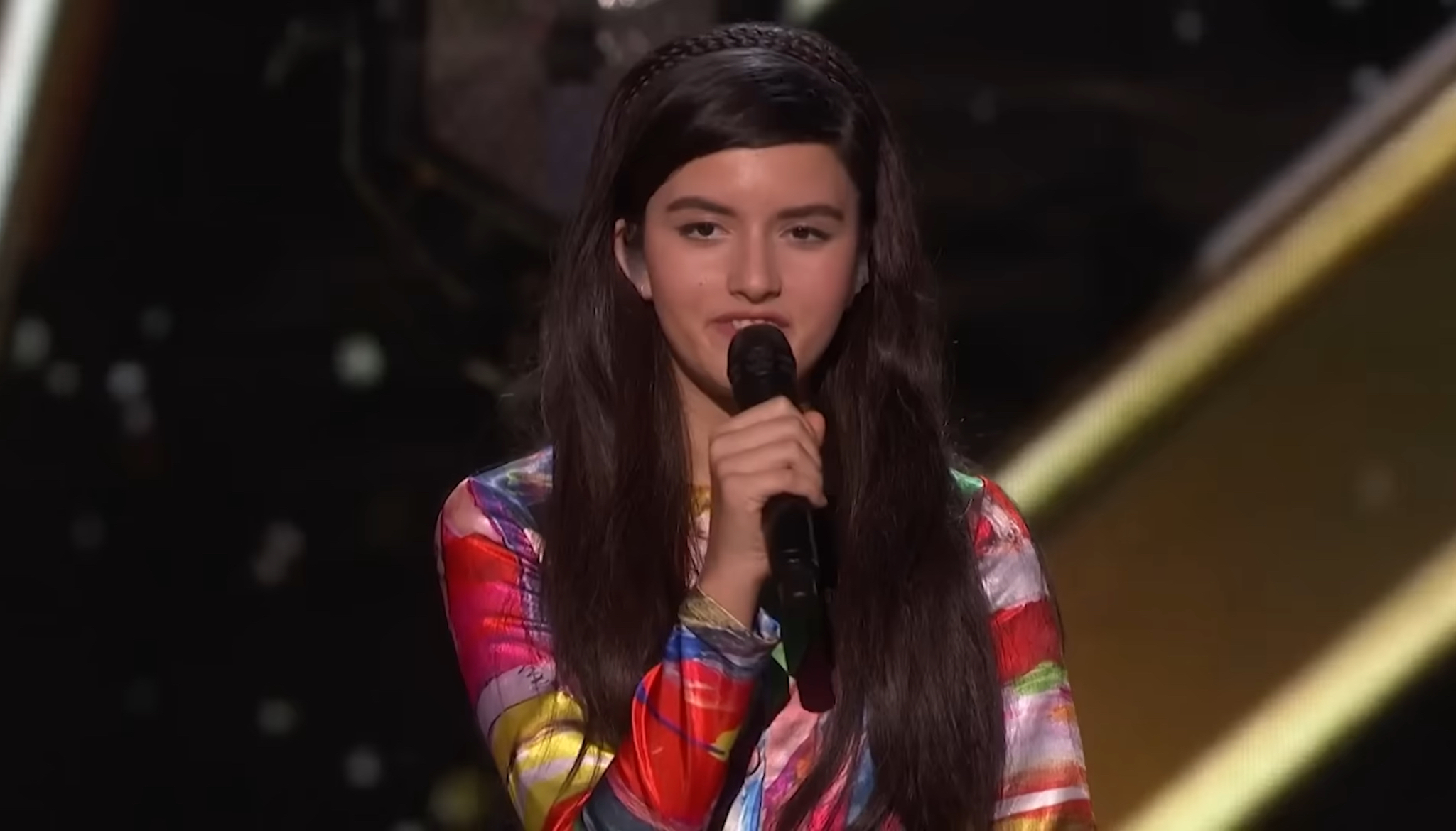
When Angelina Jordan stepped onto the America’s Got Talent: The Champions stage, there was already a quiet story trailing behind her. At just thirteen, she arrived with a résumé that read older than her years — she had already won Norway’s Got Talent at seven, and in the years since she’d carved out a reputation as a young singer who preferred smoky jazz standards to typical pop fare. That backstory mattered. It suggested that this wasn’t a child dabbling in performance for the novelty; this was a young artist who had been quietly honing her craft for most of her life. And she admitted, with a small, earnest smile, that one of her biggest dreams had been to perform for Simon Cowell. After ten years of waiting, the moment had finally come.
From the first second of her audition it was clear Angelina had no interest in doing the obvious. Instead of attempting a faithful, belting cover of Queen’s “Bohemian Rhapsody,” she stripped the song down to its bones and rebuilt it entirely in her own image. Dressed simply and standing barefoot — a small detail that made her appear more vulnerable, more rooted — she delivered a version that felt like a late-night jazz club take on a rock opera. The roaring guitars and theatrical shifts gave way to slow, smoky phrasing, and the result was both disorienting and enthralling. Listeners who expected the bombast of the original were forced to recalibrate: this was not imitation, it was reinvention.
Angelina’s voice was central to that reinvention. For someone so young, she possessed a timbre far beyond her years — a deep, weathered-sounding tone that carried the weight of lived experience. She navigated the song’s complex lyricism with a delicate control, stretching lines, bending notes, and infusing each phrase with a kind of intimate sorrow that made the familiar lyrics feel newly poignant. Where Freddie Mercury’s original runs with operatic bravado, Angelina chose restraint, letting silence and breath shape the emotional contour of each bar. That decision revealed both courage and artistic maturity; it is not easy to reimagine a beloved anthem, but to do so with such conviction is rarer still.
The arrangement itself served as a showcase for her musical instincts. With sparse instrumentation supporting her, the performance leaned heavily on mood and nuance rather than spectacle. A held note would hang in the air like a question, then resolve into a hushed, confiding phrase; dramatic crescendos were replaced by quiet swells that invited listeners in rather than pushing them back. Those choices made the performance feel personal, as if Angelina were inviting the audience into a secret rather than giving a showy demonstration of vocal fireworks. It’s the kind of interpretation that can make a room lean forward — and the audience did just that, collectively drawn into the fragile world she created on stage.
The judges’ reactions amplified the sense that something extraordinary had just happened. Alesha Dixon was visibly shaken by the performance, calling it “insane” and saying she felt like she was witnessing the birth of a star. Howie Mandel echoed that astonishment, praising the arrangement as “amazing” and admitting he had never heard Queen’s anthem treated that way before. Their comments underscored how rare it is for a contestant to take such a bold risk and have it pay off so completely. But it was Heidi Klum’s response that turned the moment into television history: moved by the artistry and apparent life-changing potential of Angelina’s audition, she hit the Golden Buzzer.
The Golden Buzzer moment was theatrical and emotional. When Heidi slammed it, the camera cut to Angelina’s face — a mixture of stunned disbelief and fragile joy. The buzzer sent her straight to the finals, a symbolic seal of approval that felt earned rather than theatrical. The judges’ unanimous reaction, combined with that decisive gesture, suggested that Angelina’s performance had achieved something more than temporary viral fame; it had established her as an artist capable of reinventing familiar material in a way that resonates on a deep, human level.
When she left the stage, barefoot and modest as she had arrived, there was a sense that viewers had witnessed not just a great audition but a rare moment of artistic translation: a rock masterpiece transformed into a jazz confession, delivered by a teenager whose musical sensibilities seemed far older than her years. Angelina Jordan’s take on “Bohemian Rhapsody” reframed the song’s emotional core for a new audience and, in doing so, announced her arrival as a distinctive voice in the world of music — one whose future the judges, and now the viewers, were eager to follow.