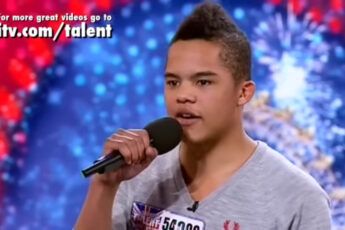

Aaron Frith’s journey to the Britain’s Got Talent stage began far from glittering marquees and standing ovations. At first glance, he seemed an unlikely candidate for showbiz — a down-to-earth young man from Maidstone in Kent who spent his weekdays working in a garden centre, joking that he “knows nothing about plants.” That self-deprecating humor hinted at a humility that made him instantly likable, but beneath the laid-back exterior was a quiet, old-soul ambition. Aaron didn’t grow up dreaming of chart-topping pop stardom; instead, his musical imagination was shaped by late-night records and the smoky croon of classic entertainers. It was his father who introduced him to the world of Frank Sinatra and Michael Bublé, and those influences would come to define the very heart of his audition.
Deciding to audition felt like a leap of faith. For Aaron, the stage represented a chance to take a passion he’d long kept private and present it to the world. He didn’t choose the obvious route of singing another pop ballad or belting out a contemporary hit in the way the song was intended. Instead, he made a deliberately bold choice: he would take Britney Spears’ globally recognized dance-pop anthem “Toxic” and rework it into a swing-era, big-band-style number. It was an audacious musical gamble — the kind of artistic risk that could either fall flat or reveal something unexpectedly brilliant. Aaron’s confidence wasn’t flashy; it was quiet, rooted in a belief that good music could be reshaped and still retain its emotional core.
From the moment the opening bars began, it became clear that the gamble had paid off. The sprightly, electronic shimmer of the original was replaced with brushed snares, warm brass accents, and a relaxed, walking bass that invited listeners to sway rather than dance. Aaron’s deep, velvety tone slid into the arrangement with the ease of someone who had spent hours practicing phrasing in front of a mirror. There was a polished restraint to his delivery — he didn’t try to over-sing or mimic the bombast of pop production. Instead, he focused on nuance: a slight pause here to let a lyric land, a hushed inflection there to give a line intimacy. Those choices transformed the song’s meaning; what had been flirtatious and urgent in its original form became cool, sophisticated, and flirtatiously wry when filtered through Aaron’s interpretation.
The audience reaction built gradually as people recognized the familiar melody reframed in a vintage light. Middle-aged viewers smiled at the nostalgia of the arrangement, while younger audience members seemed intrigued by the novelty. You could feel the room warming to him — murmurs of appreciation, the soft clapping that comes when a crowd senses something special. Judges leaned forward; David Walliams later described Aaron’s voice as “smooth red wine,” an image that captured the relaxed, luxurious quality of his tone. Such a comparison wasn’t just flattering wordplay — it was an acknowledgment that Aaron wasn’t merely performing notes, he was delivering an atmosphere.
Of course, reinvention requires more than a pretty voice. It requires personality, and Aaron had that in spades. He moved with an understated confidence, tipping his cap at a well-timed moment, smiling in a way that suggested a wink to the audience. His presentation hinted at an understanding of the Rat Pack showmanship he admired, even if he didn’t yet fully inhabit that larger-than-life persona. Simon Cowell, usually the stickler for commercial viability, gave feedback that mixed praise with practical advice. He acknowledged the difficulty of forging a career in a style with only a few dominant figures — the market for modern swing crooners is narrow, and the path to lasting fame in that niche is steep. Simon encouraged Aaron to hone not just his voice but the “style and charisma” associated with the greats, implying that to succeed he would need to cultivate a stage identity as smooth as his vocal tone.
That critique didn’t dampen the moment; it framed it. The judges recognized that Aaron had talent and potential, even if the commercial roadmap was uncertain. They applauded his bold artistic vision and his undeniable likability. His choice to reframe a pop song as a classic swing number was brave and smart — it showcased his strengths while setting him apart from the sea of predictable auditions. When the panel announced their decision, Aaron earned four emphatic “yeses.” The roar that followed wasn’t just for the performance; it was a cheer for the story behind it: the garden centre worker with a golden voice who dared to imagine a life beyond the rows of potted plants.
As he walked off the stage, there was a palpable sense of possibility. For Aaron, the next round would be an opportunity to refine the very elements the judges had pointed out — to deepen his charisma, sharpen his repertoire, and perhaps find a way to translate the timeless appeal of Sinatra and Bublé into something modern audiences could embrace. Whether or not he would become the next big name in contemporary swing, that moment on Britain’s Got Talent revealed something simple and true: talent can grow in unexpected places, and a bold reinterpretation can change how we hear a familiar song. Aaron’s audition proved that a well-placed voice, a daring idea, and a little bit of charm can transform a pop hit into something utterly new — and leave an audience wanting more.