
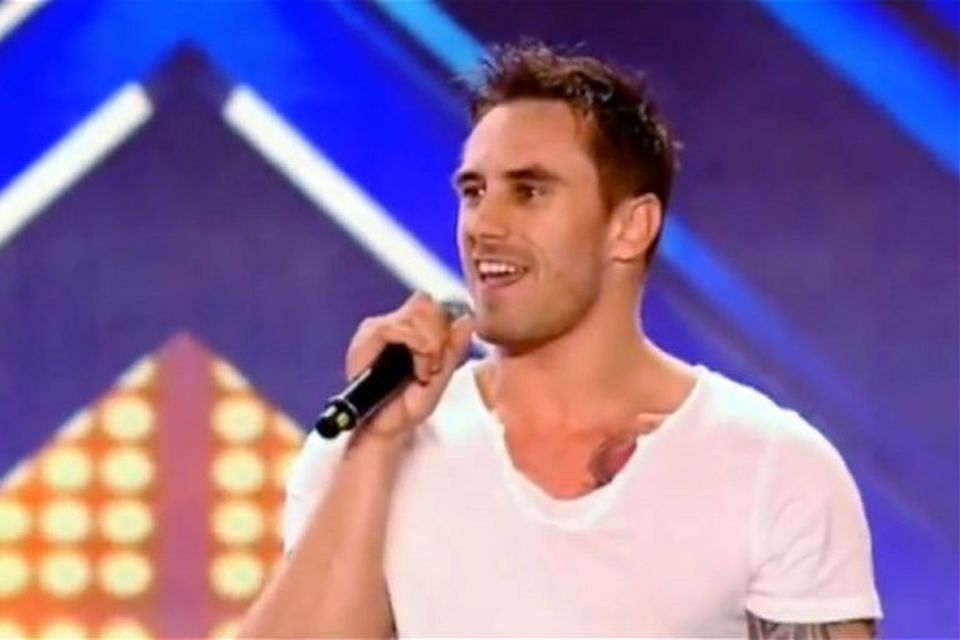
Joseph Whelan, a 26-year-old tool salesman from Wolverhampton, walked onto the X Factor UK stage with a quiet, unassuming presence that immediately tugged at the heartstrings of everyone watching. Dressed simply and standing a little stiffly beneath the lights, he spoke plainly about who he was and why he’d come: a man who had chased music for ten years, juggling odd gigs and day jobs, and now a father determined to give his four-year-old son, Kian, something to be proud of. The image of a devoted dad, balancing responsibility and dreams, settled over the studio like a warm blanket. You could see it on the judges’ faces and in the crowd — people were rooting for him before he sang a single note.
Joseph’s story came out in small, human details that made it feel real rather than rehearsed. He told them about early mornings at the tools warehouse, long nights playing in pubs and at local events, and the moment he held his son for the first time and felt a shift in everything. Becoming a father hadn’t dimmed his desire to perform; it sharpened it. Suddenly the stakes were different. He wasn’t trying to become famous for himself — he wanted to show his boy what persistence looks like, to model courage, and to leave a legacy that Kian could admire. That simple motivation made the whole room lean in.
Then he chose his song: Led Zeppelin’s “Whole Lotta Love,” a bold, unapologetic rock classic. For someone of Joseph’s soft-spoken introduction, the choice was startling — which is exactly why it worked. From the moment the opening riff hit, there was a sense of anticipation: would he simply mimic the original, or would he bring something of himself? As he launched into the first lines, any lingering doubt evaporated. His normal speaking voice melted away and was replaced by a raw, powerful rock tone that filled the theater and seemed to rattle the lights. What followed was a performance that didn’t just cover a song; it inhabited it.
There was something almost cinematic about the transformation. One minute a modest man was standing at the microphone; the next, he had the presence of someone who’d been born to perform. His voice possessed a gravelly edge and an effortless reach that made the familiar lyrics feel urgent and alive. He played with dynamics — softening a verse to draw listeners in, then releasing a surge of power on the chorus that sent the crowd to its feet. It wasn’t just volume; it was control and emotion. You could sense the years behind the sound: nights of practice in small rooms, learning how to shape a phrase so it would land just right, the discipline of honing an instrument that, unlike a guitar, lives inside you.
Small moments in the performance made it feel deeply personal. Joseph’s eyes closed on a hard line, as if remembering the small stages where no one but the band and a few regulars listened. He glanced once toward the audience with a half-smile that suggested both joy and relief — the kind of look a man gives when a risk finally pays off. When he hit the higher notes, the crowd reacted not just to pitch and power but to conviction: this was a man singing for something bigger than himself. People shouted and clapped, then quieted themselves to catch every nuance. It was the rare kind of audition where you felt the room collectively breathe with him.
The judges’ reactions tracked that shift from skepticism to astonishment. Gary Barlow and Mel B both leaned forward during the performance, their faces moving from polite interest to open admiration. When the last note hung in the air and the band cut out, an electric silence held for a heartbeat before the audience erupted into a standing ovation that felt as much relief as celebration. Joseph, usually reserved, was visibly moved. Tears welled at the corner of his eyes and his shoulders rose and fell as he took in the response. He stepped off the stage for a moment, then returned to gather his son in an embrace the cameras captured in vivid detail: Kian’s small arms around his father’s neck, family members cheering, and a man who had done something he’d promised himself he would try.
The judges piled on praise in the aftermath, focusing not only on the vocal performance but on the authenticity behind it. Gary Barlow commended Joseph’s incredible voice and the emotional truth he brought to a demanding rock song. Mel B celebrated the raw rock star energy he had unearthed, noting how genuine his style felt. Their compliments mattered because they reflected a recognition of both talent and character. When each judge pressed the “yes” button, it felt like an endorsement of an entire life’s worth of effort: four votes that signaled a new chapter for Joseph.
Beyond the immediate spectacle, the moment carried a quieter resonance. Joseph’s journey from selling tools in Wolverhampton to belting out a Led Zeppelin anthem on national television was a reminder that dreams often sit beside everyday responsibilities, and they don’t have to be mutually exclusive. He hadn’t abandoned his day job or spent years chasing fame with reckless abandon; he had carved out time, showed up, and refined his craft. That dedication — wrapped up now in a moment of triumph — offered something hopeful to anyone who’s ever had to choose between practicality and passion.
As Joseph left the stage, surrounded by hugs and tears, it was clear the audition had done more than earn him a place in the competition. It had given him a memory to show his son, a story of perseverance to pass on, and the first real step toward a future where his music and his fatherhood could coexist. For the audience that night, it was a powerful reminder that sometimes the quietest people carry the loudest talents.