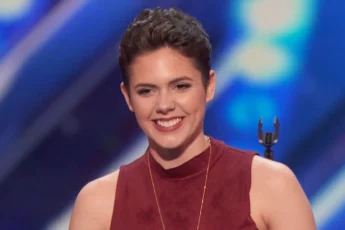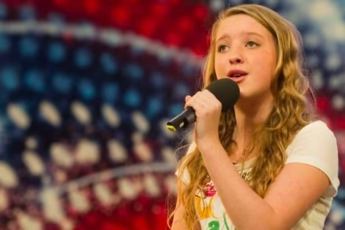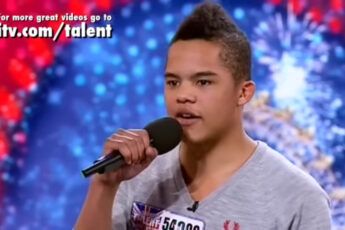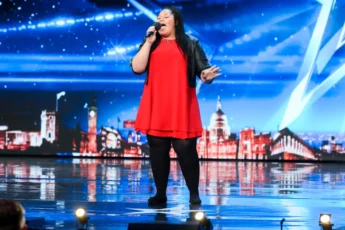
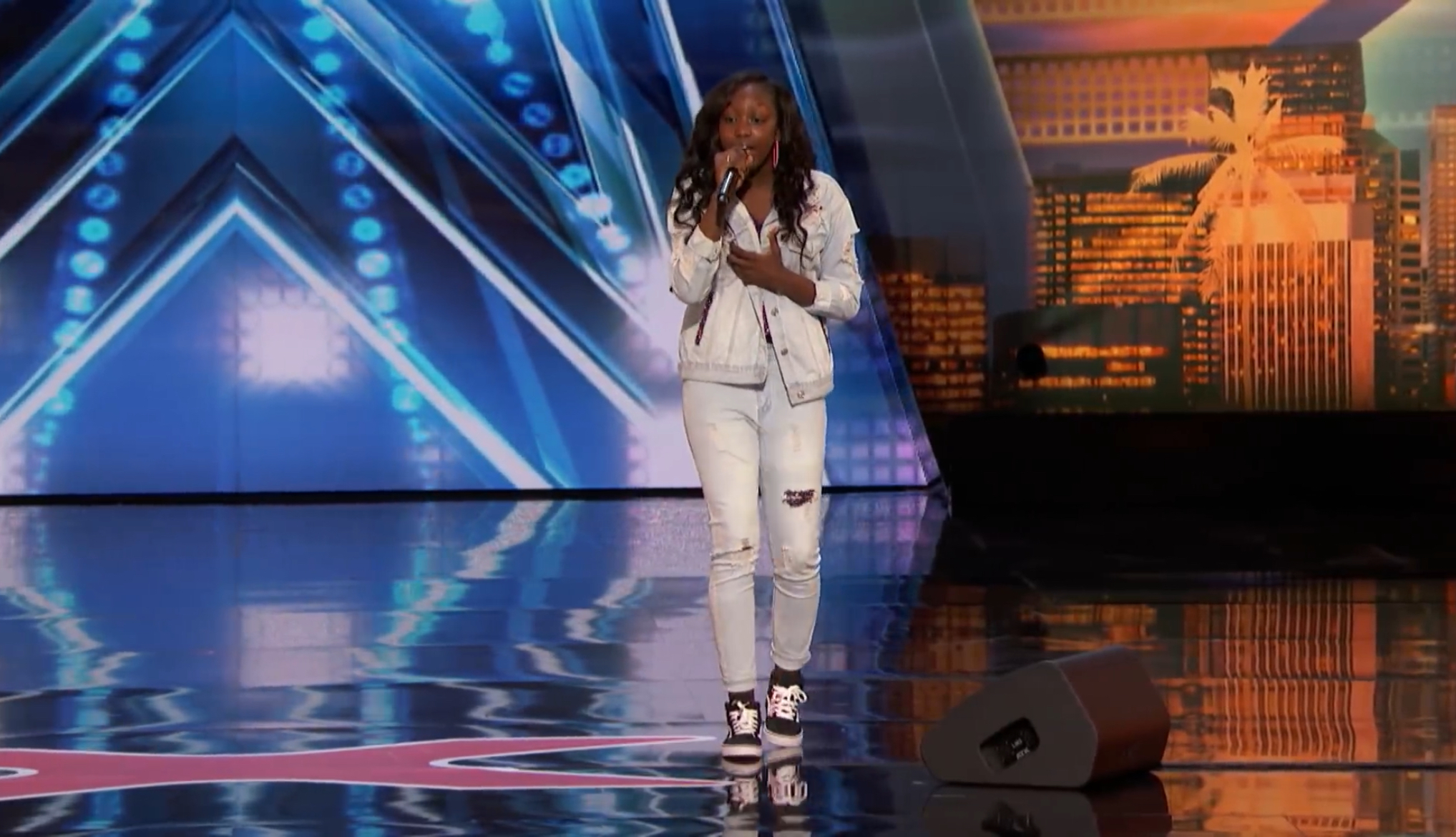
At just fourteen years old, Flau’jae walked onto the America’s Got Talent stage carrying more than a backpack and a mic — she carried a legacy. Hailing from Savannah, Georgia, she spoke candidly about a hole in her personal history: her father, an aspiring rapper himself, was killed before she was born. That absence shaped her life in ways both quiet and profound. Rather than allowing that loss to define her only as a victim, Flau’jae had chosen to transform it into purpose. She came not simply to compete, but to complete a story her father could never finish, to use the music he loved as a platform for something bigger than fame.
When she introduced her original song, the room seemed to lean in. Original material is always a gamble on a competition stage — it exposes the artist’s rawest self and leaves no room to hide behind a familiar melody. For Flau’jae, the gamble was deeply personal: her lyrics confronted gun violence head-on, and the opening lines carried the weight of memory and accusation. “If you would have put that gun down, then he would have been here right now,” she repeated, turning private grief into a rhetorical hammer. That refrain didn’t feel like a clever hook; it felt like a wound being named aloud, a direct appeal to empathy with moral urgency.
From the first bar, it was clear she wasn’t just imitating tricks learned from online videos. Her flow was tight and deliberate, switching cadence and emphasis to drive the point home. She moved across the stage with a confidence that belied her youth, making eye contact with the audience and delivering each line as if she were standing in front of the people she wanted to convince. Small moments revealed her command: a rapid-fire series of internal rhymes that landed with precise rhythm, a softening on a particularly vulnerable line so the words would sit heavy in the room, and a controlled shout at the chorus that turned the verse into communal protest.
The song’s structure reinforced the message. Verses unpacked personal memories and hypothetical futures — scenes of what might have been if a single decision had been different — while the chorus widened the scope into a civic plea. By folding personal narrative into a broader call to action, Flau’jae avoided melodrama and instead created urgency. She wasn’t just recounting tragedy; she was demanding change. The track resonated because it was both intimate and universal: anyone who has lost someone senselessly could find themselves reflected in her lyrics, and anyone tired of the normalization of gun violence could hear both the pain and the solution in her refrain.
Judges and audience members responded not only to technical skill but to the song’s moral clarity. Heidi Klum, visibly moved, commended her directness and truthfulness, noting how on point and honest the performance felt. Moments like that — a judge’s hand to her chest, eyes glistening — made it obvious this was more than another audition clip. It was a communal acknowledgment that art can be a vehicle for grieving, for testimony, and for social critique. Simon Cowell, who often frames his feedback in the context of marketability and industry potential, delivered a strikingly emotional verdict. Even admitting his limited familiarity with rap as a genre, he recognized raw, undeniable talent. “We are witnessing the start of somebody’s career, big time,” he said, calling it his favorite audition by a clear mile. That phrase — favorite audition — echoed around the theater like a benediction.
Flau’jae earned four unanimous “yes” votes, a decision that validated both her artistry and her message. Yet the approval felt like more than a ticket to the next round; it was a public affirmation that stories like hers deserve to be elevated. Her performance demonstrated how young artists can harness personal pain to address systemic problems. In the weeks after the audition aired, clips of her performance spread online, not only for the impressive flows and confident stage presence, but for the way she used her platform responsibly. Fans and commentators praised her for turning trauma into activism, and educators and community leaders began using her audition as an example of how youth voices can catalyze conversation about violence and community safety.
Backstage, moments after the judges’ praise, Flau’jae’s composure softened. The relief and pride were visible in a fleeting exhale, a small smile that suggested she felt seen. For her, the yeses meant more than advancing in a TV competition; they meant validation that her father’s story mattered, that her voice could be a conduit for change. Walking away from that stage, she didn’t just leave a performance behind — she left a challenge for listeners: to listen harder, to question choices that lead to irreversible loss, and to imagine a different path.
At fourteen, Flau’jae reminded everyone who watched that youth and pain can coexist with wisdom and resolve. Her rap was not just technically impressive; it was a plea wrapped in rhythm and rhyme, an urgent message from someone who turned inherited grief into a platform for action. In doing so, she signaled that the next generation doesn’t only want to be heard for its talent — it wants to be taken seriously for its message.