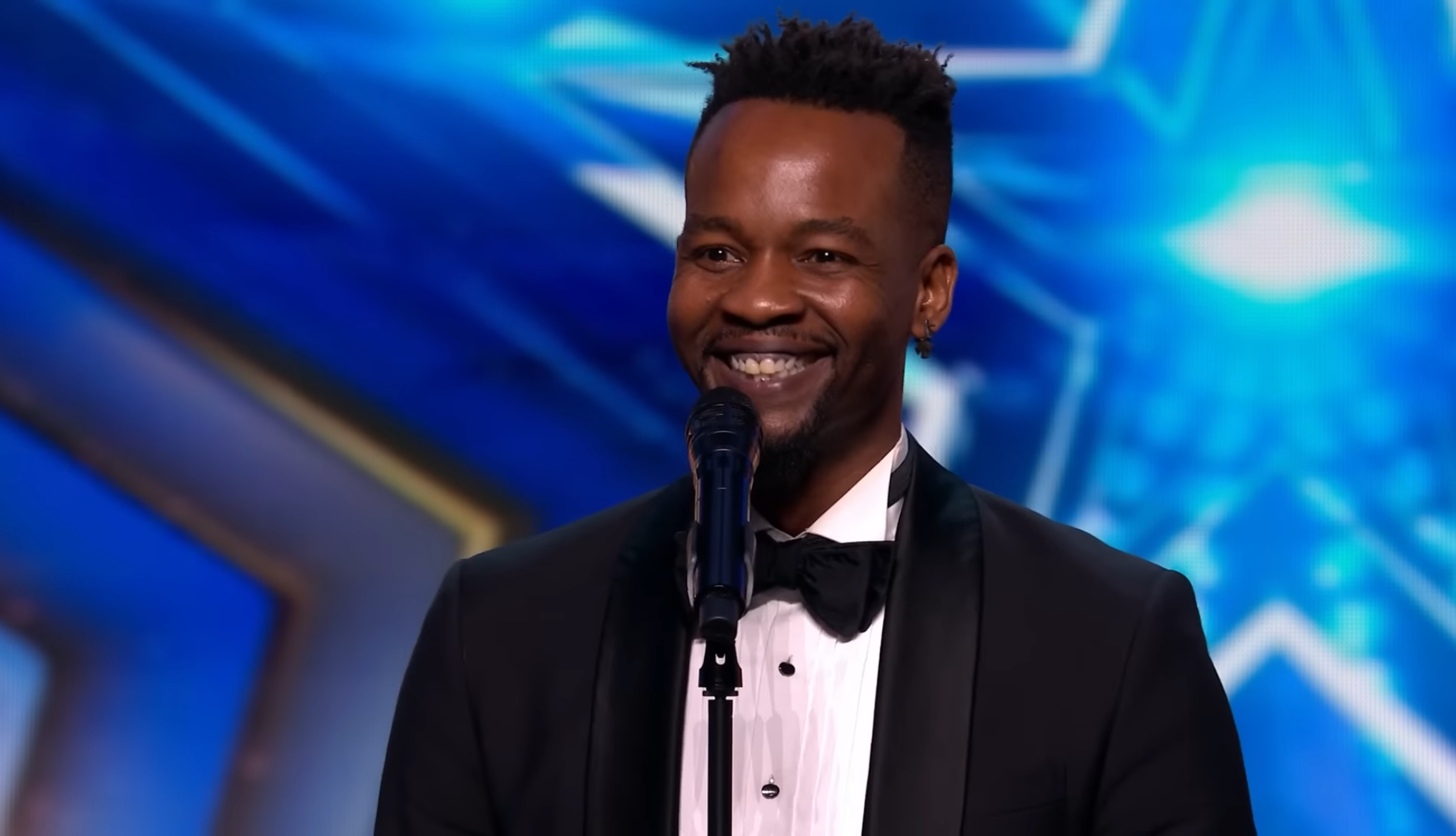
Babatunde Akinboboye arrived at the Britain’s Got Talent stage with the kind of presence that immediately suggested he had thought this through. At 40, he cut a sharp figure in a tailored suit, hair neatly groomed, confidence radiating from a man who had traveled all the way from Los Angeles to make a statement. He introduced himself calmly, and there was an air of quiet purpose about him — not the nervous energy of a hopeful who stumbled into their moment, but the poised assurance of someone with a clear artistic vision. The judges braced themselves for a polished, perhaps classical vocal display; after all, his opening tone and posture hinted at tradition.
What the audience got, however, was anything but conventional. Babatunde opened with a sumptuous operatic line: pure, supported tenor that filled the room with the kind of tone you expect in a concert hall. The initial bars were beautifully executed — breath control, resonance, and phrasing that suggested formal training and a deep appreciation for classical technique. For a moment it felt like the familiar arc of a powerful audition: a strong start, an impressive register, and a singer who could hold an audience in a hush. But then the track subtly shifted, and with it, the rules of the performance.
Without warning, the arrangement modulated into a different groove, and Babatunde did something daring: he slid seamlessly from operatic bel canto into a rhythmic, spoken-word cadence that resembled rap. The transition wasn’t abrupt for the sake of shock; it felt deliberate, as though two musical worlds had been stitched together with care. He traded sustained arias for clipped, syncopated lines and moved from soaring vowels to consonant-heavy wordplay. The juxtaposition — the operatic legato blending into streetwise flow — created a tension that was thrilling rather than jarring. It was clear he hadn’t simply layered one style over another; he’d built an architecture where each element brought out the best in the other.
There were tangible details that made the fusion convincing. In the operatic sections, Babatunde leaned into vowels and carried resonance into the hall, letting the sound bloom. In the hip-hop portions, his diction sharpened, his rhythm tightened, and he demonstrated a sense of timing that fit the beat perfectly. The backing track mirrored his journey, moving from orchestral swells into bass-driven slices and syncopated percussion, giving the performance a cinematic arc. More than anything, Babatunde’s delivery made it feel natural — as if the expressive sweep of opera and the conversational immediacy of rap were two dialects of the same language he had been preparing to speak.
The judges’ reactions captured a room caught between surprise and delight. Alesha Dixon was effusive, praising the concept for making classical music feel accessible and “cool.” Her enthusiasm centered on the idea that genres often perceived as separate could be brought together in a way that invited a new audience into classical technique. Simon Cowell, characteristically blunt, admitted that while he didn’t necessarily love the particular song choices, he couldn’t deny the ingenuity of the idea. He called the concept “great,” and suggested that with some fine-tuning it had serious commercial potential. That blend of critique and encouragement summed up the panel’s mood: divided on specifics, united in their appreciation for originality.
What the judges and audience ultimately applauded was not only Babatunde’s vocal skill but his bravery in proposing something risky on a national stage. It’s one thing to sing well within the safety of a single genre; it’s another to try to bridge two very different musical traditions and ask listeners to come along for the ride. The act tested expectations — for those who revere classical music, it offered a fresh, contemporary veneer; for fans of hip-hop, it introduced operatic grandeur as a dramatic new layer. The emotional payoff came from the way each style reframed the other, giving familiar motifs renewed urgency and making the performance feel like an experiment that had actually succeeded.
Beyond the judges’ verdicts, there were subtle audience moments that underscored the performance’s impact: heads tilted in curiosity, a collective intake of breath when the arrangement shifted, and then spontaneous applause that felt both astonished and approving. People exchanged surprised smiles, and you could see producers and crew leaning forward as if witnessing the type of risk television rarely gets to capture. When the four “Yes” votes were finally announced, they landed as a validation of the gamble. The panel’s unanimous decision was a nod not just to Babatunde’s execution but to the concept’s cultural promise.
Walking off stage, Babatunde left behind more than applause — he left an idea that seems poised to grow. In a landscape where musical boundaries are increasingly fluid, his “Hiphopera” felt like a timely invention: respectful to tradition while defiantly modern. For viewers and industry insiders alike, the audition suggested a new pathway for crossover artistry, one where operatic technique can amplify the emotional heft of urban storytelling, and where hip-hop’s pulse can inject immediacy into grand vocal lines. Babatunde’s performance wasn’t just a moment of entertainment; it was a creative proposal, and on that night in front of the judges, the world said yes.