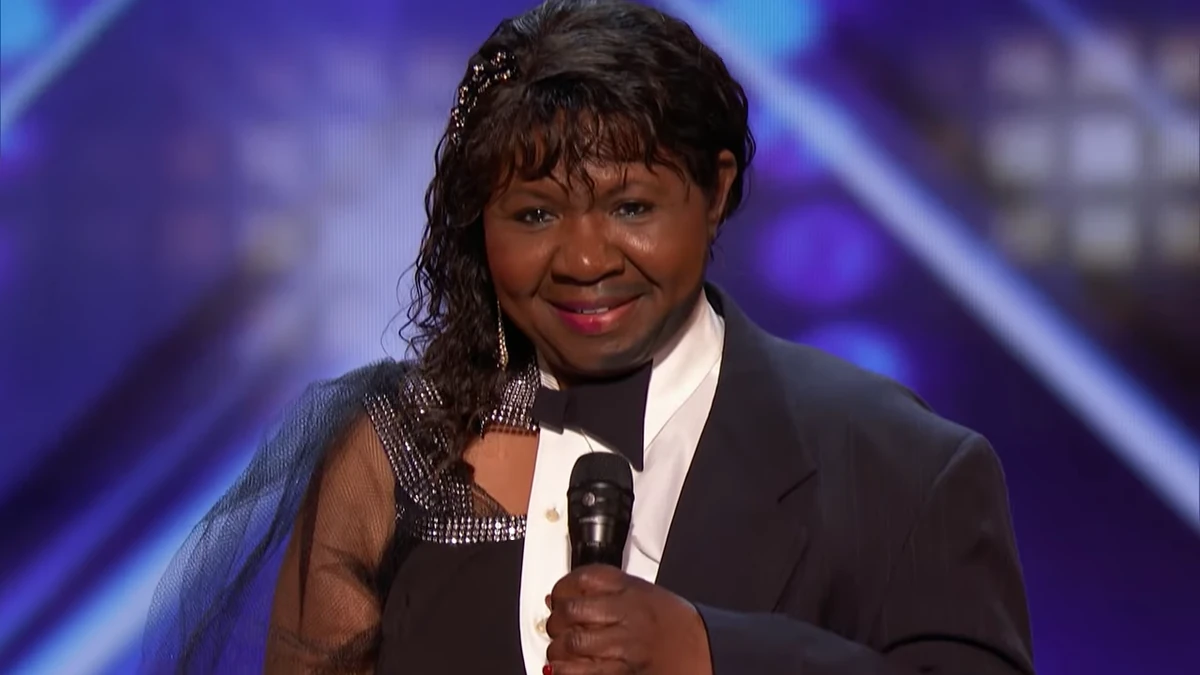
Adaline Bates walked onto the America’s Got Talent stage carrying a quiet confidence that had been years in the making. At 63, the Arizona native introduced herself as a former vocal coach and group singer who had once stood comfortably in the wings of performance, harmonizing and teaching others how to find their voices. But life, as it often does, had shifted her priorities. After her teenage singing group split up decades ago, Adaline tucked her own solo ambitions away to raise children and tend to family responsibilities. Now, with her kids grown and her schedule her own again, she wanted to see if the voice she’d kept warm through teaching and occasional group gigs still had the power to surprise people — and, more importantly, to make her feel like she was finally putting herself on the “front burner.”
There was a gentle nervousness in the way she smiled at the judges and a warmth in the way she spoke about stepping back into the spotlight. She framed her audition not as a desperate bid for fame but as a personal experiment: could she reclaim something she had set aside for decades? That framing made the room receptive; folks tend to root for someone courageously reclaiming a deferred dream.
Then the performance began in a way nobody expected. After a brief pause, Adaline left the stage to “get ready,” and when she returned she wore a costume that split her down the middle — one side fully glamorous in a sparkly gown, the other side tuxedoed and neatly coiffed, a literal visual representation of two people in one body. The sight drew a chuckle and a curious murmur from the audience, but what followed quickly turned curiosity into astonishment. As the familiar strains of “Unforgettable” started, it became immediately clear that Adaline wasn’t just playing with costume; she was staging a vocal sleight-of-hand. She produced two distinct, fully formed voices: a shimmering soprano and a surprisingly robust baritone, seamlessly switching characters by physically turning from one side to the other.
Technically, the feat was impressive. Singing in two registries requires different placements, breath support and resonance, and Adaline executed the shifts with remarkable control. One moment she floated delicate, crystalline high notes that could have come from a conservatory-trained singer; the next she grounded the phrase with a sonorous, chest-driven baritone that filled the room in an entirely different way. The transitions were smooth, aided by theatrical pacing—she’d give a coy smile to the soprano side, then pivot, chin down, to embody the baritone’s gravitas. It was both a vocal and theatrical performance, a small-scale show within a show that treated the audience as willing co-conspirators.
Beyond the novelty of the split costume and gender-bending duet, Adaline’s musicality made the stunt more than a gimmick. Her phrasing was tasteful and deliberate; she respected the song’s romantic lyricism while finding playful ways to inhabit both perspectives. The timing was spot-on—delivering a hushed soprano line then answering it with a full-bodied baritone response felt like watching two veteran performers trading lines in a jazz club. Adaline’s dynamic control allowed each voice to belong its own space: the soprano glittered without shrillness, and the baritone rang without bluster. Those qualities suggested years of teaching others about technique had also kept her own instrument finely tuned.
The audience reaction grew from delighted laughter to genuine admiration. People clapped and whooped as they realized the extent of what she was doing—not merely a visual trick, but a demonstration of range, character and stagecraft. When the final harmonies faded, the theater gave her a standing ovation, and the judges responded in kind. Simon Cowell, often cautious with praise, acknowledged that while the act had comedic elements, the singing itself was legitimately good. Julianne Hough, effusive and animated, called the performance “rad,” praising its uniqueness and the inventive way Adaline chose to present herself. Their comments underscored an important point: the performance worked because it balanced showmanship with real vocal substance.
For Adaline, the moment was about more than applause. It was a declaration that reinvention is possible at any age and that putting yourself first doesn’t mean abandoning what you’ve been — it means integrating it. Her act celebrated both the serious musician and the playful entertainer in her, and that duality resonated with viewers who have likewise shelved dreams for family, work or practicality. The three “Yes” votes were a formal recognition of talent, but the warmth of the crowd and the judges’ affectionate reactions were the deeper reward: proof that at 63, she could still surprise people, delight them and, most importantly, reclaim a piece of herself.
As she left the stage smiling, one could almost see the relief and exhilaration wash over her — the kind that comes from finally letting an old voice be heard. Adaline’s audition was a reminder that creativity doesn’t have an expiration date, and that sometimes the most memorable performances come from those who’ve had the patience to let life season them before stepping fully into the light.