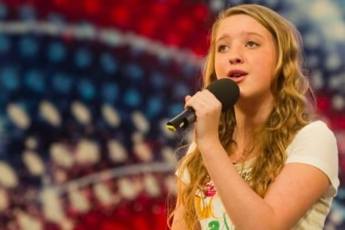

When Brazilian singer Ninah Sampaio stepped onto the America’s Got Talent stage, she carried none of the usual theatrics that often accompany big auditions — no costume, no dancers, no elaborate setup. She looked like a regular young performer chasing a dream: modest outfit, a quiet confidence, and a quick, self-effacing smile as she explained her unusual plan. When she told the judges she intended to sing P!nk’s “Try” while solving a Rubik’s Cube, the audience chuckled; it sounded equal parts daring and silly, the kind of stunt people imagine might get a few viral clicks more than real praise. Some of the laughter was nervous, the way crowds laugh when they’re not sure whether to be skeptical or entertained.
Then the first notes came, and any hint of mockery drained away. Ninah opened with a tone that was unexpectedly full-bodied and emotional, a voice that carried warmth and grit in equal measure. “Try” is a song that demands everything from a singer: raw vulnerability, power, and precise control across dynamic shifts. It’s easy to be overwhelmed by the song’s emotional heft, but Ninah navigated it with a maturity that belied her years. As she sang the verses with restrained intensity, her vowels were clear, her breath support steady, and there was an honest ache in the way she delivered certain lines — the kind of small inflection that tells you the performer is inhabiting the lyrics rather than showcasing them.
At the same time, her hands were working at a speed that made the cube blur. Watching both things happen simultaneously felt almost disorienting: the brain expects multi-tasking to mean divided attention, but Ninah made it look like a harmonious duet between fingers and voice. She rotated layers, twisted corners, and executed algorithms you’d expect to see in a cubing competition, all without interrupting the emotional arc of the song. Most people who solve a Rubik’s Cube in public rely on absolute quiet and concentrated focus; Ninah was doing it under stage lights, with a backing track, and while commanding complex vocal lines. It was a feat of coordination and concentration that made you appreciate both skills anew.
Small details made the act feel more than a trick. Mid-song, she hesitated for a breath and then carried into a bridge with a slightly huskier texture, as if she’d decided in that moment to lean harder into the emotional truth of the words. Her fingers didn’t speed up then — they adapted, snapping a corner, pivoting a face, as if the cube was an instrument responding to her phrasing. As the music swelled toward the chorus, she introduced slight dynamic shading: softer on the opening line of each verse, then swelling into the belt with clean, rounded vowels. Those musical choices kept the audience invested in both the voice and the spectacle.
The moment that tied everything together arrived near the song’s climax. As the band rose beneath her and the final refrain built toward its cathartic peak, Ninah clicked the last piece into position and, without missing a beat, held the completed cube up to the lights while hitting the last, soaring note. It was a perfectly timed reveal — a visual exclamation point placed exactly when the song demanded release. The audience reacted instantly: a ripple of shocked applause that mushroomed into a full, roaring standing ovation. You could see people around the theater exchanging looks of disbelief, some laughing in awe, others wiping at the corners of their eyes in the way you do when you’ve been surprised into feeling something genuine.
The judges’ responses were as enthusiastic as the crowd. They grinned, they laughed with amazement, and when it came time to vote, all four jumped at the chance to send her through. They praised the originality of the concept and, crucially, the fact that the music held up independently of the stunt. That distinction mattered; had the singing been weak, the cube would have felt like a cheap distraction. Instead, the act demonstrated an unusual blend of talent: the technical aptitude and problem-solving speed required to solve a cube, paired with a voice capable of delivering emotional truth.
Ninah’s audition became one of those AGT moments people replay not because it was flashy for flashiness’ sake, but because it struck an unexpected balance between brains and heart. It was a reminder that creativity onstage can take many forms and that combining disparate skills can produce something memorable when done authentically. After the show, clips circulated widely online — viewers delighted by the novelty, critics impressed by the vocal credibility, and aspiring performers inspired by the idea that originality paired with solid craft can cut through the noise. In a season packed with extremes, Ninah’s performance stood out because it felt refreshingly human: clever, surprising, and ultimately, genuinely moving.