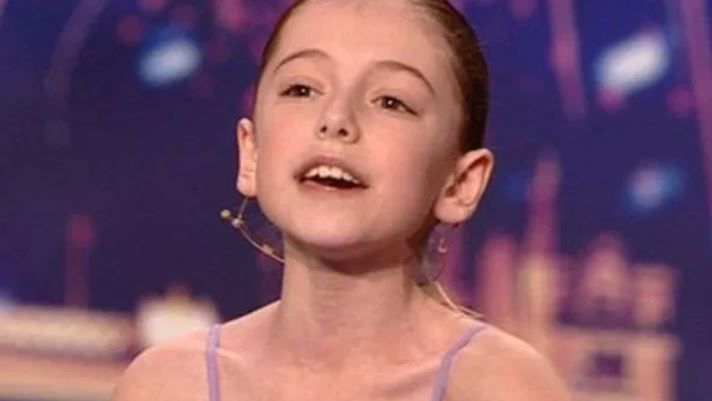
When Hollie Steel walked onto the Britain’s Got Talent stage at just ten years old, the scene looked like something out of a school recital. She wore a frilly tutu and had her hair swept into a neat bun, and for a moment the audience and judges braced for a charming but predictable child performance. Parents in the crowd exchanged affectionate smiles, and her family—mothers, aunts, perhaps a proud grandparent—watched from the wings with that particular blend of nerves and hope that comes with sending a child into the spotlight. There was an innocence to the setup that lowered expectations in the nicest possible way: this would be cute, sweet, possibly endearing, but unlikely to shatter any musical preconceptions.
Then Hollie opened her mouth, and everything changed. She chose “I Could Have Danced All Night,” a classic that demands clarity, breath control, and an ability to shape long, lyrical lines. From the first phrase her voice revealed itself as something startlingly mature. Rather than the tiny, tentative sound many expect from a child singer, Hollie delivered a tone that was clear, resonant, and astonishingly controlled. Her vibrato was tasteful and centered; she placed each word as if she had lived the lyric for years. The auditorium—which had been filled with the light hum of polite attention—fell into a heavy, reverent silence as listeners adjusted to the gap between appearance and sound.
Part of what made the moment so arresting was how seamlessly she moved through the song’s demands. The melody has moments that require both delicacy and power, and Hollie navigated those shifts with astonishing poise. She softened lines in the verses to make the crescendos feel earned, and she sustained long phrases without any of the wobble or breathiness that betray inexperience. There was a tonal richness—especially in the middle register—that gave her singing an operatic color, and when she climbed into the higher reaches of the melody the notes rang with surprising depth rather than the thinness one might expect from a pre-teen. For judges who have heard hundreds of hopefuls, that level of technical control coming from someone so young is genuinely rare.
The judges’ reactions told the unfolding story. Initially, faces showed that familiar, slightly indulgent amusement reserved for children onstage. But as Hollie continued, those expressions shifted—brows lifted, mouths fell open, and eyes widened in disbelief. Simon Cowell, notorious for his bluntness and often skeptical of cutesy auditions, was visibly taken aback. He admitted afterwards that he’d misread the situation: what he thought might be a novelty performance was actually a display of serious vocal talent. His change of tone—moving from dismissive to full-throated praise—was emblematic of the broader shift in the room. Applause that began as polite encouragement turned into an eruption of appreciation by the final phrase.
There were intimate details in the audition that made it feel authentic rather than manufactured. The camera occasionally cut to Hollie’s family, and you could see a mixture of tears and stunned smiles that made the moment feel grounded in real support rather than television drama. Backstage, producers later remarked on how composed she seemed—no visible panic, just focus. Onstage she used small gestures: a tilt of the head, a delicate smile at a well-landed phrase, a glance toward the band—tiny theatrical choices that hinted at both training and natural instinct. Those moves helped transform the performance from a simple vocal demonstration into a little theatrical vignette, which suited the song perfectly.
The broader response was immediate. Clips of Hollie’s audition spread quickly across social media and video-sharing sites, racking up millions of views as people shared the clip with captions that read like admonitions against judging by appearances. Many commenters confessed to their own surprise—expecting a novelty act and finding instead a young artist who sounded imminently ready for conservatoire study or even professional engagements. Music teachers and vocal coaches weighed in, noting the rarity of such breath control and tonal maturity at that age. For a generation raised on viral surprises, Hollie’s audition fit the pattern: an authentic talent revealed in an unexpected package.
Beyond the technical applause, there was a human story that resonated. Holly’s audition became an emblem of discovery and the delight of being proven wrong in the best possible way. It reminded viewers that talent can be hidden behind bows and tutus, that children can surprise adults with their depth, and that shows like Britain’s Got Talent still have the power to produce genuinely moving, unscripted moments. With unanimous praise from the judges and a spot in the next round secured, Hollie Steel’s audition didn’t just earn her advancement in a competition—it announced the arrival of a young performer who, in a single song, made an entire room reconsider everything they thought they knew about looks and voice.