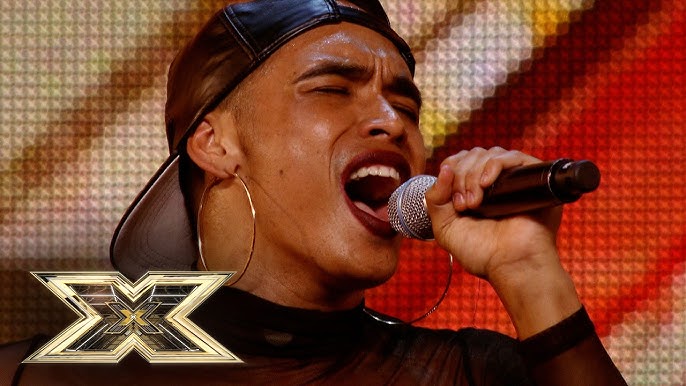
When Seann Miley Moore walked onto The X Factor UK stage in 2015, he did more than audition—he made a statement. Born in Australia, Seann had relocated to the UK with a clear purpose: to chase a musical dream without compromise. He arrived in an outfit that stopped the room—a voluminous fur coat paired with a leather skirt and high heels—an image that immediately signaled he would not be shrinking himself to fit anyone else’s expectations. Before a note was sung, he spoke about the importance of authenticity, explaining that his look was a celebration of identity and a refusal to be constrained by gender norms or industry boxes. That candidness disarmed and intrigued the audience; it set a tone that this was going to be an audition about truth as much as talent.
The choice to perform Queen’s “The Show Must Go On” felt purposeful. The song itself carries themes of perseverance, public façade, and the determination to carry on despite inner storms—ideas that resonated with Seann’s own narrative. As the opening chords began, the arena quieted. There was an expectant hush, the kind that falls over a room when everyone realizes they are about to witness something rare. Seann didn’t attempt a checklist of vocal tricks; instead, he immersed himself in the drama of the piece. He used his theatrical instincts to shape each phrase, tilting moments of tenderness against surges of operatic power so that the performance felt like a living, breathing thing rather than a mere audition piece.
What struck people immediately was the unusual combination in his voice: an operatic control that allowed long, sustained phrases to soar, married to a raw, grainy vulnerability that made the lyrics feel painfully real. He could glide into high, ringing notes with astonishing ease and then pull back to an intimate whisper, as if leaning close to confide a secret. That dynamic range created tension and release across the song, keeping listeners emotionally off-balance in the best possible way. Small details mattered—how he used a tremble on a held note to imply fragility, or the subtle way he stepped forward on certain lines to punctuate a lyric. Those micro-choices revealed a performer who understood not only how to sing, but how to tell a story.
Reaction in the room was immediate and visceral. Cameras lingered on faces in the crowd that shifted from curiosity to open admiration; you could see people reaching for tissues and wiping away tears. Rita Ora, unable to hold back, was visibly moved to tears by the intensity and honesty of Seann’s delivery. It’s telling when an artist’s performance penetrates past technical assessment and lands as a personal moment for judges and viewers alike. Simon Cowell, a man whose critique can make or break a career, complimented Seann for his courage to be different and singled out his unmistakable “star quality.” Those words mattered because Simon’s praise is rarely handed out without weight; in this case, it underscored that the audition transcended novelty and entered the realm of genuine artistry.
Beyond the judges’ reactions, there was a broader cultural resonance to the moment. Seann’s presence challenged easy categories—he disrupted tidy notions of what a pop star should look and sound like—and did so not as a gimmick but from a place of sincere expression. That made his audition feel timely and important. For viewers at home who had ever felt out of step with prevailing norms, Seann’s performance offered a potent image: a talented artist standing fully revealed, telling the world that authenticity could coexist with mainstream success. It was a small but powerful disruption—an illustration that the stage can be a place where identity and artistry enhance, rather than limit, one another.
Technically, the audition showcased someone with professional training and an innate musicality. Seann’s phrasing and breath control hinted at hours of disciplined work, while his stagecraft—how he used movement, gaze, and costume—showed a performer comfortable commanding space. Yet what made the audition linger in people’s minds was not just the skill but the courage behind it. He asked the audience to accept him on his terms, and he rewarded that acceptance with a performance that was both polished and painfully sincere.
When the judges rose to give their verdicts, the standing ovation that followed felt natural rather than orchestrated. Four enthusiastic “Yes” votes affirmed not only that Seann could sing, but that he could connect. He had entered the studio as an unknown and left with a promise: that he would be someone to watch. For many, that audition became one of the most memorable of the season—not merely for its visual boldness, but because it demonstrated how authenticity, technical ability, and theatricality can combine to create something that feels like art. Seann Miley Moore’s audition wasn’t just a bid for a place in a competition; it was a declaration of self, and for a few electrifying minutes, the world paused to listen.