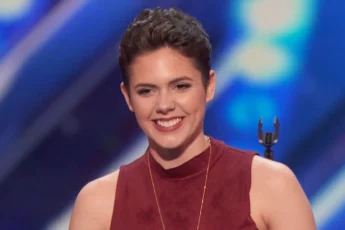

Carlos Guevara, a 16-year-old from South Carolina, walked onto the X Factor USA stage carrying more than a song — he carried a story of endurance and quiet courage. At just 12 years old, Carlos was diagnosed with Tourette’s Syndrome and OCD, conditions that made everyday life unpredictable. The involuntary movements and vocal tics became so disruptive that he stepped away from a conventional school life he’d once embraced, leaving behind roles that had defined him: student body vice president, member of the football team, a kid who fit neatly into the routine of class and practice. Those identities were put on hold as he learned to navigate a world where simple things, like sitting still or speaking without interruption, became challenges.
Music, however, offered something different. It wasn’t an instant cure, but it provided Carlos with a rare pocket of peace. When he picked up a guitar or closed his eyes to sing, the tics that had been constant companions seemed to retreat. For someone whose days had been punctuated by involuntary sounds and movements, the steadiness of a melody and the structure of a song felt like lifelines. Over time, music turned from a refuge into a purpose — a place where he could breathe, concentrate, and be himself without the interruptions that had followed him for years.
Choosing to perform John Mayer’s “Gravity” was a telling decision. The song’s slow-building intensity and introspective lyrics mirror the balancing act Carlos had been living: the pull to stay grounded while navigating forces that try to pull you off course. Standing under the hot stage lights, he admitted to extreme nerves; anyone who’s seen an audition knows that those first seconds can make or break a performance. For Carlos, those seconds were even more fraught because his body didn’t always cooperate. Just before he began, small tics rippled across his shoulders and neck — visible reminders of the journey he’d been on to get to that moment.
Then he started to sing. From the opening line, his voice carried a richness and a warmth that belied his age. There was an emotional clarity in his tone, a way of stretching each phrase so it landed with honest feeling. The room grew quiet the way it does when everyone in the audience stops in unison to listen — not out of obligation, but because something real is unfolding. You could almost feel the air change: the nervous energy in the auditorium gave way to stillness as people leaned in to hear him. The vocal ticks that had threatened to intrude faded into the background, and what remained was a focused, soulful performance that felt both practiced and very immediate.
Small details made the moment more powerful. The way Carlos tilted his head slightly on a long note, as if listening back to himself. The brief pause he took before the bridge, drawing a breath that steadied not only his voice but the audience’s attention. The expression on his face — equal parts concentration and release — told you that this wasn’t just a display of technical skill, it was a small liberation. For many watching, the show became less about competition and more about witnessing someone reclaim a part of himself onstage.
The judges’ reactions reflected that shift. Demi Lovato, who has spoken openly about mental health herself, was visibly moved. She told Carlos how proud she was, referencing the “beautiful soul” she saw in him and the energy he brought to the stage. Her words carried an extra weight coming from someone who understands the complexity of personal struggle. Simon Cowell, known for his blunt critiques, offered praise that cut to the heart of Carlos’s journey. He lauded the boy for refusing to be defined by his diagnosis, saying that Carlos was not a “victim” but a young man who had chosen to fight for his dreams despite the odds. That kind of validation from a stern judge felt like more than a compliment; it was an acknowledgment of the hard work and courage required just to stand there and perform.
When the votes were read and the panel delivered four enthusiastic “Yes”es, the reaction in the room was electric. The standing ovation from the audience wasn’t just applause for a strong audition — it was applause for the resilience on display. Cameras captured his smile, a mix of disbelief and relief, as he took in the moment that could open doors he’d once thought closed. For Carlos, advancing in the competition wasn’t simply about moving on to the next round; it represented a broader possibility — that passion could be a bridge away from limitation, that a stage could be a place of healing as well as exposure.
Backstage, you could imagine the flurry of messages, congratulations, and perhaps a few tears. But beyond the immediate buzz, Carlos’s performance left a quieter, more important impression: that the human spirit often finds a way to express itself, even when the body resists. His journey from a boy sidelined by involuntary tics to a teenager standing center stage, singing with clarity and heart, reminded everyone watching that sometimes the act of creating — of making music — can be the most powerful medicine of all.