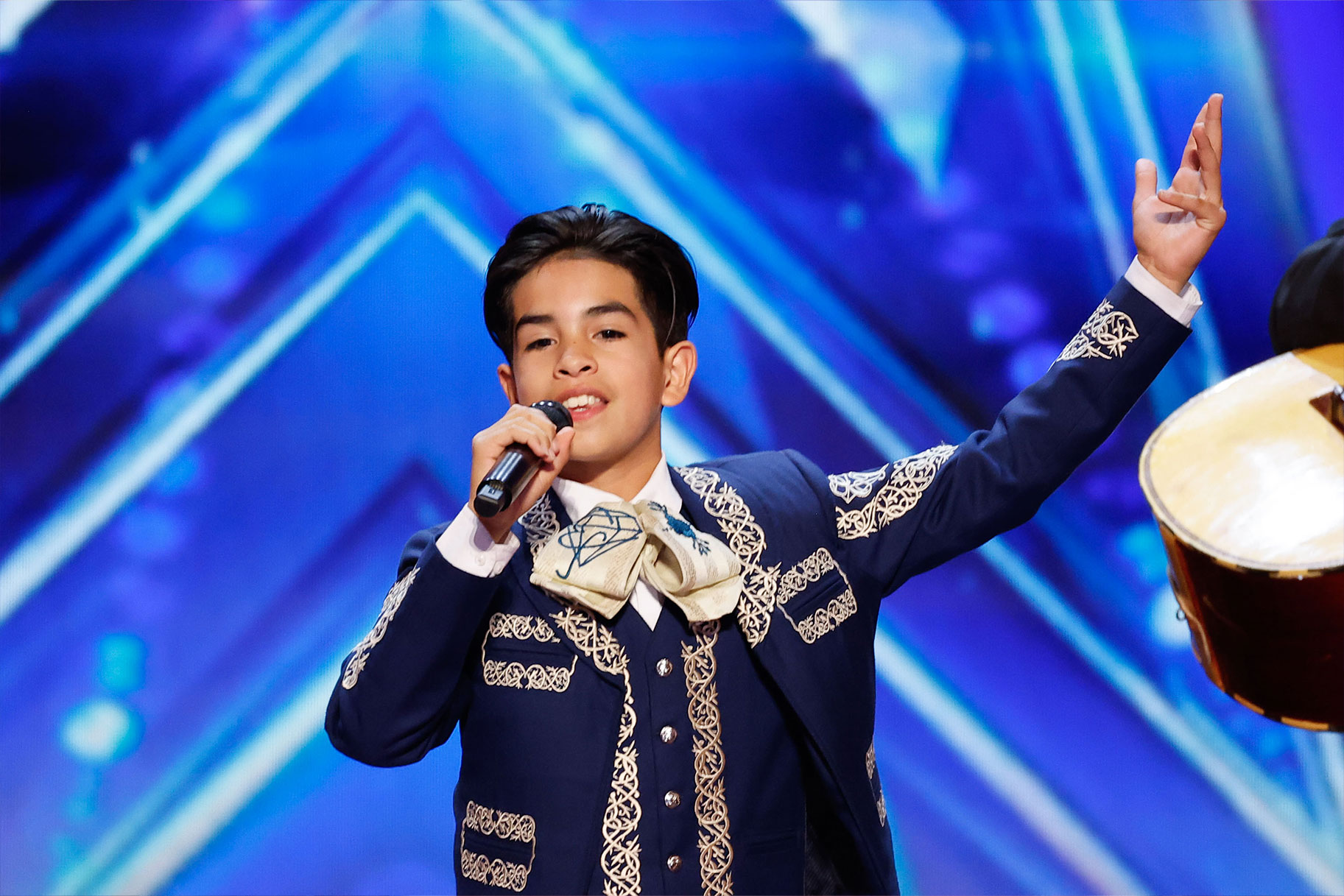
When Eduardo Antonio Trevino walked onto the America’s Got Talent stage, the first thing that struck you wasn’t just the striking Charro suit tailored to his small frame — it was the quiet confidence he carried with him. At 11 years old, he stood like someone far older, a young ambassador for a musical tradition that stretches back generations. There was a hush of respect before a single note escaped his lips, as if the room itself sensed that something important was about to happen.
Eduardo’s story added a weight to the moment that made the performance feel inevitable. He told the audience he’d been singing since he was three, and that he was honoring an unfinished dream: his great-grandfather had wanted to pursue Mariachi music in 1926 but had to give it up because of poverty. That detail transformed the audition from a display of talent into a bridge across time — a child resurrecting his family’s lost aspiration on one of the world’s biggest stages. Suddenly, every phrase, every ornamentation in his voice, carried not just melody but lineage.
From the opening line, Eduardo’s voice had a presence that belied his years. There was a clarity and control in his tone that made listeners lean in, an ability to sustain long notes with easy breath support and an expressive vibrato that felt earned rather than affected. He didn’t just sing the song; he inhabited it, infusing traditional Mariachi phrasing with a cinematic intensity reminiscent of icons like Vicente Fernández. The comparison isn’t mere hyperbole — in the way Eduardo shaped a mournful phrase or released a triumphant howl, he channeled the bravado and tenderness that define the genre.
Beyond technical skill, what made the performance unforgettable was the emotional authenticity woven through it. At moments he softened into delicate, almost conversational lines, and at others he unleashed a full-throated cry that reverberated through the auditorium. Those shifts were not theatrical; they felt like a lived narrative unfolding in real time: nostalgia for a past never known, pride in cultural roots, and the gravity of fulfilling a family’s deferred dream. The result was a rendition that tugged at both the ear and the heart.
The judges’ faces told part of the story as well. Initial curiosity gave way to visible astonishment — mouths slack, eyes wide, some wiping tears discreetly. The audience followed suit; the usual hum of cameras and muttering fell away, replaced by an almost sacred silence. When Eduardo landed his final phrase and held it just so, the room erupted not merely in applause but in a collective, visceral reaction: standing ovations, cheers, and a rush of social media commentary that transformed a single stage moment into a global conversation. Clips of his audition spread rapidly online, accumulating millions of views as people marveled at how such a young voice could carry so much weight.
Small details made the performance feel even more intimate. Between verses, the way Eduardo closed his eyes suggested he was picturing someone — perhaps a great-grandfather he never met, perhaps the many evenings of practice in a family living room. His hands, steady at his sides, betrayed none of the nervousness one might expect from a child in that spotlight; instead, they conveyed a solemn respect for the song and the story behind it. Viewers on social platforms zeroed in on those gestures, commenting that it felt less like a performance for judges and more like a devotion.
The impact of Eduardo’s audition reached beyond entertainment: it sparked conversations about cultural preservation and representation. In an era when mainstream media often sidelines traditional forms, seeing a child honor Mariachi on a massive televised platform resonated deeply with viewers from similar backgrounds. Many wrote about the pride of witnessing a young person reclaiming a part of family history and presenting it to millions in a way that felt proudly, unmistakably authentic.
Of course, viral moments can be fleeting, but Eduardo’s audition seemed to carry a durability that suggested more than a one-time sensation. Talent with rootedness — technical excellence married to a genuine story — has a way of lasting in people’s minds. For Eduardo, the immediate aftermath included an outpouring of support, offers to perform, and the kind of attention that can open doors to music education, collaborations, and stages beyond late-night club gigs.
Yet, perhaps the most touching aspect was how the audition reframed what success looked like for his family. The dream deferred in 1926 had been quietly living in the DNA of his household, and watching Eduardo sing felt to many like a moment of reclamation. It served as a reminder that sometimes dreams don’t die; they wait, passing through generations until the right voice arrives to carry them forward.
When the dust of virality settled and the applause faded, what remained was a young boy in a Charro suit who had, for a few unforgettable minutes, made an entire world hold its breath. Eduardo’s performance wasn’t just a showcase of prodigious talent; it was an offering — to family, to culture, and to anyone who knows what it means to keep a dream alive against the odds.