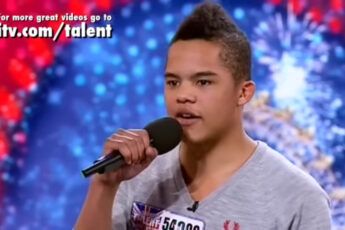

When Gabriel Brown walked onto the America’s Got Talent stage, he didn’t look like a magician or a vaudeville act — just a regular guy with a microphone, an easy grin, and the kind of nervous energy that lives in the palms of your hands when you know a lot is riding on a single moment. He introduced himself in a casual voice, joked with the judges for a beat, then dropped the curveball: he was going to sing a single song while shifting through more than fifteen distinct voices — impressions of famous singers, TV personalities, and even cartoon characters. The audience chuckled at first. It sounded like a silly party trick, the kind of thing that might get a few laughs but wouldn’t hold up for long.
Then the music started, and any skepticism evaporated within seconds. Gabriel didn’t announce each change; he simply became them. One moment his tone had the twang and breathy softness of a country crooner, the next a gritty, nasal rock edge that could’ve come straight from a stadium stage. He transitioned into soulful runs, then dropped into a cartoonish squeal that made people laugh out loud, and before you could register the shift he was echoing the clipped cadence of a television judge so perfectly that the real panel couldn’t help but grin in recognition. The switches weren’t sloppy impressions tacked onto a tune; they were razor-sharp transformations, each voice complete with its own timbre, phrasing, and eccentricities.
What made it so mesmerizing wasn’t just the range of sounds but how naturally he stitched them together. Gabriel timed every alteration to the rhythm and emotional content of the song, making it feel less like a highlight reel and more like a coherent performance. He used tempo shifts and syllable emphasis to cue the next impression, and somehow the characters he summoned matched the lyrical arc — a sentimental line might be sung tenderly in one artist’s style, then flipped into a comedic snort and a half-note in a cartoon voice to puncture the moment. That kind of musical intelligence — the ability to keep a song intact while reimagining its entire vocal palette — is rare, and it landed him somewhere between virtuoso and entertainer.
The audience reaction was immediate and escalating. Laughter bubbled up at the first cartoon squeak, applause punctuated a particularly uncanny celebrity mimic, and by the time Gabriel launched into a rapid-fire string of voices near the end, the theatre was howling. People who had been polite and restrained at the start were now openly whooping, clapping in the gaps between impressions, and trading elbow nudges with neighbors in disbelief. It felt like being at a live comedy show and a concert simultaneously — a strange, joyful hybrid where you couldn’t predict whether the next second would make you laugh or cheer.
The judges’ faces told a mini-drama of their own. Initially they wore the usual polite skepticism: raised eyebrows, mild curiosity, the “we’ve seen it all” look. As Gabriel moved through the first few impressions, those expressions shifted. Smirks turned to wide smiles; one judge started to laugh with genuine delight; another leaned so far forward it was clear they were trying to decode his technique. There was an audible intake of breath when Gabriel hit a particularly dead-on impression of a well-known rock singer, and a burst of applause when he mimicked a beloved cartoon character with such fidelity that you could almost see the animation in his eyes. By the finale, the panel looked like teenagers at a talent show — delighted, surprised, and thoroughly entertained.
Small, human moments made the performance feel even more special. Mid-song, Gabriel flashed a quick, sheepish grin toward the audience after pulling off a particularly outrageous voice, as if surprised at his own nerve. He made a subtle eye contact with a band member and nodded, acknowledging that this was a team effort of timing and trust. When he reached the final run of impressions — a dizzying tumble where he rattled off voice after voice in under twenty seconds — you could see the judges mouthing along, trying to name every impression. That shared, conspiratorial excitement made the moment communal, not just a solo stunt.
By the time he finished, the room was vibrating with applause, cheers, and laughter. The performance had started as something that could have been dismissed as a gimmick, but Gabriel had turned it into a showcase of craft: breath control, precise vocal placement, characterization, and comedic timing. He respected the music even as he toyed with its presentation, and that balance is what pushed him from novelty to artistry.
It’s the kind of audition that sticks with you not because it was the loudest or most dramatic, but because it was delightfully impossible to forget. People left the theatre smiling and talking, replaying their favorite impressions and arguing over which voice was the most accurate. The clip went viral for understandable reasons — it’s rare to watch one performer become so many at once and do it with warmth and skill. In a season full of extremes, Gabriel’s act stood out as a reminder that talent can surprise you in playful, inventive ways — and that sometimes the best showmanship is simply knowing how to make an audience laugh and gasp within the same breath.