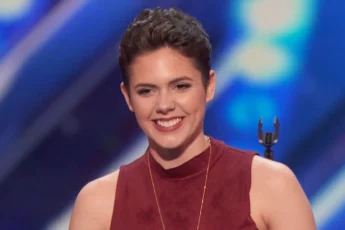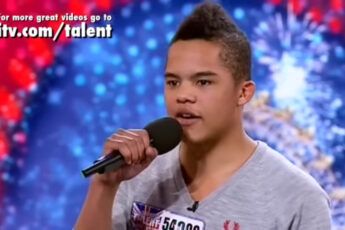
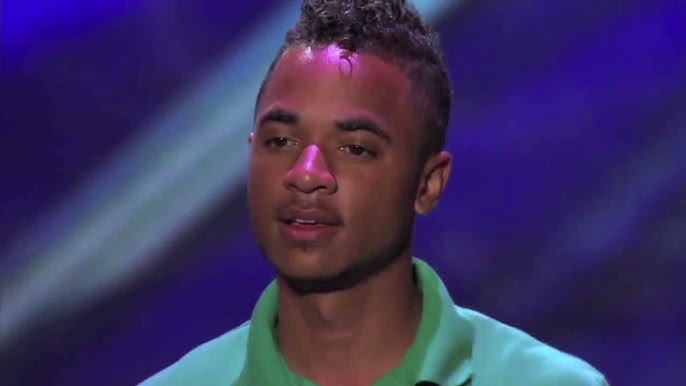
The X Factor stage has seen its fair share of dramatic entrances, but few auditions have walked the line between romantic serenade and unsettling intensity the way Wesley Mountain did. He didn’t just step onto the stage—he practically charged it, eyes locked on judge Kelly Rowland as if he’d been composing his entire life for nothing more than this moment. His introduction was unabashedly flirtatious, a rapid-fire mix of compliments and longing that landed somewhere between earnest courtship and full-on pursuit. The room went quiet in a way that felt charged, as if everyone present was holding their breath to see whether this boldness would crumble into embarrassment or evolve into something memorable.
At first, Wesley’s energy read as overwhelming. He hovered in front of the judges’ table like someone who’d rehearsed the confession more than the song, and his gaze—intense, unwavering—sent a ripple through the audience. You could see it on the judges’ faces: amusement shadowed by unease. Demi Lovato didn’t mince words; she called him “creepy,” a blunt assessment that reflected the discomfort many felt. Simon Cowell, never one to shy away from a sharp observation, likened Wesley’s stare to a hungry dog eyeing a steak—equal parts funny and slightly unnerving. Those reactions could have easily written the rest of his audition off as a miscalculated stunt.
But then Wesley opened his mouth to sing, and the whole tone of the room shifted. He chose “Wanted” by Hunter Hayes—a song that demands sincerity without tipping into melodrama—and from the first note he proved he could handle that delicate balance. There was a rawness in his voice that suggested he wasn’t performing a persona; he was, rather, airing something very real. To hear someone who had just been so theatrically forward suddenly channel that intensity into a controlled, emotive vocal performance was disarming. His phrasing was thoughtful, his timing steady, and when he hit the higher notes, they rang with surprising clarity.
Concrete moments in the performance underscored what was happening: the way he softened the bridge to let a vulnerable line hang in the air, the small, almost involuntary smile that crept across his face when the crowd began to respond, the manner in which he leaned into the mic during the chorus as if sharing a secret with everyone watching. That pivot—from an awkward opening tableau to a polished musical delivery—was what ultimately made Wesley’s audition compelling. It wasn’t just noise or bravado; it was someone who could translate strong, messy emotions into a form of artistry that connected.
The judges’ reactions mirrored the room’s transformation. Initial laughter and side-eye were replaced by nods of approval and, eventually, genuine admiration. Kelly Rowland’s face, which had been a mixture of surprise and bemusement, softened into the recognition of talent meeting opportunity. Even Demi, having thrown down the “creepy” label earlier, couldn’t ignore the quality of the voice she was hearing. By the time the last chorus swelled and Wesley closed with a confident final note, the skepticism that had met him at the start felt almost like a distant memory.
That said, the judges didn’t hand out praise blindly. Their yeses came with caveats—stern, almost parental advice about tempering his offstage antics. Simon, with his typical dry humor, reminded Wesley that relentless intensity might be captivating in a controlled performance but could easily tip into discomfort if not managed. The message was clear: the vulnerability and passion that make a performer magnetic must be carefully harnessed, especially on a large platform where every gesture is amplified. They commended his ability to command a stage and reach an audience emotionally, but they also wanted to see growth in how he presented that energy.
For many in the room, Wesley’s audition became a study in contrasts. There was the disquieting flirtation that could have derailed him, and then there was the undeniable talent that saved and elevated the moment. Those contrasts are what made the audition memorable—the tension between persona and performance, between pursuit and poetry. By the time the panel gave him the unanimous nod, it felt less like a rescue and more like recognition: beneath the eccentric exterior was a vocalist who could move a crowd and potentially evolve into a compelling artist.
Walking off the stage, Wesley carried with him a mix of relief and triumph, but also a tangible responsibility. The next round wouldn’t just test his singing; it would test his ability to balance charisma with propriety, showmanship with respect. For now, though, he’d earned his place to go forward—a chance to refine that high-octane passion into something the judges, the audience, and ultimately the wider world could embrace without feeling uneasy.