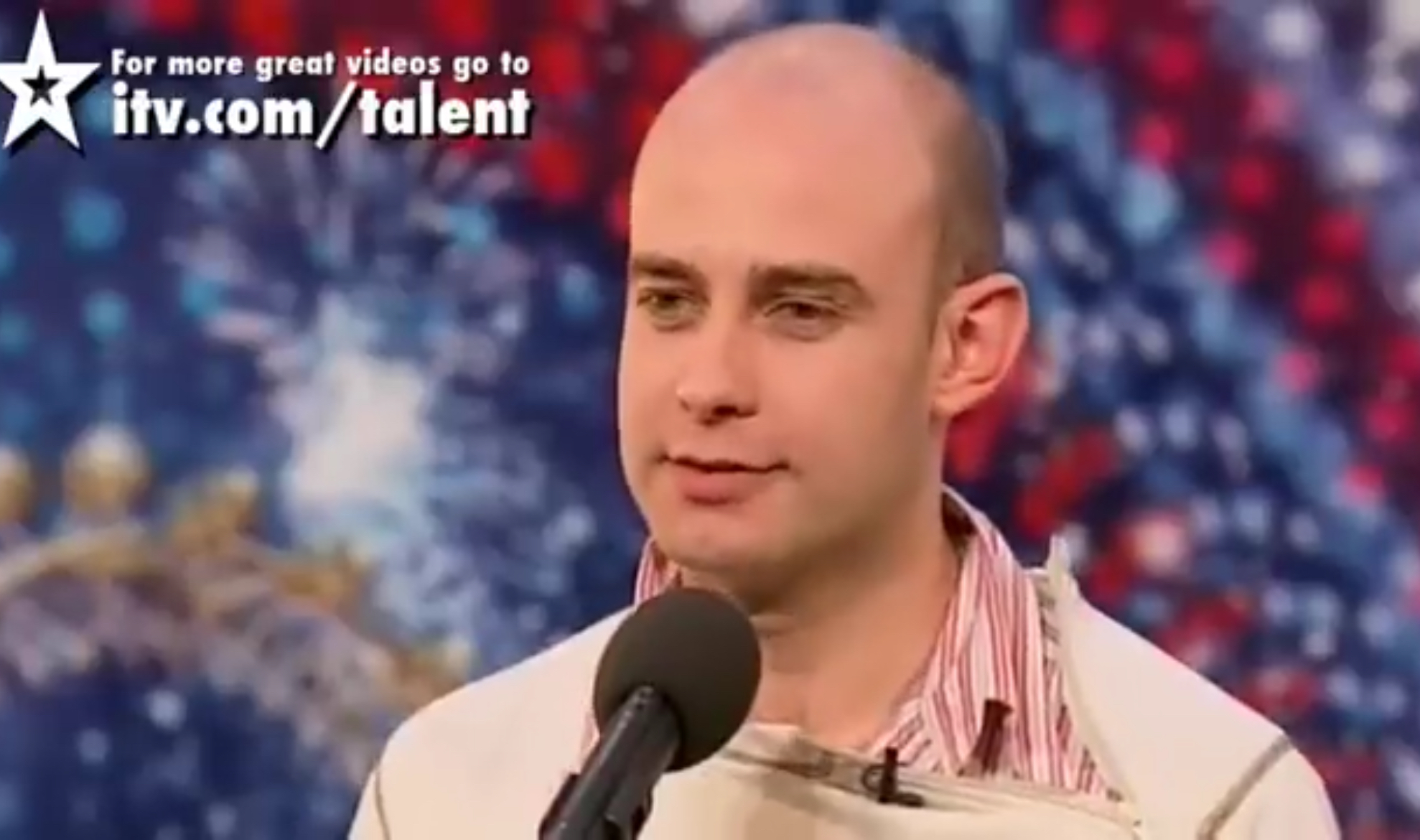
At twenty-eight, Christopher Stone could easily have been mistaken for any other young professional heading home from a long day at the office. By trade he was an accountant, someone accustomed to ledgers, deadlines and the quiet certainty of numbers. But on this particular evening he swapped spreadsheets for the glaring lights of the Britain’s Got Talent stage, stepping into a world where emotion and exposure mattered far more than balance sheets. He admitted as much before he began: he had entered the competition largely because his parents, who sat anxiously in the audience, had never stopped encouraging him to pursue a long-held dream. Their presence was a tangible reassurance—familiar faces in a sea of strangers—but it also underscored the pressure he felt. For Christopher, this wasn’t just an audition; it was a culmination of gentle nudges, quiet hopes and the weight of familial expectation.
When he walked onto the stage, you could see how much the moment meant to him. He looked neat and unassuming, the sort of person who might discuss tax returns over dinner, not arias. From the first hesitant breath he took, nerves were obvious: his hands wrung together repeatedly, a small, human tic that betrayed the storm of anxiety under his composed exterior. He confessed aloud that this was “probably the scariest thing I’ve ever done in my life,” a line that made the audience sit up and the judges lean forward. The admission didn’t undermine his performance; instead, it framed it. Here was a man putting himself in a place of vulnerability, exposing a part of himself he’d kept private while he navigated a steady career.
Choosing “Maria,” a classic anthem with operatic leanings, was a bold move. It’s the kind of song that doesn’t forgive hesitation; it rewards commitment and command. At first, Christopher’s voice announced itself as something unexpected—rich, resonant, and unmistakably trained. The opening lines hinted at a powerful instrument beneath the anxiety, a voice that could easily fill a concert hall. Yet the contrast between the sound and the singer’s body language was striking. Simon Cowell, ever the blunt critic, wasted no time pointing out what the performance lacked. He zeroed in on Christopher’s demeanor, commenting on a deficit of “conviction” and “self-belief,” and even called out the visible hand-wringing. It was raw feedback, the kind that can feel harsh in the moment, but it also focused attention on the central tension of the audition: a gifted singer wrestling with fear.
As the song unfolded, a subtle shift began to occur. The initial stiffness gave way to moments of release—brief flashes when Christopher seemed to forget the cameras and the judges altogether, when the music carried him and he surrendered to the emotion of the piece. Piers Morgan, watching closely, noted that change. He observed how Christopher gradually started to lose himself in the performance, moving from being constrained and self-conscious to looking like someone who was truly enjoying the moment. It was in those seconds that you could see a different possibility: a man discovering his own capacity for bravery and the joy of doing something he loved, despite his terror.
Amanda Holden’s response captured the duality of the performance neatly. She called it “brilliant” and praised the tone of his voice, highlighting what was objectively impressive about the singing itself. Piers, too, took a sympathetic stance, saying he had enjoyed the journey the audition represented—an arc from fear to engagement that felt authentic and compelling. Even Simon, whose barbs are part of his on-camera persona, conceded that Christopher had a “really, really good voice.” His critique about lacking “swagger” wasn’t a dismissal so much as practical advice for growth: this material calls for not only vocal ability but stage presence, the kind of confident body language that convinces an audience to surrender fully to a performance.
In the end, the judges’ decisions reflected a balance between critique and recognition. They couldn’t ignore the undeniable quality that lay at the heart of Christopher’s audition. His voice, polished and powerful, was the decisive factor. The three “yeses” he received felt like vindication—not just of his talent, but of the courage it took to stand in front of thousands and sing despite feeling petrified. The applause that followed wasn’t merely for the notes he hit; it was for the small triumph over fear, for the visible effort of someone determined to be more than the safest version of themselves.
Walking off the stage, Christopher carried with him more than a pass to the next round. He left having faced a very human crossroads: to remain defined by caution and routine, or to chase an uncertain dream. His parents’ smiles, the judges’ mixed but ultimately approving reactions, and the quiet steadiness of his own voice all suggested that, for now, he had chosen to move forward. It was a modest victory, but meaningful—a reminder that sometimes the bravest thing we do is simply show up and let ourselves be seen.