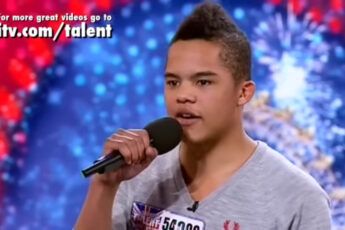

Nicolo Festa’s audition on The X Factor stands out as a striking example of stage presence, artistic confidence, and the kind of self-assurance that immediately separates a contestant from the rest of the crowd. From the moment he stepped into the spotlight, there was an undeniable shift in energy in the room. He didn’t walk out like someone hoping to impress; he entered like someone fully aware that all eyes belonged to him. That quiet but unmistakable “diva” energy was present in the way he carried himself, the way he dressed, and even in how he acknowledged the audience with a composed, almost cinematic confidence.
Before he even sang a single note, Nicolo had already made an impression. His appearance was carefully styled, not in a way that felt forced, but in a manner that reflected personality and intention. Every detail, from his posture to his expression, suggested that he understood the importance of storytelling before the music even begins. The judges noticed it immediately. There was a brief exchange of glances, the kind that happens when a contestant either completely loses or instantly captures attention. In Nicolo’s case, it was the latter. The room seemed to lean toward him, waiting to see if his vocal performance could match the boldness of his entrance.
When the music finally started, that anticipation transformed into full focus. Nicolo began his rendition of Donny Hathaway’s iconic classic, “A Song For You,” a song already known for its emotional weight and vocal difficulty. From the very first phrase, it became clear that he wasn’t just performing the song—he was interpreting it, reshaping it through his own emotional lens. His voice carried a richness and control that surprised many in the audience, especially given the flamboyant and theatrical impression he had initially given. There was a depth in his tone that contrasted beautifully with his visual presentation, creating an unexpected balance between vulnerability and confidence.
As the performance continued, Nicolo demonstrated an impressive ability to navigate between technical precision and emotional expression. Certain lines were delivered with soft restraint, almost like a personal confession, while others soared with intensity, filling the studio with a sense of urgency and passion. It wasn’t just about hitting notes correctly; it was about telling a story that felt lived-in and personal. At moments, he closed his eyes, seemingly disconnected from the cameras and audience, as if he were singing directly to someone only he could see. That level of immersion gave the performance a raw honesty that resonated deeply with those watching.
What made the audition particularly compelling was the contrast between Nicolo’s stage persona and the emotional vulnerability he revealed through the song. The “diva” energy he projected at the start didn’t disappear—it evolved. Instead of feeling like a mask, it became an extension of his artistic identity. He moved between restraint and expression with ease, controlling the dynamics of the performance in a way that kept the audience completely engaged. Even the judges, who are often quick to evaluate and critique, seemed momentarily absorbed, their usual commentary replaced by focused attention.
By the time he reached the climax of the song, there was a noticeable shift in the atmosphere. The performance had grown from an audition into something that felt closer to a live concert moment. The emotional intensity in his voice, combined with his command of the stage, created a sense of finality that held the room in silence for a brief second after the last note faded. It was the kind of silence that speaks louder than applause, where everyone is processing what they have just witnessed.
The judges’ reactions reflected a blend of shock, admiration, and genuine respect. They weren’t just responding to a good vocal performance; they were reacting to a complete artistic statement. Nicolo had managed to present himself as someone who understood both identity and performance on a deeper level. He was unapologetic in the way he expressed himself, unafraid to be bold, theatrical, and emotionally open all at once. That combination is rare in an audition setting, where many contestants focus solely on vocal ability without fully embracing the broader artistic experience.
As the applause finally broke through, it was clear that the performance had left a strong impression. The audience responded enthusiastically, not just because of the song itself, but because of the presence Nicolo brought to it. In a show filled with talent, his audition stood apart as something that challenged expectations and expanded the definition of what a contestant could be.
It wasn’t just another performance on The X Factor. It was a moment that reminded everyone watching that true artistry comes from the merging of skill, identity, and fearless expression. Nicolo Festa didn’t simply audition—he created an experience, one that lingered in the minds of both judges and viewers long after the stage lights dimmed.