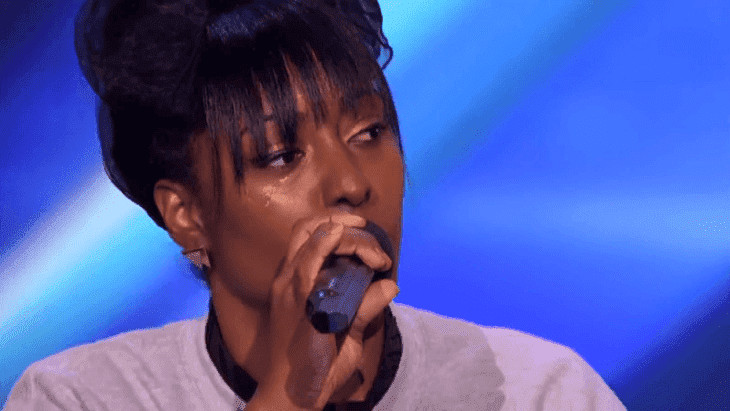
Ashly Williams walked onto The X Factor USA stage carrying a grief that was as raw as it was personal. Before a note escaped her lips, she sat down with the cameras and told the story that had shaped so much of her life: when she was 14, her mother had been murdered. The weight of that loss had followed her through adolescence and into young adulthood, and now, on the eve of what would have been her mother’s birthday, Ashly wanted to sing as a gift — a dedication and a way of transforming pain into something meaningful. The moment she spoke, the room felt smaller and quieter; her openness made everyone listening feel like they were being entrusted with a fragile piece of her heart.
Choosing Whitney Houston’s “I Will Always Love You” was both bold and fitting. The song is notorious for its technical demands — the control, the breath, the climactic lift — and for the emotional vulnerability it requires. For Ashly, the choice was more than a challenge: it was a vehicle. She didn’t pick the song to show off; she picked it because its lyrics and its longing matched what she wanted to say to the mother she lost. As she stood under the lights, you could tell this was not a performance in the usual sense. It was a conversation with absence, an offering, and an act of remembrance.
From the very first phrase, Ashly made the song her own. Her voice carried a husk of sorrow that never became overwrought; instead, it added depth and authenticity. She set phrases gently at first, with a sense of reverence, and then gradually expanded into the bigger moments with a control that suggested both training and lived experience. When she held notes, the audience felt every fraction of time with her; when she softened, the room leaned in. There were tiny gestures that magnified the emotional impact — a closing of the eyes at the chorus, a trembling inhale before a sustained note — that made you aware this was more than technique. This was a woman telling a story through sound.
The reaction in the auditorium was immediate and visceral. You could see it on the faces in the crowd: mouths slightly open, hands to chests, eyes welling. When she hit the powerful moments, people who had been sitting quietly began to stand, one by one, until the entire audience rose in a collective standing ovation even before the song’s final run. That kind of response doesn’t happen for mere vocal fireworks; it happens when an artist invites you into something deeply human. Judges who are used to critiquing tone, pitch, and stagecraft found themselves reacting with something more primal — the urge to honor someone’s courage and to acknowledge the truth in what they’d just witnessed.
The judges’ feedback reflected both professional admiration and personal empathy. Simon Cowell, often the show’s toughest critic, delivered one of those rare full-throated endorsements, saying that Ashly embodied exactly what the American edition of the show had been created to find: authentic, singular talent that connects beyond the mechanics of singing. His words carried the weight of industry experience; when Simon praises raw emotional authority, the compliment resonates. Demi Lovato, moved by the performance and the story behind it, expressed a desire to guide Ashly as a mentor, clearly sensing the potential for growth and the need for compassionate direction. Kelly Rowland singled out the humility in Ashly’s delivery — how she managed to stay true to herself even while tackling a song that could easily become showy in the wrong hands. “She spilled her heart out,” Kelly said, capturing precisely the mixture of vulnerability and mastery that made the audition unforgettable.
It wasn’t just the technical command that stood out; it was Ashly’s ability to channel sorrow into a form of beauty without exploiting it. Too often, reality TV can reduce pain into spectacle, but here the narrative felt honest and respectful. Ashly’s performance became an example of how grief, when met with artistry, can be transformed into a tribute that uplifts rather than simply reopens old wounds. The standing ovation, the judges’ tears, and the offers of mentorship were all tangible signs that the performance had gone beyond success — it had made a meaningful connection.
When the votes were revealed, the four unanimous “Yes” answers were almost an afterthought to the emotional arc of the moment, but they mattered nonetheless: they moved Ashly forward in the competition and crystallized her status as a frontrunner. For the audience at home and those in the studio, her audition became more than a clip to be shared; it became a story of resilience. People didn’t just watch; they felt invested in where she would go next, curious to follow how she might transform personal tragedy into a sustainable career and how a platform like The X Factor could serve as a catalyst for healing.
In the days following, one could imagine messages of support flooding in — strangers reaching out with their own stories of loss and gratitude, artists offering guidance, and fans pledging their loyalty. For Ashly, the immediate future was a mix of relief and renewed purpose. She had taken a painful anniversary and turned it into a moment of artistic truth. Whether she ultimately won the competition or not, that audition would remain a defining snapshot: a young woman who used a song to remember a mother, to heal a part of herself, and to invite the world to witness the raw, redemptive power of music.