
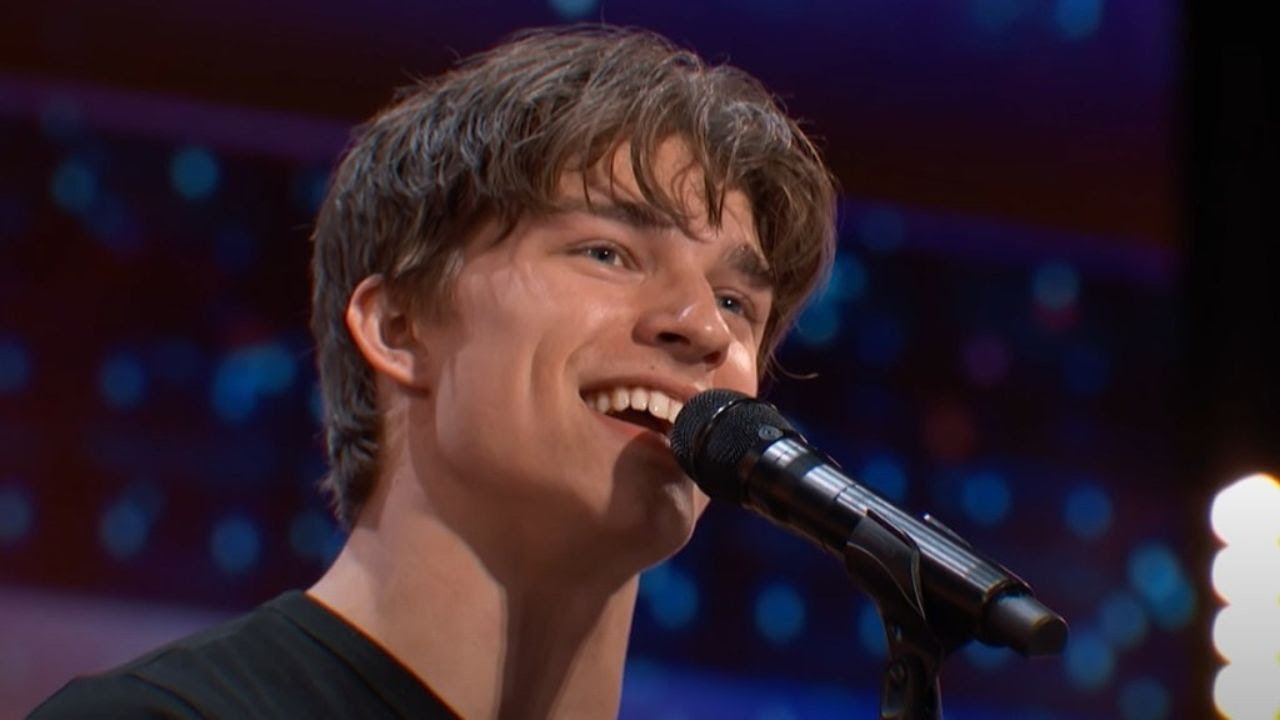
When Alex Sampson stepped onto the America’s Got Talent stage, you could feel the contrast between his small-town roots and the bright, overwhelming world he’d entered. At 20 years old and from Atikokan, Ontario — a place where the population barely fills a high school gym — he admitted later that the theatre likely held more people than his entire hometown. That vulnerability was part of the appeal: here was a kid who could have hidden behind nerves and humble origins, but instead chose to let both show. The result was an audition that felt refreshingly genuine and oddly timeless.
Alex didn’t play it safe. Rather than choosing a familiar cover to win over the crowd, he put an original song on the table: “Pretty Baby.” Choosing an original track in that moment is risky; the audience and judges have nothing to compare it to, and the performer has to trust the song as much as their own voice. For Alex, the risk paid off immediately. “Pretty Baby” carried a deliberate retro flavor — not a throwaway imitation, but a carefully constructed nod to the 1950s and 1960s pop sensibility. The arrangement leaned on simple, melodic phrasing and warm, vintage-sounding chords, which made the piece stand out in a sea of contemporary pop and dramatic ballads.
From the first notes, there was something quietly cinematic about the performance. Simon Cowell, who can be famously blunt, responded in a way that underscored how special the moment felt; he compared Alex’s sound to something you might hear in a Martin Scorsese movie, which is to say it evoked a kind of nostalgia paired with storytelling. Simon praised the songwriting as clever and genuine, pointing out that Alex wasn’t just mimicking a style — he’d written a song that used that retro color palette to tell a modern, heartfelt story. The lyrics were small and vivid: details about a familiar kind of longing, flirty lines that didn’t feel forced, and a chorus that lingered. It wasn’t blockbuster drama; it was intimacy dressed up in classic pop clothing.
Alex’s stage presence evolved as the song unfolded. He confessed beforehand to being nervous, palms probably clammy and heart racing, but that anxiety didn’t get in the way — it became the fuel for a performance that felt authentic. Early on, his voice carried a tentative quality, but as he moved through the verses and into the hook, his confidence grew. The nervousness melted into charm. There was an old-school crooner warmth in his delivery, but with a contemporary sensitivity that made the song feel alive rather than retro for retro’s sake.
The judges reacted in ways that highlighted different facets of the audition. Sofía Vergara responded to the emotional sweep of the performance; she commented on the beauty of Alex’s voice and the apparent ease with which he concealed fear beneath the music. Her reaction spoke to the power of performance as transformation — how someone can step into a role so fully that the audience sees not the anxious person behind the mic, but the artist on stage. Heidi Klum focused on vulnerability, noting that Alex’s openness made him feel more accessible and real. In an industry where performers often hide behind personas, Heidi’s point landed: sincerity can be as compelling as technical prowess.
Howie Mandel offered a different but equally important perspective. He observed that Alex was carving out unique territory in the music world — a niche that, at the moment, doesn’t quite exist on a large scale. Howie likened Alex’s vocal approach to the lead singer of Herman’s Hermits, capturing that mid-century pop brightness, but emphasized that what made Alex interesting was how fresh it felt. There’s a difference between copying a classic sound and reviving its essence in a way that resonates with modern listeners; Howie saw Alex doing the latter. That observation hinted at commercial potential: a young artist who can offer something both familiar and new has a chance to stand out in a crowded marketplace.
Small details in the performance made the difference. Alex’s phrasing — the way he lingered on certain syllables and pushed others forward — gave the song personality. His little smiles at the end of lines, the way he glanced at the band, and the subtle head movements suggested stagecraft beyond his years. There was also a simplicity to the staging that complemented the music: no over-the-top choreography, no dramatic props, just a voice and a song, allowing listeners to focus on the craft.
In many ways, Alex Sampson’s audition serves as a blueprint for how unique content and authentic personality can cut through the noise. He didn’t try to be the loudest or the flashiest; he leaned into a particular aesthetic and made it his own. That transformation — from a timid small-town vocalist into a performer with polished charm and an ageless sound — was the heart of his appeal. By embracing a vintage vibe and delivering with unguarded honesty, he offered something rare: a young artist who feels both rooted in musical history and ready to push it forward. For a brief stretch on that stage, Alex didn’t just sing — he invited listeners into a world he’d created, and that invitation proved impossible to ignore.