Rafferty Coope, a talented 16-year-old standing at an impressive 6’4”, stunned both the judges and the audience during his audition on Britain’s Got Talent 2026 in a way that few people in the room will likely forget. From the moment he stepped onto the stage, there was something immediately striking about him—not just his height or confidence, but the calm, almost quiet focus he carried, as if he already knew he was about to do something unusual. He introduced himself with a modest smile, briefly mentioning his two greatest passions: music and magic. At first, the combination sounded intriguing but familiar. What followed, however, quickly proved that Rafferty had redefined what that blend could look like.
The performance began subtly. Soft musical tones filled the auditorium as Rafferty positioned himself at the center of the stage. With a simple gesture toward Simon Cowell, he performed his first illusion: a seemingly impossible moment where sound appeared to pass through Simon’s hand. It wasn’t loud or dramatic, but it was precise enough to make the judges immediately lean forward. Simon’s reaction alone—half confusion, half disbelief—set the tone for what was to come. The audience, sensing they were witnessing something carefully constructed and highly original, fell into a tense silence, waiting for the next moment to unfold.
As the performance progressed, Rafferty began blending rhythm and illusion more deeply. Objects on stage appeared to respond to musical beats, subtly lifting and shifting as if guided by invisible forces tied directly to the melody. One particularly memorable moment came when a small set of props floated slightly above the table in time with the music, rising and falling as though breathing with the sound itself. The synchronization between audio and visual elements gave the entire act a dreamlike quality. It no longer felt like watching a trick or a performance—it felt like watching music take physical form.
The atmosphere in the room shifted again when KSI was invited to participate in the act. Rafferty handed him a set of playing cards and asked him to choose freely, ensuring there was no pattern or preparation. The tension in the auditorium was palpable as KSI shuffled and selected cards at random, clearly intrigued but skeptical about where this was going. Rafferty then began translating the values of the chosen cards into musical notes. Each selection corresponded to a precise sound, and as the sequence built, something remarkable began to happen: the scattered notes slowly transformed into a recognizable melody.
The audience gradually realized what was forming. The notes were converging into “Don’t Stop Believin’” by Journey. The transition was so seamless that it almost felt accidental at first, as though the melody was emerging on its own rather than being constructed. Yet as Rafferty continued, it became clear that every choice, every sound, had been deliberately guided. The performance reached its peak when the rhythm fully aligned with the iconic anthem, filling the entire studio with a wave of recognition and excitement.
But Rafferty still had one final surprise. After the music swelled and the audience began reacting with visible amazement, the playing cards were flipped over to reveal letters printed on their backs. Those letters, when arranged, spelled out the title of the song itself: “Don’t Stop Believin’.” The reveal landed with immediate impact. Gasps echoed across the room as people processed what they had just seen—not just a musical performance, but a layered illusion that connected sound, choice, and meaning into a single cohesive moment.
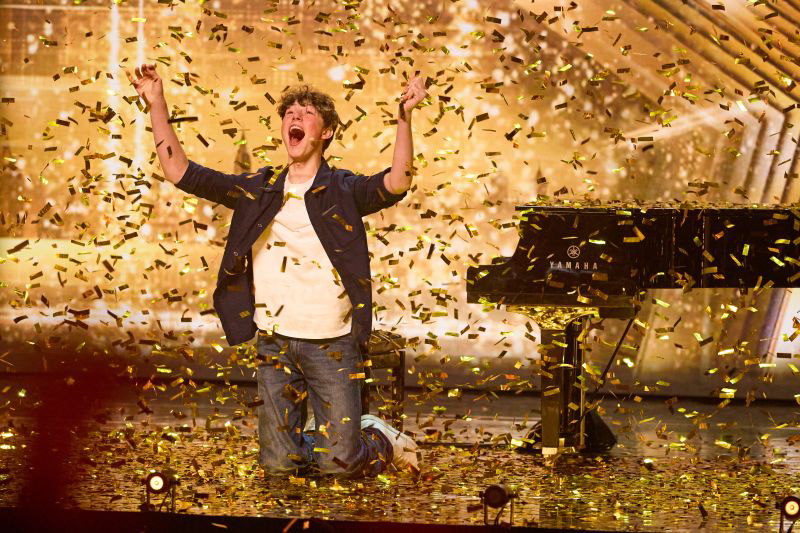
The emotional weight of the act became most apparent in the final seconds. KSI, visibly moved by both the creativity and confidence of the young performer, paused for a moment before reaching forward and pressing the Golden Buzzer. The golden confetti erupted almost instantly, cascading over Rafferty as the audience erupted into cheers. For a brief moment, he stood still, taking it in, overwhelmed by the realization that he was being sent directly to the live semi-finals. It was a dream he had apparently carried since he was five years old, and now it was unfolding in front of a national audience.
As the confetti continued to fall, Rafferty’s expression shifted from shock to gratitude, acknowledging the judges and crowd with a mix of disbelief and joy. The moment felt less like the end of an audition and more like the beginning of something much larger. With his rare combination of stage presence, creativity, and technical skill, Rafferty Coope had not only impressed the judges but had also carved out a distinct identity as one of the standout acts of the season. In a competition filled with talent, he managed to create something that felt genuinely new, leaving the audience with the lingering sense that they had just witnessed the rise of a truly unique performer.