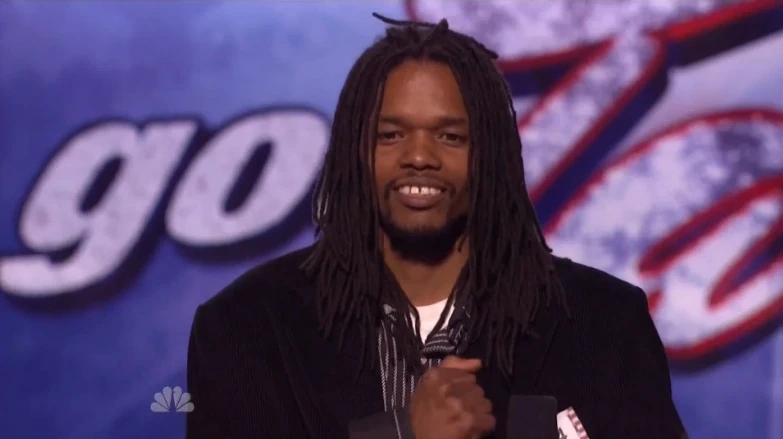
Landau Eugene Murphy Jr., a 36-year-old car washer from West Virginia, arrived at the America’s Got Talent audition room with the easygoing air of a man who’s spent his days doing honest, physical work and knows the comfort of routine. He spoke with a casual humor about his decade spent scrubbing tires and polishing fenders — an existence measured in soap suds, early mornings, and the small-talk of customers — and you could tell he’d grown used to being overlooked. With dreadlocks tucked back and a laid-back smile, he joked his way through the introduction, even popping gum and doing silly impressions that had the judges exchanging skeptical glances. The persona he presented was deliberately self-effacing: here was a guy who’d never been groomed for show business and who seemed entirely at ease exposing that fact.
That unpolished charm made his confession about wanting more all the more affecting. He talked about dreaming of singing for a living, a dream he’d carried quietly while his hands did the daily work of cleaning other people’s cars. There’s something almost cinematic about someone who spends hours making other things gleam, harboring a talent waiting to catch its own light. The story framed him as an underdog in the classic sense — not bitter or tragic, just quietly persistent. The judges were primed for an amusing, low-stakes performance: the kind of moment that fills TV with feel-good quirks. What none of them expected was the voice that followed.
When the orchestra began the opening bars of Cole Porter’s standard “I’ve Got You Under My Skin,” the room, which had been light and amused, dropped into a reverent hush. Landau opened his mouth and what came out was a clarion, velvety baritone with the phrasing and phrasing nuance of a seasoned jazz singer. His delivery was smooth and effortless, full of subtle timing shifts and a warm vibrato that made every line feel lived-in. It wasn’t a novelty impression; it was a masterclass in interpretation. The song shifted from being a demonstration of crooner nostalgia to a personal statement about where he’d come from and where he might go.
The contrast between his earlier joking manner and the gravity of his singing made the moment doubly powerful. There was a tangible sense that the voice had always been there beneath the gum-chewing and the farm-boy banter — a hidden instrument shaped by years of private practice, church hymns, and late-night crooning in a car by headlights. Piers Morgan’s astonished question about whether Landau was miming a tape captured how disorienting it felt to have such a polished sound arrive from such an unlikely source. But the voice was real: nuanced, rhythmic, and drenched in classic swing feel. Landau’s timing was impeccable; he danced around the beat in a way that made the orchestra sound like it was playing to him rather than the other way around.
Small details made the performance even more affecting. Landau’s hands were expressive but controlled; he didn’t rely on flashy moves, instead letting micro-gestures — a tilt of the head, a gentle reach toward the audience — amplify the song’s emotional arc. His eyes found different faces in the crowd as if sharing private lines with strangers, turning a television audition into a series of intimate conversations. The judges’ faces told a story in themselves: curiosity melting into awe, skepticism giving way to something like gratitude that they’d been given this moment to witness.
Feedback afterward was a mix of shock, admiration, and recognition of potential. Piers admitted he’d come in expecting a “total train wreck” but left feeling “blazed” by the quality of the performance. Sharon Osbourne and Howie Mandel echoed that sentiment, talking about how Landau had changed the tenor of the room and, by extension, his life. They praised not only the technical excellence — the perfect pitch, the phrasing, the tonal control — but also the way the performance transformed a simple man into someone carrying the weight of a larger story. The unanimous sense among the judges was that this wasn’t a one-off novelty; it was a breakthrough moment.
When the votes came in and Landau earned a ticket to Las Vegas, the reaction was both triumphant and tender. For a man who had spent years in the background, a simple “Yes” unlocked the possibility of being seen on a national scale. His reaction — a mix of relief, disbelief, and quiet joy — made the moment feel less like spectacle and more like justice. In the minutes after he left the stage, the narrative had already begun to form: here was proof that talent hides in plain sight, that a lifetime of ordinary labor can coexist with extraordinary gifts, and that sometimes the most surprising performances are the truest.
Landau’s audition endures because it was a reminder of the unpredictability of talent and the humility of real artistry. A car washer from West Virginia stepped into bright lights and delivered a performance that bridged eras, bringing Sinatra-era sophistication into a modern TV arena. In doing so, he offered something rare on reality television: the sense that a single, honest moment can change everything.