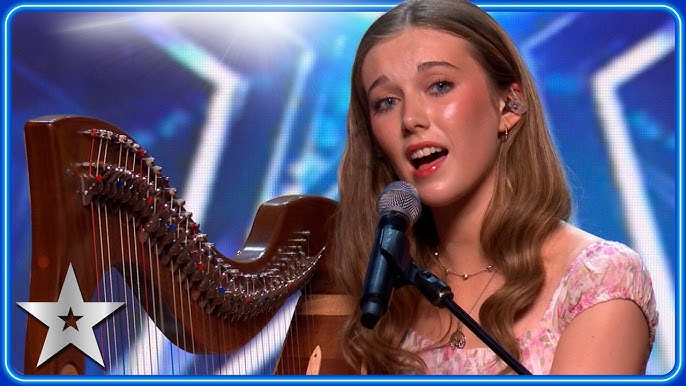
The audition room fell into a hush the moment seventeen-year-old Neve from Ireland stepped onto the Britain’s Got Talent stage. There was nothing theatrical about her entrance — just a quietly confident teenager, a harp that gleamed under the stage lights, and her mother watching from the audience. For many, the harp conjures images of concert halls and background music at weddings, but Neve had come to challenge that assumption. Within seconds of her performance beginning, it was clear she wasn’t there to play it safe.
She chose a modern pop song — Alex Warren’s hit — and arranged it for harp in a way that felt both reverent and rebellious. Where others might have tried to make the harp mimic a guitar or pad, Neve leaned into the instrument’s natural strengths: bell-like arpeggios, warm resonant bass, and delicate, ringing harmonics. Then she layered her voice on top, a clear, controlled instrument in its own right. What emerged was a version of the song that felt freshly minted, like hearing a familiar story told in a brand-new language.
The contrast between her small frame and the expansive sound she produced made the moment cinematic. She began with a whisper — fingers plucking single notes that hung in the air — and gradually built to chords that filled the auditorium. Her vocal delivery moved seamlessly from intimate verses to a soaring chorus, and she navigated that climb with the kind of breath control and phrasing that typically comes from years of disciplined practice. It wasn’t just technical skill; there was a sincerity to her performance that made every note land emotionally. You could see it in the way she closed her eyes during a line, concentrating on nuance, and then opened them at the chorus as if inviting everyone into the story.
The judges’ reactions captured the room’s transformation. KSI, known for his blunt, influencer-honed commentary, sat visibly moved, later calling her voice “angelic.” His surprise felt genuine — it’s not every day a contestant turns a harp into the focal point of a pop arrangement and makes it sound effortless. Simon Cowell, who’s seen thousands of acts and rarely offers effusive praise, described her approach as “sensational” and unique, noting that the show seldom witnesses such a fresh reimagining of a traditional instrument. Their responses echoed the audience’s shift from polite curiosity to wide-eyed amazement.
Beyond the judges’ soundbites, the performance resonated in more subtle ways. Neve’s arrangement included moments of rhythmic pizzicato that suggested percussion, and at one point she used a soft glissando to bridge an emotional beat — small decisions that demonstrated both musical intelligence and creative bravery. Those details turned the harp from a background texture into a lead voice that interacted with her singing rather than simply accompanying it. It was as if she’d taken two musical worlds — classical technique and pop sensibility — and taught them to speak to one another.
There was also something undeniably human about the audition. At its start, Neve appeared nervous; she tucked a stray strand of hair behind her ear and glanced briefly toward her mother. By the end, that nervousness had transformed into a quiet confidence that didn’t feel rehearsed. The judges’ unanimous “yes” felt less like a procedural vote and more like a communal recognition that they had witnessed something rare. The standing ovation that followed wasn’t just for a polished audition; it was for a young artist who’d dared to rewrite expectations.
This moment has all the ingredients of a social media sensation. The visual — a teen and her harp, stage lights catching the instrument’s polished wood while a crystalline voice fills the room — is inherently sharable. The narrative is classic: a nervous underdog, supportive family in the crowd, and a surprise performance that flips assumptions. But beyond virality, Neve’s audition points to a wider shift in how young musicians are defining success. Rather than abandoning classical training for pop fame, she demonstrated how traditional skills can be repurposed to create something contemporary and marketable. That blueprint — classical technique applied with modern aesthetics — could inspire other young artists to think differently about their instruments.
For Neve herself, this moment will likely feel like the hinge of a career. The applause and judges’ praise grant her immediate momentum, but the deeper impact may be the confidence to keep experimenting. Already, you can imagine her arranging more contemporary songs for harp, collaborating with electronic producers to blend acoustic textures with synths, or composing original material that leans into the unique timbre of her instrument. Her performance suggested not an end point but the beginning of an evolving artistic identity.
When she left the stage, the energy in the room had shifted permanently — not only had she secured a place in the next round, but she’d also nudged the industry’s imagination. For viewers and fellow musicians, Neve’s audition offered a reminder that innovation often comes from unexpected pairings and the courage to reframe what we take for granted. In that sense, her performance was more than a modern cover: it was a small revolution, played with nimble fingers and a voice that refused to be categorized.