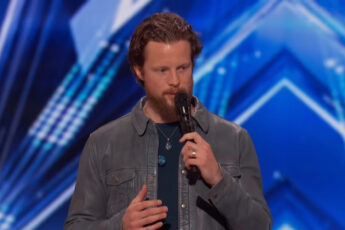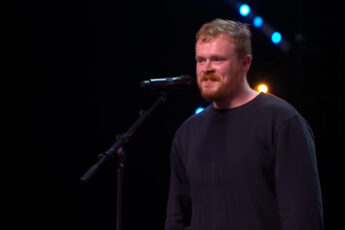

Twenty-three-year-old Mark McMullan walked onto the Britain’s Got Talent stage with the quiet steadiness of someone carrying more than just a desire to perform. He introduced himself simply as a singer from Northern Ireland, but the words that followed revealed the weight behind his decision to audition. Nearly six years earlier, his older brother had suffered a catastrophic brain injury that left him with locked-in syndrome — a condition in which a person is conscious and aware but unable to move or speak. For Mark, music had become one of the few bridges between them. He explained that his brother, though trapped inside his own body, could still hear. That knowledge turned every note Mark sang into something larger than a career move; it was a language of love.
Mark explained he had two ambitions. Part of him hoped for the obvious — the chance to launch a singing career and see where his voice could take him. The other part, softer and more urgent, was driven by family: to do his brother proud and to give him something to reach for in a world that had been dramatically narrowed. There was no grandstanding in his delivery, just a tremor of feeling and an honest humility. When he mentioned that his brother was in the audience, the room shifted. You could feel the collective intake of breath from theatre and judges alike; it’s one thing to sing for yourself, another to sing for someone who listens with all the attention they can give.
He chose a song that matched the moment’s gravity: “Bring Him Home” from Les Misérables. Mark called it “very, very personal” — a simple statement that made the choice resonate. The piece itself is a prayer of protection, a plea for safety, and its lyrics about sacrifice and hope fit the family’s story in an almost painful way. Mark didn’t need flashy gestures or theatricality; his preparation was visible in the small, human details. Before he started, he took a breath, closed his eyes briefly, and placed a hand over his chest — a small ritual you sense he performs both for himself and for his brother. Those quiet actions set the tone: this wasn’t about showmanship, it was about connection.
From the first line, his tenor voice held the room. There was a controlled purity to his phrasing and a warmth that suggested both technical training and lived experience. He navigated the song’s long, soaring lines with a measured restraint, never pushing for volume when feeling would do. Instead, Mark let emotion sit in the cracks between words, allowing the audience to lean in. When he reached the climactic passages, his voice rose without strain, and there was a tenderness that made the lyrics feel like a direct conversation with his brother. You could see people in the theatre visibly moved: hands went to mouths, shoulders bowed, eyes glistened. The cameras, as they often do, cut to the family at critical moments — a close-up on his mother’s face, a long shot of his father gripping a program tightly — and then, most poignantly, to his brother in the audience. Though his brother could not respond with a smile or tears that the camera might capture, his presence alone made everything in the room hold a little more reverence.
The sound design for the performance was understated, allowing Mark’s voice to remain the focal point. A gentle piano and a sparse string arrangement filled out the harmony without overwhelming him. That simplicity mattered; it mirrored the sincerity of his intent. At times the staging seemed to disappear, and all that remained was the human exchange between vocalist and listener. By the time Mark reached the final notes, there was a hush so complete it felt sacred. Then the applause began — tentative at first, then swelling into a standing ovation that lasted and lasted. People stood not simply to acknowledge talent but to honor the story that had been laid bare on stage.
The judges, too, found themselves affected. Their faces softened; a few dabs at eyes were exchanged. Comments afterward were short but heartfelt — not the manufactured praise sometimes heard on reality TV, but something real: admiration for his vocal control and for the bravery it took to put such raw emotion on public display. They praised the performance not only as a technical accomplishment but as an act of love. For the young man who had arrived intent on both making a mark and lifting his brother’s spirits, their words carried weight. When the four “yeses” lit up, it wasn’t just a procedural step forward. It felt like a communal affirmation: your voice mattered, your reason matters, and we’ll see you in the next round.
After the audition, Mark’s expression was a mixture of relief, exhaustion, and quiet joy. He hugged his family, and in that embrace you could see the small victory of a man who had managed to translate private grief and hope into a public, moving moment. For an audience of thousands and millions watching at home, the performance was a reminder of why music can matter so deeply — it becomes a vessel for memory, for prayer, and for the fragile, persistent human urge to be heard by the people we love.