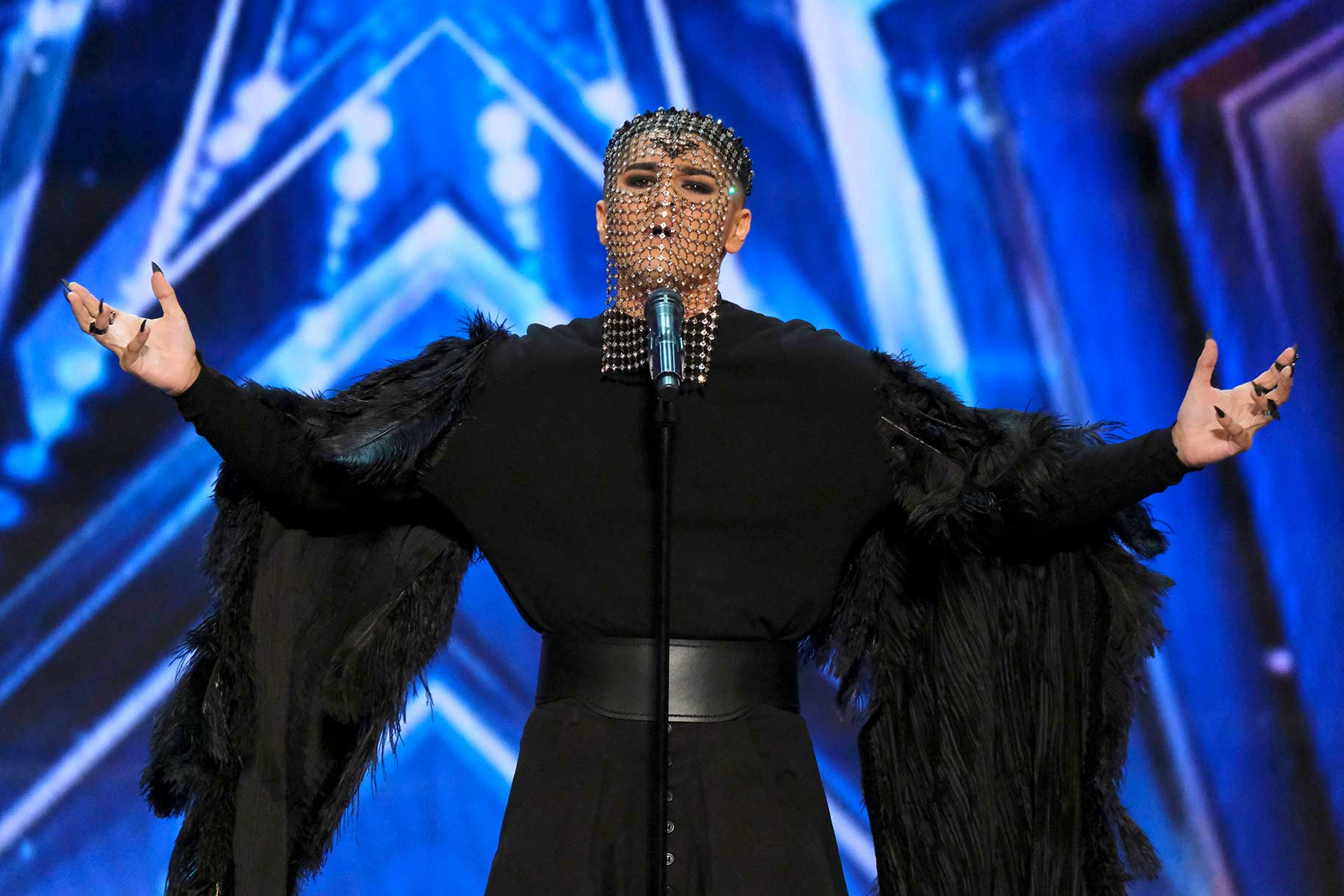
Sheldon Riley, a performer from Sydney, Australia, delivered one of the most visually arresting and emotionally resonant entrances America’s Got Talent has seen in recent seasons. He stepped onto the stage wearing an ornate, glittering mask and high-fashion, avant-garde clothing that caught the lights and refracted them into a constellation around him. The look was theatrical but impeccably styled — think couture-meets-performance-art — and it immediately set a tone of mystery. For a few tense, electric moments he remained silent, letting the audience and the cameras linger on the elaborate costume and the unanswered question: who is the man behind the mask?
When Sheldon finally began to sing, the silence paid off in the most powerful way. He chose to perform “idontwannabeyouanymore” by Billie Eilish, a song that demands intimacy and emotional honesty, and he rendered it with a voice that felt both haunting and mature. There was a tremor of vulnerability in his lower register that suggested lived experience, and an unexpected, crystalline clarity in his higher notes that pierced the auditorium. He didn’t compete with the pageantry of his attire; instead, his vocal control and phrasing turned the mask from a gimmick into a meaningful part of the storytelling. Every breath he took, every subtle dynamic shift, made the lyrics land harder — you could sense the audience leaning in, collectively holding theirs as Sheldon unpacked the song’s quiet anguish.
Small details in the performance made a big difference. At one point his gloved hand reached up to touch the edge of the mask, a tiny, human gesture that hinted at the person beneath the embellishment. He tilted his head just so on a sustained note, and the stage lights caught the glitter, making the moment feel like a private revelation expanded into public catharsis. You could hear a pin drop during the most fragile phrases; when he let a phrase hang in the air and the room exhaled only after it dissolved, the effect was spine-tingling. The judges’ faces moved from curiosity to stunned admiration as the song progressed; the mask, which had started as a barrier, became the frame for an undeniable vocal portrait.
After the last note faded, Sheldon finally spoke for the first time, and the warmth in his voice matched the courage he’d shown onstage. He explained that the mask and the dramatic aesthetic were part of his journey toward self-confidence. Growing up, he said, he often felt invisible or out of place, and he found that people began to notice when he dressed in a way that reflected his inner world. The costume, he explained, was more than an image — it was armor and invitation at the same time: armor to protect the fragile parts of him, and invitation to others to look beyond appearances. He confessed that he’d shied away from big opportunities in the past because of fear and uncertainty, and that coming to the U.S. was a deliberate step to challenge himself. He believed that in America, difference is not merely tolerated but can be celebrated — a sentiment that resonated with many watching.
Sheldon’s backstory gave the performance an extra layer of meaning. He spoke about long nights practicing in small rooms, the supportive yet worried looks from family members, and the bittersweet sting of being overlooked until he embraced his own eccentricities. Those anecdotes made him feel less like an enigmatic stage figure and more like someone viewers could root for: a young artist who’d chosen authenticity over assimilation. It was easy to imagine a child watching at home, seeing someone both bold and vulnerable on a national stage, and thinking, I can be myself too.
The judges responded with heartfelt praise. Simon Cowell, who is often terse and exacting, lauded Sheldon’s originality and the theatrical mystery that accompanied his artistry, remarking that the presentation felt fresh in a competition that occasionally leans on formula. Sofia Vergara’s reaction was emphatic and warm; she complimented his “Cleopatra eyes,” a comment that, while playful, acknowledged the dramatic intensity he brought even with much of his face concealed. Other judges echoed similar sentiments, focusing on the emotional honesty of the vocal delivery and the integrity of the concept. When Sheldon explained that his goal was to inspire young people to embrace their uniqueness without fear, the judges’ praise felt natural rather than obligatory.
Ultimately, the response from the audience and the judges culminated in three resounding “yes” votes, sending Sheldon Riley through to the next round. It was a deserved affirmation: his performance had been a synthesis of bold visual storytelling and genuine vocal talent. The mask did not hide him so much as reveal a different way to be seen. As social media lit up with clips of his audition, comments poured in from fans moved not just by the technical skill but by the courage to perform authentically. Sheldon’s appearance on America’s Got Talent became more than an audition; it was a statement about identity and artistry, and a reminder that true talent finds a way to be unmistakable, even from behind a mask.