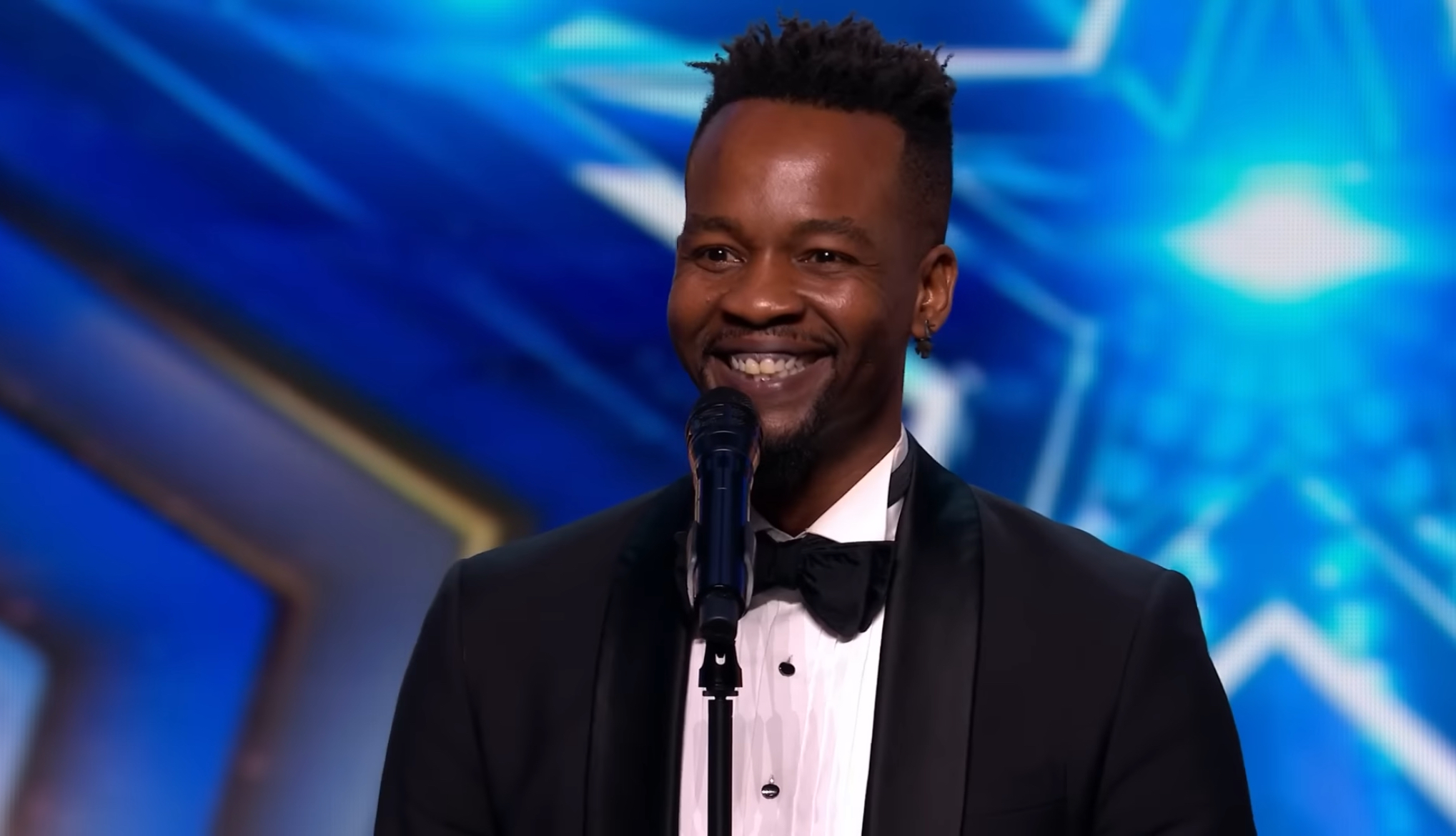
Babatunde Akinboboye arrived on the Britain’s Got Talent stage like someone who knew exactly what he wanted to say. At 40, he cut a striking figure in a tailored suit, every detail of his appearance meticulously groomed — polished shoes, a neat pocket square, a calm, confident smile. He told the audience he had come from Los Angeles with a mission: to prove his talent on one of the world’s biggest stages. That kind of determination was clear in the way he held himself, but what the judges and viewers didn’t yet know was how he planned to deliver his message. This was not going to be a typical audition; Babatunde had been working on something unusual, a collision of genres he believed could open new doors for musical performance.
He began in a way that felt familiar and instantly impressive. Standing center stage, he launched into an operatic tenor passage with the kind of control and resonance that suggested formal training and serious vocal discipline. The opening moments drew polite, appreciative murmurs: the power, the purity of tone, the way each phrase blossomed and sustained. For a few bars, he seemed like a classical singer proving his chops, the sort of moment that would earn nods from purists. Then, as the arrangement shifted, the audience realized they were witnessing the set-up for something bolder.
Without warning, the backing track pivoted, snapping the performance into a new gear. The lush orchestral bed gave way to a punchy beat, and Babatunde moved seamlessly from sustaining arias into a tight, rhythmically complex hip-hop flow. It was a startling pivot, but it felt effortless coming from him: one minute he was belting Italianate lines with dramatic vibrato, the next he was articulating rapid-fire verses with clear diction and an urban swagger. The effect was electrifying. Instead of feeling jarring, the transition read as intentional artistry, a carefully constructed hybrid that played to both disciplines’ strengths.
What made Babatunde’s “Hiphopera” so compelling was not merely the novelty of combining opera and hip-hop, but the craft behind it. He didn’t just overlay rap on top of an aria; he composed a conversation between two musical worlds. He would stretch a phrase into a soaring high note and then fold it back into a percussive bar of rap, using dynamics and phrasing to create contrasts that felt musical rather than gimmicky. His lyrical choices leaned into contemporary themes — identity, ambition, the immigrant experience — which made the classical passages feel grounded in the present. Moments of theatrical vibrato gave emotional weight to the lines, while the rap sections provided immediacy and edge. It was a dialogue between tradition and modernity, and Babatunde played both roles with conviction.
The judges’ reactions mirrored the audience’s mix of astonishment and curiosity. Alesha Dixon was visibly excited, praising the idea of making classical music “accessible” and “cool” to a younger, more diverse audience. She appreciated that this wasn’t a stunt but a thoughtful attempt to bridge cultural divides. Simon Cowell, ever the pragmatist, admitted he wasn’t enamored with every song choice within the performance but couldn’t deny the potential in the concept. He called it a “great idea,” noting that originality often trumps perfection on a stage like BGT. That blend of critique and encouragement underscored the broader feeling in the room: this was something new, and while it might need refining, it had unmistakable promise.
Beyond the panel’s comments, the larger theatre seemed to pulse with approval. Some viewers cheered the spectacle; others nodded as if they’d witnessed an entirely new genre being born. There was a sense of playful bewilderment turning into genuine admiration. Babatunde’s command of both vocal techniques — the disciplined breath control for sustained operatic lines and the rhythmic precision for rapid rap delivery — convinced skeptics that this fusion was not a novelty but a thoughtful experiment in musical storytelling.
Backstage and online, the idea of “Hiphopera” began to feel like a conversation starter. Producers and music lovers alike could imagine ways to polish and package the act: tighter song choices, clearer narrative through-lines, or even collaborations with classical institutions and urban artists. For Babatunde, the audition was less about immediate perfection and more about planting a flag. He had shown that musical boundaries are porous and that audiences are hungry for bold blends that reflect a world of overlapping cultures and sounds.
When the votes were revealed, the judges rewarded his daring: four “yes” votes sent Babatunde through to the next round. It was a unanimous endorsement of an artist who had dared to introduce something unfamiliar on a mainstream stage. More than that, his performance left behind a tantalizing idea — that innovation in music can thrive at the intersections, and that a single performer with vision and skill can make listeners reconsider what’s possible when high art meets street art.