
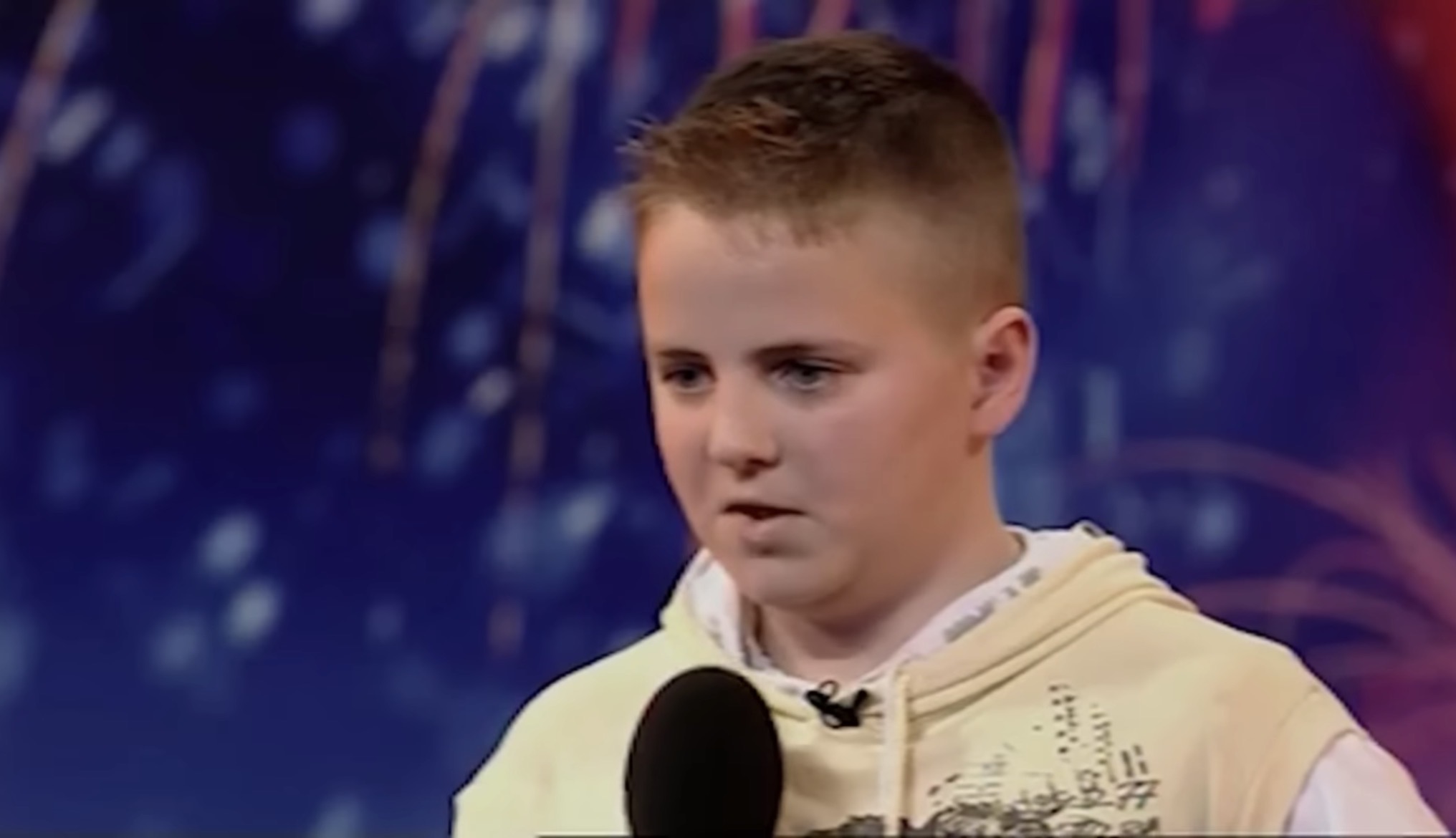
When thirteen-year-old Andrew Johnston walked onto the stage, he looked smaller than the bright lights and booming speakers around him — a slender boy with nervous hands and a hesitant smile. It was hard not to notice the contrast between his shy demeanor and the grandeur of the moment; he fidgeted with the microphone stand, offered a quiet hello to the judges, and answered their questions in a soft, unassuming voice. There was nothing theatrical about him: no flashy clothes, no practiced bravado. What you saw was a teenager who seemed more comfortable with sheet music than with spotlight glare, and that made what happened next all the more powerful.
Andrew’s backstory added a raw, human layer to the audition. He spoke plainly about being picked on at school because of his interest in classical music — small-town taunts and the kind of isolation that can make a child doubt himself. Rather than dramatize his past, he described it matter-of-factly, explaining that he chose to spend time practicing and learning rather than giving in to the pressure to fit in. That quiet determination was palpable; it framed his appearance not as a plea for sympathy but as proof of a boy quietly building a life away from the negativity that surrounded him.
Then the music began. From the opening lines of Pie Jesu, any remaining doubt evaporated. Andrew’s voice emerged bright and pure, a crystalline sound that carried with surprising weight for someone so young. Where his conversation had hinted at fragility, his singing revealed a maturity that the judges — and the entire audience — had not expected. He navigated each phrase with stunning control, blending breath support, clear vowel placement, and an emotional intensity that never felt forced. There was a solemnity to his interpretation, as if he understood not just how to sing the notes but why they mattered.
Small details made the performance even more affecting. Andrew closed his eyes during particularly tender passages, as if he were both hearing and remembering something deeply personal. His posture, which had been slightly hunched at the start, straightened as he found his footing in the melody; by the time he reached the aria’s climactic moments, he was standing tall, allowing his voice to project naturally into the room. The camera lingered on the judges’ faces: Amanda Holden’s expression softened to a look of stunned admiration, and when a small tear escaped, it felt less like television drama and more like a genuine human reaction.
The impact in the room was immediate. The usual polite applause that greets many auditions turned into a hush of reverence during the final notes, followed by a wave of thunderous applause as reality caught up with the performance. You could see people in the crowd wiping eyes, heads thrown back in disbelief, and even the production crew exchanging surprised smiles. That collective response underscored what a rarity the moment felt like: not just a technically impressive audition, but a piece of storytelling in which a young person had turned his pain into art.
What the judges said afterward added another layer to the narrative. Amanda, visibly moved, struggled to articulate how she felt, her voice catching as she praised Andrew’s ability to convey emotion beyond his years. Simon Cowell, known for his bluntness, offered measured but sincere praise, reminding Andrew that those who had mocked him could never touch the unique gift he possessed. When a seasoned judge like Simon speaks in such admiring terms, it lands differently — it’s not merely approval, it’s recognition of potential that transcends the television moment itself.
Beyond the immediate accolades, Andrew’s audition felt like a turning point for him personally. He had walked into the studio carrying the weight of small-town ridicule and the quiet work of practice; he left with public validation and the beginning of a career that could lift him out of that environment. For many viewers, that transformation was the heart of the story: a boy choosing discipline over despair, trade-offs of rehearsal over hanging out, and ultimately being rewarded in front of millions. The performance made it easy to imagine what might come next — vocal coaching, recording sessions, and invitations to perform on stages he’d only dreamed about.
In the days after the show, the clip of Andrew’s audition circulated widely. Fans commented on the sincerity of his delivery, vocal coaches dissected his technique, and casual viewers shared the clip with notes about resilience and hope. For people who had faced similar bullying, his success was validation; for others, it was a reminder that passions pursued quietly can still lead to dramatic, life-changing moments.
When the lights dimmed and the applause faded, Andrew allowed himself a small, shy smile — the kind that comes from having been seen and heard in a way that matters. That smile marked more than a successful audition; it marked the start of a new chapter. In a single, unforgettable performance, a bullied schoolboy had revealed a voice that not only silenced his critics but also announced his arrival as an artist.