
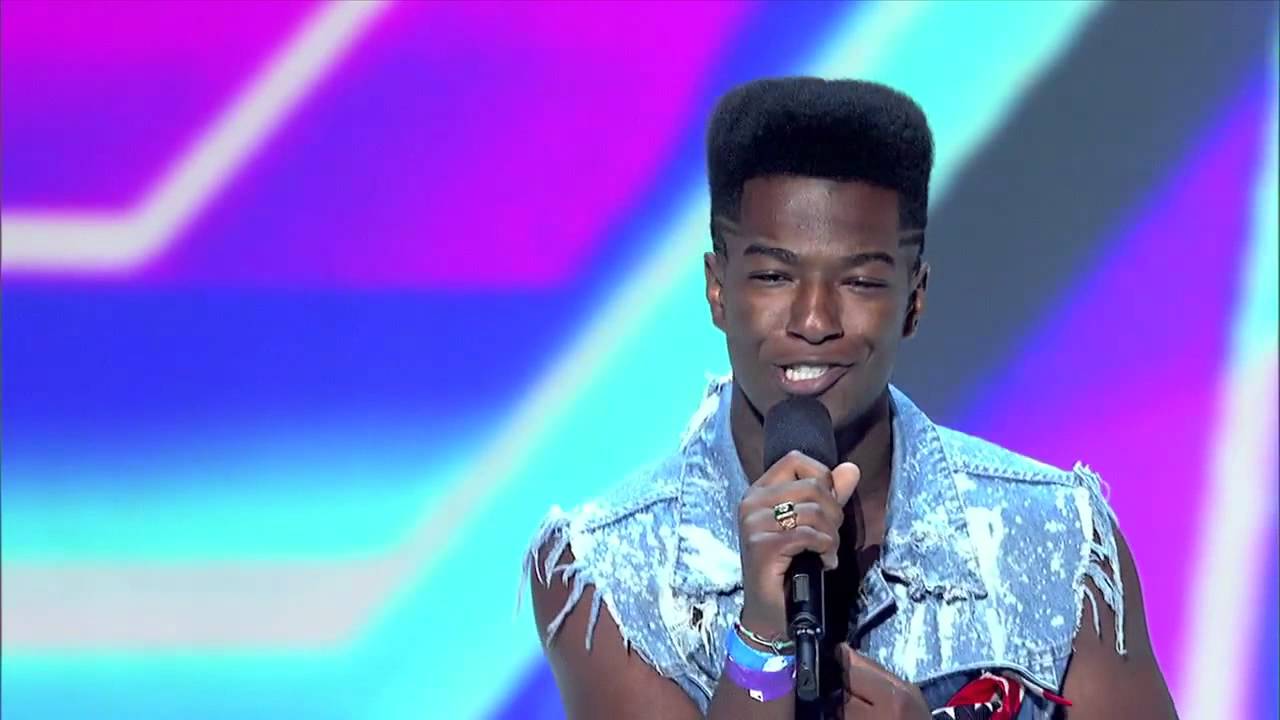
Willie Jones walked onto The X Factor USA stage looking like he’d stepped out of a 90s sitcom: bright, bold colors, a confident swagger, and an outfit Demi Lovato couldn’t help but liken to the “Fresh Prince of Bel-Air.” He greeted the judges politely—“Yes, sir,” “Yes, ma’am”—a courteous formality that made him instantly likable and set a warm tone. At seventeen, he carried that blend of playful fashion and old-fashioned manners like a personal brand, and the room’s expectation quickly settled into a comfortable assumption: this would be a contemporary pop or hip-hop moment, full of energy and modern grooves.
Then the music began, and everything shifted. Willie opened his mouth and a voice completely unexpected poured out—deep, resonant, and unmistakably country. He’d chosen Josh Turner’s “Your Man,” and his rendition dug into the song’s romantic swagger with a bass-baritone that felt decades older than his years. The contrast was immediate and deliciously disorienting: a teenage kid in neon and gold crooning like a seasoned Nashville pro. You could see the surprise ripple across the judges’ faces—smiles twisting into looks of genuine disbelief—as the audience tried to reconcile the image with the sound.
Willie’s vocal quality was the kind of rare thing that makes people stop mid-breath. His lower register possessed a fullness and warmth that could be mistaken for someone twice his age, while his phrasing showed an intuitive feel for country timing and lyric emphasis. He didn’t attempt to mimic Turner exactly; instead, he made the song his own—softening vowels in all the right places, using subtle vibrato at the ends of lines, and holding a few well-placed pauses that let the lyrics land emotionally. It wasn’t just technical ability; it was taste and musical maturity, the kind that suggests he’d been listening closely to classic country records and learning not just to sing notes but to tell a story.
Part of what made the audition unforgettable was the way the visual and the aural collided. Willie’s vibrant outfit and youthful mannerisms compounded the surprise: people expect image and sound to align, and when they don’t, the resulting dissonance can be arresting. The judges—each with a different background and palate—reacted in real time. Simon Cowell, who’s heard thousands of performances, sat forward and declared him “an absolute original,” visibly taken by the uniqueness of the presentation. Demi marveled at the juxtaposition, and Britney and L.A. Reid echoed that blend of surprise and admiration. When L.A. Reid called his vote a “giant-normous big fat yes,” it felt like the industry recognizing not just a voice but an unmistakable marketable twist: a young artist who could cross stylistic boundaries.
Beyond the immediate shock factor, Willie’s performance worked because it felt authentic. He didn’t put on a country affectation; his voice sounded lived-in, as if he’d practiced late-night covers in a bedroom and discovered something honest on the other side. That authenticity translated into stage presence. He stood confidently yet without pretense, making eye contact with the camera and the audience at moments that punctuated the song’s romantic lines. The crowd’s energy followed suit: laughter and surprise melted into steady applause, then into a roar of approval that carried all the way through the final note.
There was also a human story beneath the spectacle. Willie’s youth and his choice to embrace an unexpected genre suggested a young artist unafraid to be complicated, to hold multiple tastes and influences at once. In an era when labels and images are often manufactured to fit neat boxes, his audition was a reminder that artists can be knotty and interesting—part pop culture, part tradition. That has commercial power: a performer who can surprise keeps audiences listening, and industry figures love surprises they can package into a lasting career.
When the panel delivered four unanimous yeses, it felt both celebratory and inevitable. The judges weren’t merely rewarding a gimmick; they were acknowledging a performer who redefined expectations in a short span of time. For viewers at home, the audition became a conversation starter: was Willie a one-off novelty or the start of a genuine career that could bridge genres? For the judges and the producers, he represented a valuable, rare commodity: someone who could spark headlines, split musical assumptions, and draw in a wide audience.
As Willie stepped offstage, the buzz was immediate. Clips circulated online not just for the shock value but because the moment captured something delightful—the unpredictable magic of live auditions, where image and talent collide to create the kind of surprise that sticks in the memory. In a single performance he’d shown that artistry doesn’t need to fit a stereotype; sometimes the most compelling talents are the ones that defy expectation.