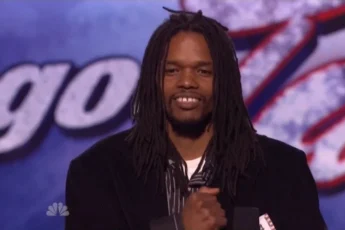

Ricky John, a soulful singer from Southwest London, walked into The X Factor audition room carrying more than just a voice—he carried years of survival, hope, and a family’s quiet love. Before he sang, he told the panel about the eight years he’d spent homeless, a truth that settled over the room like a hush. He arrived flanked by family: his ten-year-old daughter, Heavenly, who clung to him like a small anchor, and his six-month-old baby, Star, bundled close and sleeping against his chest. Those details—names that felt like prayers—gave his story an immediate intimacy. This wasn’t a staged sob story; it was a lived life, full of compromises and small, stubborn joys, and you could see why Ricky had chosen this moment to ask for a change.
Despite the heavy context, Ricky’s demeanor was quietly determined rather than desperate. He admitted he hadn’t slept properly in weeks, the kind of exhaustion that etches itself into the voice and the face. Caring for an infant while trying to find shelter and stability does that—turning nights into a patchwork of naps and wakefulness. His voice, already weathered by hardship, had a raspy edge that afternoon, but rather than being a liability it became part of his authenticity. When he explained why he’d chosen Sam Cooke’s “A Change Is Gonna Come,” it was clear the song wasn’t just repertoire; it was a declaration. Cooke’s lyrics about yearning and endurance mirrored Ricky’s own journey, and the classic’s hopeful ache aligned with the resolve he carried onto the stage.
When the first notes left his mouth, the arena seemed to bend closer. Ricky didn’t try to hide his vulnerability; instead, he let it inform the performance. His tone held that rough, lived-in timber that often accompanies singers who have sung through pain and sleepless nights. There were moments of pure, aching beauty—lines that hung like confessions, delivered with a sincerity that made listeners lean in. He phrased the song not as a polished, studio-perfect rendition but as an earnest telling of where he’d been and where he hoped to go. The rasp in his voice gave the words texture; the occasional crack, far from undermining him, underscored the truth of his experience.
About halfway through, the strain of sleepless nights showed. Ricky’s breath caught on a high note and he nearly faltered. For a second, the fragile human in him peeked through the performer—an unguarded moment where you could see how much was at stake. But rather than collapse under the pressure, he steadied himself. He inhaled, gathered the thread of the melody, and pushed forward with renewed intensity. That recovery was telling; it wasn’t just about vocal technique, it was about resilience. The judges and the audience felt it too. They weren’t watching a flawless singer; they were witnessing someone who, despite exhaustion and circumstance, refused to let a moment define him.
Small, tangible details made the audition feel immediate and lived-in. You could see Heavenly watching with wide, proud eyes, the way children of hopeful parents do when they sense something big might be changing. Star, the infant, squirmed briefly against Ricky’s chest before settling again, a tiny reminder of the daily realities that shaped his choices. Ricky’s hands sometimes moved in time with the music—not theatrically, but like someone who had long used song as both comfort and compass. When the final lines rang out, there was a hush that held for a beat longer than expected, as if the room was honoring the story behind the sound.
The judges’ responses matched the intensity of the moment. Simon Cowell, who often hides emotion behind a measured critique, admitted that Ricky’s near-collapse was actually the moment he connected most deeply with him. That vulnerability, Simon suggested, revealed a man of character and authenticity—someone you’d root for. Nicole Scherzinger was visibly moved; she told Ricky that today might have changed his life, recognizing how rare that kind of raw, honest performance is. Louis Walsh and Sharon Osbourne echoed similar sentiments, praising both the gravel-and-gold quality of his voice and the heart behind it. The feedback wasn’t just about technique; it was about the human story that made the music matter.
When all four judges stood and gave him a unanimous “Yes,” Ricky’s composure broke in a way that felt both private and public. Tears of relief and joy streamed down his face as he embraced his family. It was more than a passing moment of television drama; it was a turning point. For years he had carried the weight of unstable nights and uncertain days; for the first time in a long while, he walked off stage with a tangible sign that his life could tilt toward something better.
Whether the competition would ultimately change Ricky’s life in the long term remained to be seen, but on that day he achieved something vital: he turned a hard-lived past into a new beginning, and he did so while holding his children close. The audition was a testament to endurance, to the strange alchemy where vulnerability becomes strength, and to the idea that sometimes one brave moment can open a door to a different future.