
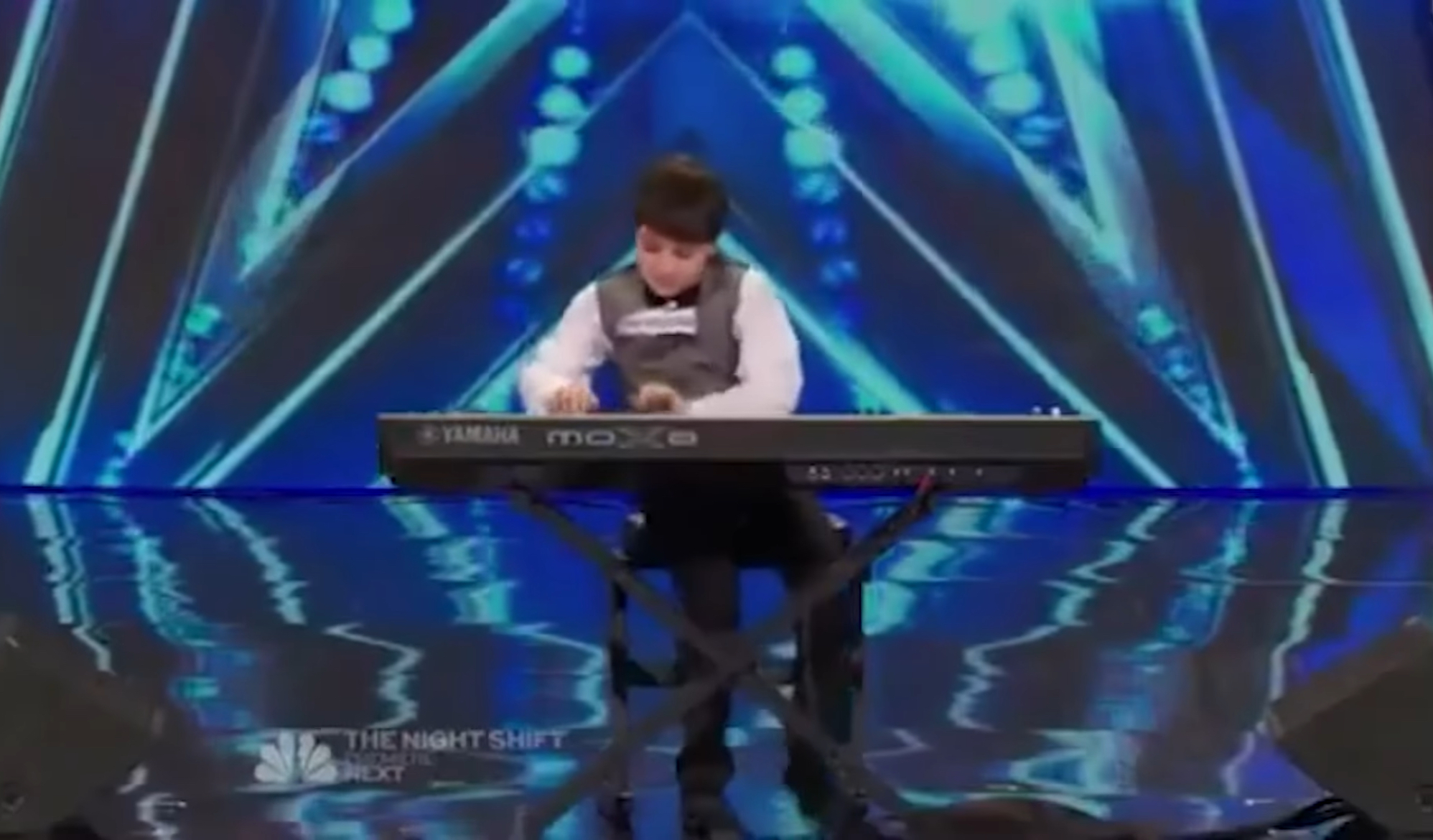
Adrian Romoff’s America’s Got Talent audition felt like watching a tiny, brilliant comet streak across a familiar sky—unexpected, dazzling, and impossible to look away from. At just nine years old, Adrian arrived with a calmness that belied his small stature; he sat at the piano with a poise you seldom see even in much older performers. Before a single note was struck, he’d already won the room over—not through gimmickry but through the kind of clear, engaging mind that made the judges listen more carefully. He matter-of-factly explained that he’d skipped five grades and would soon be on track to start college, and his conversational ease—mixing sharp humor with thoughtful answers—set the stage for what was to come.
There was an intriguing contrast between Adrian’s academic brilliance and his musical soul. He spoke about emotion in music as if it were a living thing, arguing that technical skill without feeling would be like a “piano-playing robot.” That line landed because it revealed a young artist who understood nuance: that music needs both precision and heart. It also raised the stakes for the performance. When a child declares an intent to move people with emotion, audiences tend to brace for either adorable sentiment or practiced mimicry. Adrian’s manner suggested neither; instead, he projected seriousness about craft, which made the eventual performance feel like the inevitable consequence of competence meeting intention.
He opened with a complex classical piece—an ambitious choice that showcased a high level of technical facility. The fingers moved across the keys with speed and clarity, articulating difficult passages cleanly, yet the theatrical flair of the piece created a moment of confusion for judge Howie Mandel, who wondered whether Adrian was playing live or accompanied by some pre-recorded track. The exchange might have rattled a less steady performer, but Adrian handled the skepticism with rare composure. Rather than fluster, he offered to play another piece, as if to remove any doubt through sheer demonstration. That willingness to disarm suspicion with more music was revealing: it spoke of a performer who trusted his own ability and welcomed scrutiny as a chance to prove himself.
The second piece was where Adrian’s artistry fully landed. This time, he did more than execute notes; he inhabited the music. His touch on the piano shifted from mechanical precision to expressive nuance: he softened phrases to let their melancholy breathe, then pushed into crescendos with a controlled intensity that made listeners lean forward. Dynamics—those subtle shifts of volume and emphasis—became storytelling tools in his small hands. You could hear him shape a line the way a seasoned musician shapes a sentence: pausing here for effect, stretching a harmony there for emotional resonance. It was an impressive combination of intellect and intuition, technique and communicative warmth.
Small details made the performance feel intimate rather than merely impressive. Adrian’s eyes closed at moments not out of affectation but as if to listen inward, tuning a conversation between memory and melody. He occasionally glanced at the judges, meeting their astonished faces with a modest nod, as if acknowledging their surprise while remaining focused on the music. The audience’s reaction tracked this intimacy: initial curiosity turning into astonished silence, then into enthusiastic applause that felt like recognition more than spectacle.
The judges’ responses mirrored the arc of the performance. Their earlier confusion gave way to admiration, not only for Adrian’s technical gifts but for his musical maturity. Howie’s initial question about backing tracks became almost irrelevant in the face of the second piece’s demonstrable skill. Remarks centered on the rare combination of intellect and feeling—how a child so young could possess not only the mechanical tools of a pianist but also the capacity to communicate complex emotional textures.
Beyond the immediate thrill, Adrian’s audition suggested something broader: prodigy doesn’t only mean fast fingers or early mastery; it can mean early emotional intelligence applied to an art form. He showed the potential to be more than a technically gifted youngster; he hinted at becoming an artist who thinks carefully about what music means and how it should move people. That idea—the fusion of head and heart—is what often separates a momentary wonder from a lasting musician.
When the applause finally arrived, it felt deserved and slightly stunned, as if the audience were applauding the discovery of something unexpected and true. For viewers at home, Adrian’s audition was a reminder that awe can come in small packages and that brilliance sometimes arrives with a quiet, intelligent grin and a confident hand over the keys.