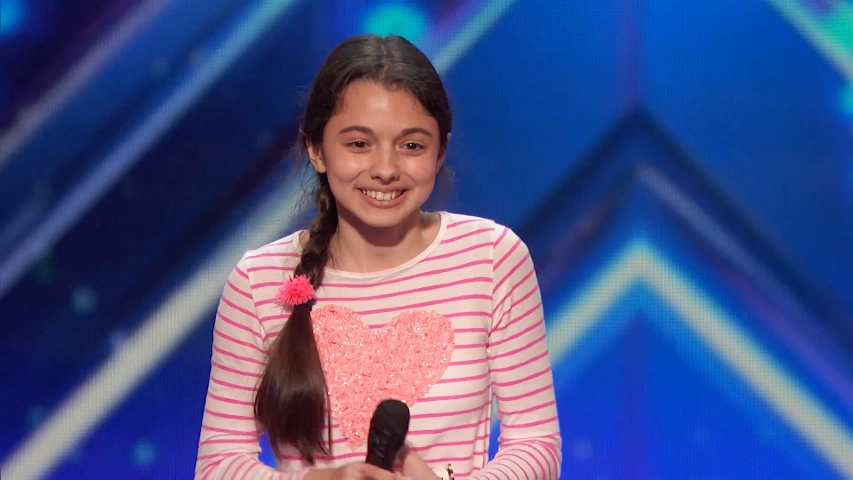
When thirteen-year-old Laura Bretan walked onto the America’s Got Talent stage, she carried all the usual signs of someone far younger than the huge moment they were facing: a tentative smile, slightly trembling hands, and the kind of wide-eyed awe you’d expect from an eighth-grader standing in front of millions. The bright lights seemed almost too loud, and for a few seconds it looked like the pressure might swallow her whole. She answered the judges’ initial questions in a soft, breathy voice, each word tinged with nervousness. You could see it in the way she hugged the microphone, as if the small metal cylinder were both an anchor and a shield. For everyone watching — from the studio audience to viewers at home — she embodied a combination of vulnerability and quiet determination.
Then she began to sing. The shift was immediate and electrifying. The fragile, hesitant girl who had been speaking just moments before was replaced by a commanding presence with a voice so large and so perfectly controlled it seemed to belong to someone far older and much more experienced. Her tone carried tonal clarity and effortless vibrato; every phrase arced with intent, every line landed with professional accuracy. It was not merely that she hit notes high and true — it was the emotional weight she brought to the music, the way she opened her throat for a full, resonant sound yet never lost the lyric’s intimacy.
From the judge’s table to the back row of the auditorium, people leaned in. Simon Cowell, known for his blunt assessments and rare enthusiasm, watched with an expression that shifted from skepticism to stunned astonishment. He later confessed that, in all his years of judging, he had never seen such a stark transformation: Laura went from a “jelly” of nerves into what he described as a world-class vocalist practically mid-performance. That reaction said a lot, because Simon’s bar is high and his praise is given sparingly. Other judges mirrored his amazement — mouths slightly open, eyes bright, some wiping away tears as the final notes lingered in the air.
The performance itself was a study in control and mature musicality. Laura negotiated challenging runs and sustained high notes with the kind of breath support and placement that even seasoned singers work years to develop. Yet she never sounded contrived; there was a sense of naturalness to her interpretation, as if the emotional center of the song resided inside her and simply found the right vehicle to come out. Small touches heightened the moment: the way she closed her eyes at certain phrases, as if recalling a memory; the subtle rise and fall of her shoulders as she navigated long phrases; the delicate hand gesture when a climactic line arrived, a teenager’s instinct to physically embody the music without overdoing it.
The audience’s reaction amplified the performance in a visceral way. Initial polite applause gave way to a stunned, sustained silence during the final passage, and then to thunderous cheers and a standing ovation that seemed to sweep the entire theater. People in the crowd could be seen dabbing at their eyes, while officials and stagehands exchanged incredulous smiles. It was one of those rare live-television moments where the collective intake of breath felt like part of the drama: viewers everywhere paused, rewound, shared clips, and discussed what they’d just witnessed. Social media lit up almost instantly, with fans and music critics alike praising the rare fusion of technical excellence and heartfelt expression that Laura displayed.
Perhaps the defining instant came when Mel B, visibly moved and reckless with emotion, reached for the Golden Buzzer. It’s a dramatic choice in any season, but for a judge to bypass standard voting and literally change the course of a contestant’s trajectory speaks volumes. As the gold confetti exploded and drifted down, Laura’s face dissolved into tears — not merely from the shock of the moment but from the relief and joy of being seen and validated on such a massive stage. The Golden Buzzer sent her straight to the live shows, but it also served as a symbolic crowning: a young artist whose singular talent and bravery had been recognized in the most public of forums.
Beyond the spectacle, Laura’s audition resonated because it challenged assumptions. She was small, young, and visibly nervous, yet the sound that poured from her was enormous and impeccably controlled. The episode reminded viewers that talent can arrive in unexpected packages, and that youthful humility and technical prowess are not mutually exclusive. For many, her audition was an emotional antidote to cynicism about talent shows — a reminder that genuine artistry and raw human feeling still find a way to cut through polished production.
When the lights dimmed and the confetti settled, what lingered was not just applause but the sense that something rare had been witnessed: a moment of emergence for a young singer who, despite visible fear, allowed her voice to speak louder than her nerves. Laura Bretan’s audition didn’t just earn her a place in the competition; it opened a conversation about potential, surprise, and the transformative power of music — and it left an indelible imprint on anyone who heard it.