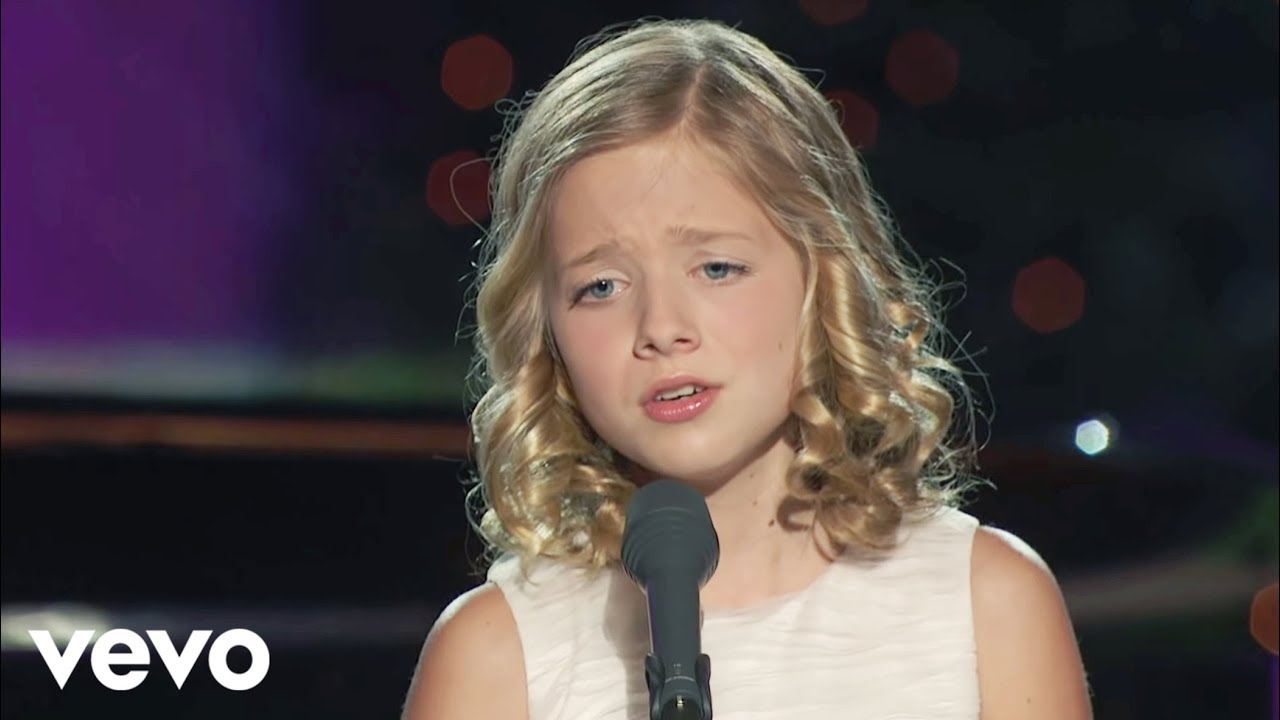
When Jackie Evancho walked onto the America’s Got Talent stage at just ten years old, there was nothing ostentatious about her entrance. She wore a simple dress, her hair neatly parted, and carried herself with the kind of quiet, polite composure more often associated with a student waiting to be called on than a performer about to stun a national television audience. Introduced as a Pennsylvania girl discovered via a YouTube clip, she looked every bit the ordinary kid the producers had described — which only made what came next more disorienting for everyone in the room.
The first few notes dissolved any doubt. Jackie opened with a purity and control that seemed to belong to someone twice her age, if not older. Her tone was crystalline and steady, with an evenness of breath support that most adults spend years developing. As she moved through the piece, the voice swelled with the kind of placement and resonance classical singers work to achieve in conservatories. Yet none of it felt forced or artificial; there was a disarming simplicity to her phrasing, as if she were simply telling the story of the song rather than flaunting technical prowess. That combination — peerless technique wrapped in modesty — is rare, and it transformed the auditorium’s air from casual anticipation to stunned silence.
Watching the judges was almost as compelling as watching Jackie. Howie Mandel, normally quick with jokes and quips, sat frozen, eyes wide and hands folded in his lap as if afraid to break the spell. Sharon Osbourne and Piers Morgan exchanged looks that mixed disbelief with an unmistakable affection, leaning forward at the same moments the audience did. Their facial expressions tracked the performance like readings on a meter, rising with each sustained high note and visibly softening during reflective phrases. When she hit the climactic passages, the panel’s collective reaction moved from astonishment to something almost parental — protective delight for a talent so precocious.
The courtroom-like quiet that fell over the theater wasn’t empty; it was full of people listening closely, rapt. You could hear the intake of breath when she launched into particularly demanding passages and the murmur of approval that followed her perfectly tuned cadences. The contrast between Jackie’s small physical presence and the enormity of sound she produced created an almost cinematic effect: the eye of a child anchoring a voice that seemed to come from another era. That contrast, more than anything, fed the sense of wonder that made the audition viral almost immediately.
Predictably, the internet and the public didn’t simply applaud; they interrogated what they’d seen. Viewers couldn’t reconcile the seamless delivery with the image of a ten-year-old, and a chorus of sceptics raised the possibility of playback. The show’s producers and judges took the doubt seriously. To lay rumours to rest, Jackie was asked to perform an impromptu note during the results show — live, unaccompanied — and she delivered it with the same clarity and control, silencing any lingering questions. That off-the-cuff moment reassured a jittery public and reinforced the reality of what had already been evident on stage: this was a genuine, extraordinary talent.
Beyond the technicalities, Jackie’s audition had emotional legs. Viewers responded not only to the sound but to the vulnerability behind it: a small girl trusting a giant stage with something deeply personal. Her brief interview before and after the song added texture — the slight, honest smile when she was complimented, the polite nods to the judges’ praise — which humanized the phenomenon. People weren’t simply marveling at a spectacle; they were rooting for a kid whose talent arrived wrapped in humility.
The result was predictable but no less significant. Jackie advanced easily to the semi-finals, buoyed by the highest number of viewer votes. From there, recordings, appearances, and opportunities multiplied. Yet the original audition remains distinct because it captured a very specific cultural moment: a collision of childhood innocence and mature artistry that few had seen before. Clips of that performance circulated endlessly, used in compilations and reaction videos, and each replay seemed to amplify the original astonishment.
More than a viral clip, Jackie Evancho’s audition became a touchstone for debates about prodigy and practice, authenticity and spectacle. It forced audiences and critics alike to confront assumptions about age and ability, and it opened a conversation about how talent is recognized and nurtured in the digital era. For a few minutes on a summer night, viewers witnessed the alchemy of music at its most surprising — a ten-year-old whose voice seemed to defy expectations and, in doing so, helped an entire audience believe anew in the possibility of wonder.