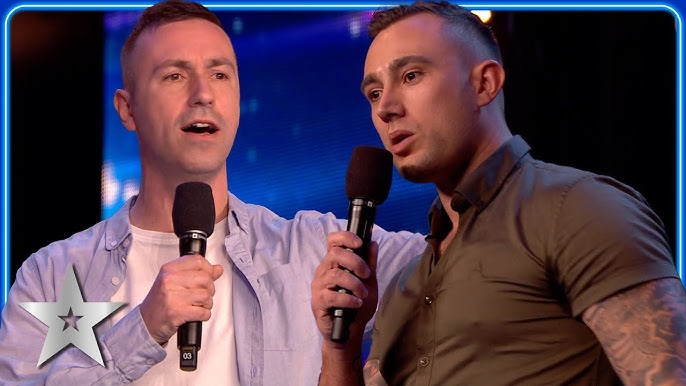
When Vince and Lee — two army veterans who call themselves the Soldiers of Swing — stepped onto the Britain’s Got Talent stage, there was an immediate sense of goodwill from the crowd. Their uniforms and easy camaraderie suggested a story worth listening to, but first impressions can be deceiving. The duo’s initial song choice felt oddly lightweight for such a dramatic backdrop: it came across as a bit casual and, as Simon Cowell later put it, “throwaway.” What followed was a rare and uncomfortable moment of silence in the audition room. The audience, polite but puzzled, shifted in their seats, while the judges exchanged looks that read more like concern than encouragement. For a pair of men who’d faced real pressure in service, this was a pressure of a different kind — one measured in seconds on live television and in the unforgiving court of public opinion.
Despite the flat start, something quieter was happening onstage. Vince and Lee didn’t panic; they listened to feedback, met each other with a steadying glance, and gave the impression of two people who had weathered storms and knew how to steady one another. The producers and Simon’s team murmured among themselves, and then something unexpected occurred: Simon offered them another chance. It was a rare invitation, and one that came with unspoken stakes. A second attempt on a show like this can be a make-or-break moment — either it redeems a shaky opening or it cements the memory of a misstep. For the Soldiers of Swing, it would be the former, but the path there required courage and recalibration.
What followed felt like the clearing of a fog. They picked “Luck Be a Lady,” a song with swagger and theatricality that suited their easy rapport and allowed them to show off more harmonies and presence. From the first bars, the transformation was palpable. Their faces shifted from tentative to focused, and their bodies loosened into the rhythm. Vince’s phrasing softened a previously clinical delivery into something with swing and charm, while Lee’s backing lines tightened into the kind of supportive harmony that elevates every chorus. They balanced the song’s bravado with a warmth that made it feel like a conversation between old friends rather than a rehearsed act.
The room responded in real time. Where there had been polite applause before, now there were gasps and laughter and a growing roar of appreciation. The judges, too, visibly shifted. Simon — who had been visibly critical just minutes earlier — sat forward with a new look in his eyes: attentiveness mixed with surprise. He caught himself smiling at a well-placed flourish; it was the kind of involuntary reaction that signals genuine enjoyment. Other judges nodded along, mouthing words and tapping feet, clearly taken by how quickly the duo had recalibrated and owned the stage.
There were small, telling details in the performance that helped cement the turnaround. Vince and Lee played to each other in ways that felt instinctive: a shared grin mid-verse, a dramatic step toward one another before a harmonized line, and a perfectly timed eyebrow raise that elicited laughter from the crowd. Those moments weren’t gimmicks; they were evidence of real chemistry borne from years of shared experience. You sensed that the trust they had built in uniform translated to the stage — that when life had demanded synchronicity and reliance, they had learned to rely on one another. It turned their act into something authentic and magnetic.
By the final chorus, the auditorium was on its feet. The standing ovation felt less like relief and more like celebration — a recognition that the duo had not only redeemed themselves but had delivered something memorable. Judges rose alongside the audience, and the panel’s comments reflected a shift from skepticism to admiration. They praised the Soldiers of Swing for their resilience, their newfound showmanship, and the warmth that made the performance stand out. Simon went so far as to admit he’d been wrong to write them off initially, acknowledging that their second chance had revealed depth and potential he hadn’t foreseen.
The narrative that followed their audition contributed to the viral nature of their success. Clips circulated that juxtaposed the awkward opening with the triumphant second performance, and the contrast made for compelling viewing. Social media users praised the duo for their humility and for making the most of a rare opportunity to correct course under pressure. For many viewers, the story resonated beyond the music: it was a reminder that talent sometimes needs the right moment to shine, and that judgment based on a single impression can be premature.
In the end, the Soldiers of Swing didn’t just survive an awkward start — they turned it into a defining moment. The audition became an emblem of redemption: two veterans who, when given one more chance, transformed a near-disaster into a career-launching performance. Their journey through that audition room was a compact drama of risk, resilience, and reward — proof, if proof was needed, that sometimes all it takes is a second chance and the courage to seize it.