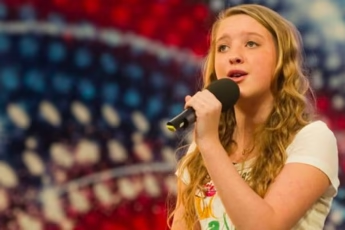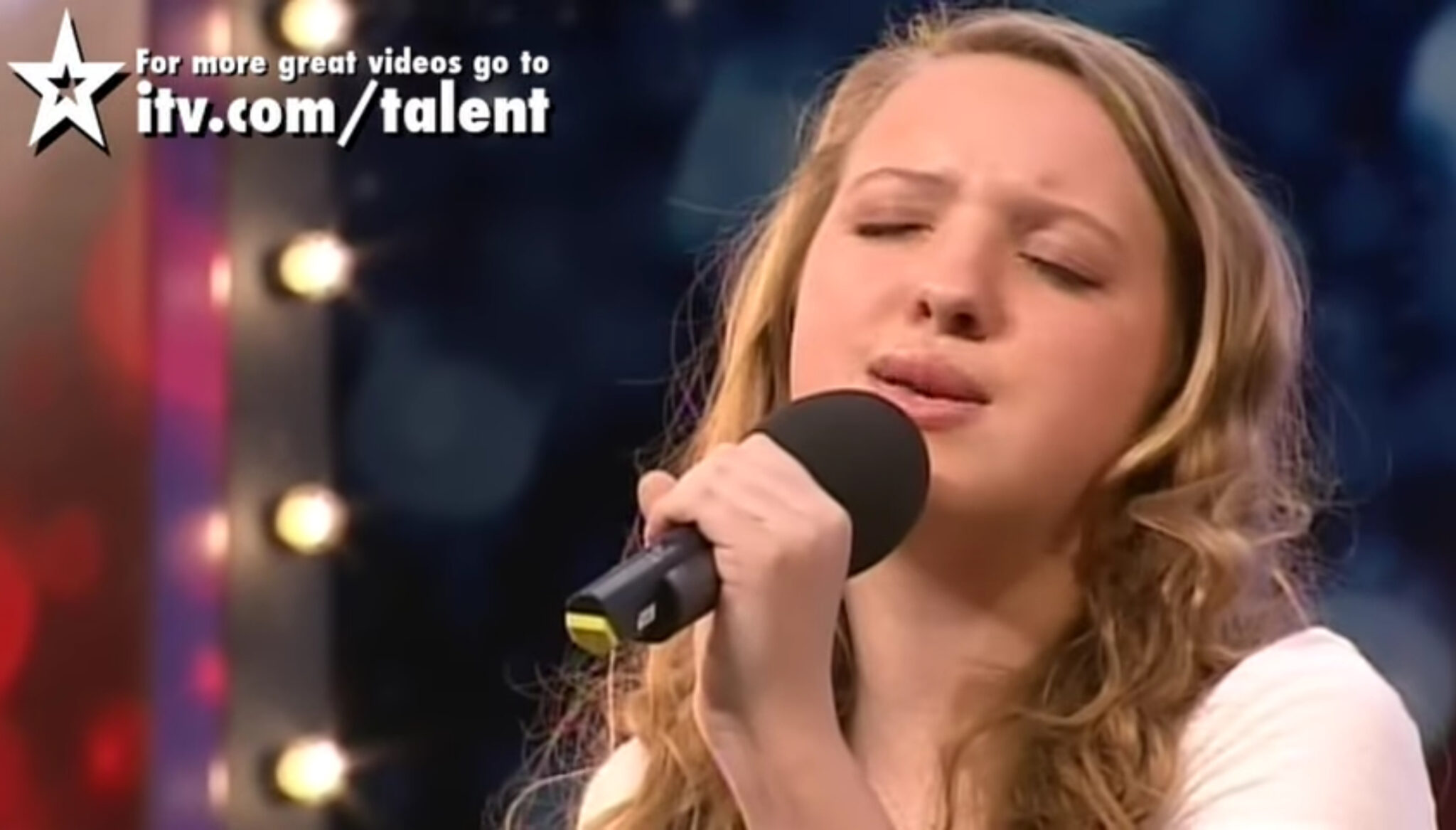
When thirteen-year-old Olivia Archbold walked onto the Britain’s Got Talent stage, she carried with her a quietness that felt more like a soft breeze than nerves. Dressed simply and with her hair tucked neatly behind her ears, she spoke in a voice that was polite and reserved, confessing that she dreamed of becoming “an actual star.” That small, earnest line landed with a surprising weight; here was a kid who carried ambition lightly but sincerely. She admitted, with a shy smile, that she was rarely without a song — humming in the hallway, singing on the stairs, even sneaking melodies through math class. Those offhand details painted a picture of a girl for whom music was not a hobby but a constant companion.
Still, the reality of stepping into a huge studio under bright lights and in front of millions cannot be understated. Olivia’s family, seated in the audience, watched her with visible pride and a little apprehension; they knew the challenge that lay ahead. Backstage, she had admitted to feeling nervous, and even as she stood at the microphone you could see a tremor of uncertainty in the way she clasped the stand. That mix of vulnerability and quiet determination made the moment feel intimate rather than theatrical. The room seemed to wait with her, sensing that this wasn’t going to be a flashy audition — it would be something more modest, personal, and perhaps unexpectedly moving.
Choosing “In the Arms of the Angels” was a bold move for someone so young. The song, steeped in longing and tenderness, asks for emotional truth as much as vocal beauty. When Olivia lifted the first phrase, however, something remarkable happened: the shyness that had defined her presence softened, and her voice unfolded into a tone both pure and hauntingly sincere. It wasn’t an attempt to imitate the original so much as a heartfelt delivery that honored the song’s sentiment. Her voice carried a clarity and warmth that made even the quietest lines resonate, and as she moved through the melody, the auditorium leaned in as if the words were being spoken directly to each listener.
Technically, Olivia surprised listeners with more than gentle phrasing; there was a maturity in her breath control and dynamic range that many singers twice her age still struggle to achieve. She navigated the song’s long, arching phrases with careful pacing, knowing when to hold a note and when to let it breathe. Her vibrato was tastefully restrained, adding color without calling attention to itself. Moments that could have easily become forced, like the climactic crescendos, were handled with restraint and musicality, allowing the emotional content to shine through rather than a show of vocal gymnastics. Little gestures — a slight tilt of her head, a downcast look at the final phrase — punctuated the performance, signaling a performer who understood how to convey nuance.
The audience’s reaction evolved in real time. What began as polite applause turned into a tangible swell of emotion; by the time she hit the most heartfelt passages, many people in the crowd were visibly moved. There is something about a young voice carrying a heavy, adult song that tugs at listeners’ empathy — it’s the collision of innocence and understanding. Olivia’s family members were among the first to show their emotion, exchanging looks of astonished pride that mirrored the audience’s growing admiration. That collective response made the final note feel less like the end of a performance and more like a shared moment of recognition.
When the judges offered their feedback, the praise was heartfelt and immediate. Amanda Holden described Olivia’s voice as “utterly beautiful,” and her tone suggested genuine surprise that the girl standing before them might not fully realize the extent of her gift. Amanda’s comment carried a mix of affection and a gentle nudge: this talent deserved to be recognized and cultivated. Piers Morgan, who often reserved his strongest remarks for the most confident acts, acknowledged the risk Olivia had taken in tackling a song so large for her age. He pointed out that many young performers choose material far beyond their years and falter, but in Olivia’s case, she had managed to make the song her own — a rare and impressive feat.
Despite still trembling slightly with nerves during the critique, Olivia stood composed as the judges articulated what viewers had already felt: this was a performance rooted in honesty more than spectacle. The unanimous “yes” votes that followed were not surprising; they felt like an inevitable affirmation of a moment that had already touched many. Securing her place in the next round, Olivia left the stage not with the loud bravado of a seasoned showman, but with the quiet assurance of someone who had just taken an important step forward.
Beyond the immediate accolades, Olivia’s audition suggested something more enduring. She showed that emotional maturity and musical sensitivity can coexist with the natural vulnerability of adolescence. In a world that often demands polish and precociousness, her performance stood out for its authenticity. The image of a soft-spoken thirteen-year-old managing a vast, emotive piece and winning over both the crowd and the critics stayed with viewers long after the cameras stopped rolling. For Olivia Archbold, those few minutes on the Britain’s Got Talent stage were less about spectacle and more about revelation — the discovery of a voice and a presence that, nurtured and guided, could carry her far.