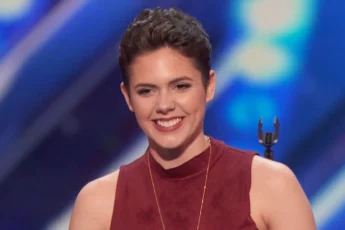

Tamera Foster walked onto The X Factor arena stage with a mix of determination and visible nerves, every step echoing in the cavernous space. The audience’s murmurs swelled and then fell away as she stood center stage, microphone in hand, the spotlight tracing her figure. For viewers who remembered her from Silver Rock, the sight of her alone was a reminder of the gamble she had taken — leaving a successful duo to test her wings by herself. That context made the moment feel heavier than a standard audition: this was a declaration, a do-or-die bid to prove she could carry a performance and an entire career on her own.
From the beginning, it was clear that Tamera understood the stakes. Her decision to perform “I Have Nothing” by Whitney Houston was a bold, almost fearless choice. It’s a song that demands technical precision, emotional honesty, and dramatic presence, and it invites inevitable comparisons to one of the greatest voices of a generation. Choosing it was a statement that she wasn’t afraid to be measured against the best — a risky move, but one that promised a big payoff if she succeeded. As the opening chords swelled, the audience hushed, and you could feel the tension in the room shift from curiosity to focused attention.
Tamera’s performance unfolded like a carefully constructed narrative. She didn’t rush into power for the sake of drama; instead, she let the verses breathe, delivering the quieter moments with a tenderness that made the song’s plea feel sincere rather than performative. In those softer phrases, small details stood out — the way she closed her eyes for a beat as if picturing the song’s pain, the subtle tremor in her hand that hinted at vulnerability, and the controlled intake of breath before she launched into the climactic runs. Those choices revealed a performer who knew how to shape a song emotionally, not just hit the notes.
As the arrangement built toward the chorus, Tamera’s voice gained steam, revealing a surprising blend of richness and clarity. The power notes landed with authority; the difficult sustained high notes were met with control rather than strain. It was this balance — strength married to technique — that made her performance compelling. At a few pivotal moments she added tasteful flourishes, not to show off, but to convey the intensity of the lyrics. The audience responded in kind: breaths were held during her biggest phrases, then released into applause that grew louder with each phrase she conquered.
Beyond mere vocal prowess, what set Tamera apart was her stage presence. She moved with purpose, not with distracting theatrics. Her gestures matched the emotional content of the song: a raised hand at a plea, a step forward during an emotional crescendo, a slight lowering of her head when the lyrics turned inward. Those gestures told a story — of regret, of longing, of someone laying their heart bare. It’s a skill often overlooked in singing competitions, where vocal fireworks can sometimes eclipse interpretive subtlety. Tamera’s control of both voice and movement signalled a performer who understood the difference between singing and truly communicating.
The judges reacted as the performance reached its peak. Their expressions shifted from watchful to visibly impressed. You could see that they were not simply evaluating technical ability; they were responding to how convincingly Tamera had inhabited the song and, by extension, the role of a solo artist. When the final note hung in the air and the last echo faded, the arena erupted into applause, a mix of relief and admiration. That ovation felt like a communal exhale — the audience acknowledging not only a great performance, but a successful transformation.
For Tamera, the result went beyond a single hit or a standing ovation. It confirmed that she could transition from being one half of Silver Rock into a solo act with its own identity and gravitas. The success of that audition rested on more than bravado; it was the product of deliberate choices: selecting a song that could showcase range, pacing the delivery to maximize emotional effect, and inhabiting the stage with quiet authority. Together, those elements created a performance that balanced risk and reward perfectly.
In the days after the show, the audition was widely discussed not merely for its vocal fireworks but for the narrative it represented: a young artist choosing solitude and vulnerability over the safety of partnership. Tamera’s rendition of “I Have Nothing” became a touchstone for what it looks like when an artist steps into full ownership of their craft. It suggested that sometimes the most courageous act isn’t belting the highest note, but knowing which moments to soften, which to hold, and how to make an entire room feel the journey with you. Her solo debut on that stage didn’t just win approval from the judges — it announced the arrival of a solo performer who had learned how to command attention not by volume alone, but by truth and presence.