
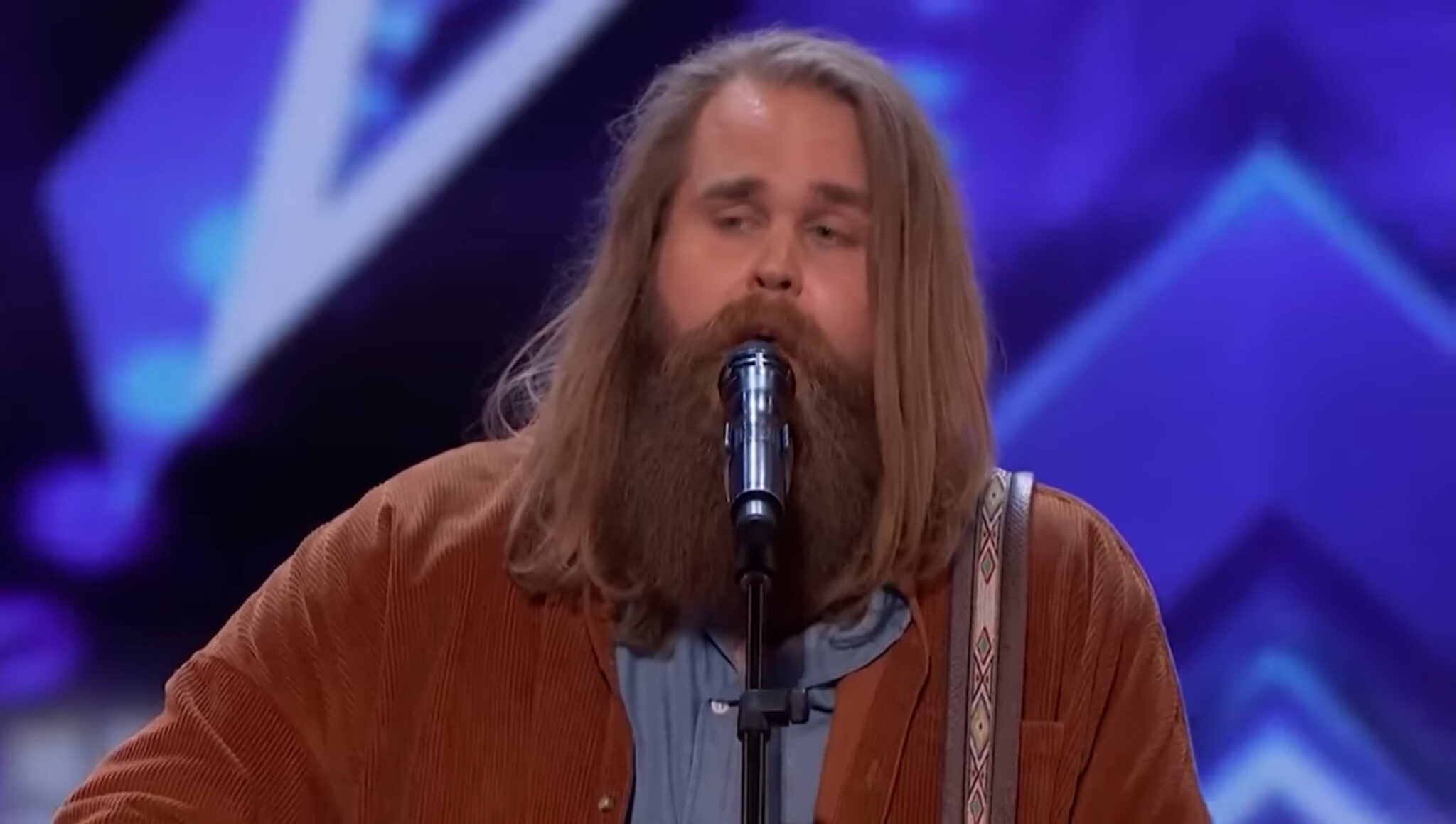
Chris Kläfford’s journey to the America’s Got Talent stage began far from the bright lights and roaring crowds—in a small village in Sweden where the rhythm of life is steadier and music often grows out of shared living rooms and local pubs. He arrived carrying the sort of quiet confidence that comes from years of playing for intimate audiences: a humble smile, a modest introduction about his love for music, and an almost offhand comment that his earliest inspiration came not from balladeers but from rock bands like Kiss. That contrast—rock-star roots and a gentle, unassuming presence—set the stage for something unexpected.
He spoke softly when he introduced himself to the judges, not trying to command attention with bravado but letting curiosity and intrigue build naturally. You could see in his hands the calluses of someone who’d spent hours with a guitar and a microphone, learning how to coax emotion from melody rather than relying on showmanship. He had traveled thousands of miles for this moment; the distance between his village and the audition stage was more than physical, it represented a leap from familiar rooms to a global platform. Yet he carried no pretense—only an honest wish to share a song that meant something to him.
When he took his place and chose John Lennon’s “Imagine,” there was an immediate sense that he wasn’t there to perform a faithful copy. Instead, he intended to translate the song through his own experiences and voice. The first chords arrived not as a polished, studio-perfect opening but as something raw and simple, like a confession. His arrangement stripped away anything decorative, leaving the melody exposed and vulnerable. In that space his voice filled the theater: warm, slightly rough around the edges, and loaded with a truth that made the familiar lyrics feel newly intimate.
Small details in his delivery made the rendition feel deeply personal. He softened certain lines as if letting them linger in the air, allowing listeners to absorb their meaning. On other phrases he leaned into the emotion, adding a rasp that suggested lived experience rather than theatrical affect. His phrasing bent and breathed in ways that made the song sound less like a cover and more like an interpretation—one shaped by late nights, quiet reflection, and an earnest desire for connection. He sang not to impress but to reach across the room and touch something inside each person listening.
The audience’s reaction shifted almost imperceptibly from polite listening to rapt attention. People who had been chatting nervously fell silent; you could feel the room tighten around the performance as if everyone were holding their breath. Judges who are used to spectacle and bravado found themselves drawn into the small, human moments Chris offered. Faces softened. One judge closed his eyes, moved by the vulnerability. Another placed a hand on the table, as if anchoring themselves to the reality of what they were hearing. The kind of performance that stays with you doesn’t always dazzle—it simply makes you remember you’re alive—and that’s precisely what happened.
By the time Chris reached the song’s quieter passages, the emotional weight in the theater was tangible. Tears began to appear, first in the audience and then on the judges’ faces. It wasn’t melodrama; it was an honest, collective response to something that felt sincere and unvarnished. His voice carried the wistfulness of longing and the strength of conviction at once, and that delicate balance is what made the moment land so powerfully. When he finished, there was a breathless pause—an instant of stunned silence in which the magnitude of what had just been shared could fully register.
Then the applause erupted, growing quickly into a standing ovation. People rose not because it was expected, but because the performance had moved them in a way that demanded acknowledgment. Chris himself became emotional, visibly affected by the response he’d elicited. It was a full-circle moment: a young man from a quiet place had stepped onto a massive stage and offered something so genuine that it resonated across cultural and geographic lines.
The judges’ comments afterward reflected the rawness of the experience. Simon Cowell called the performance “touching,” a succinct but resonant appraisal coming from a man known for his often blunt honesty. Howie Mandel praised Chris for reinterpreting such a well-known song rather than simply imitating it, commending the courage it takes to make a classic your own. Their praise, along with the reactions from the other judges, wasn’t just about technical skill; it was an acknowledgment that Chris had managed to translate personal truth into a universal language.
When the votes were counted, all four judges said “yes,” a unanimous decision that sent him through to the next round. But beyond the competition outcome, what lingered was the reminder that music’s power lies in its ability to bridge gaps—between towns and continents, between strangers and performers, and between memory and feeling. Chris Kläfford had flown a great distance to audition, and with one deeply felt song, he proved that travel is measured not just in miles but in moments that change the way people listen.