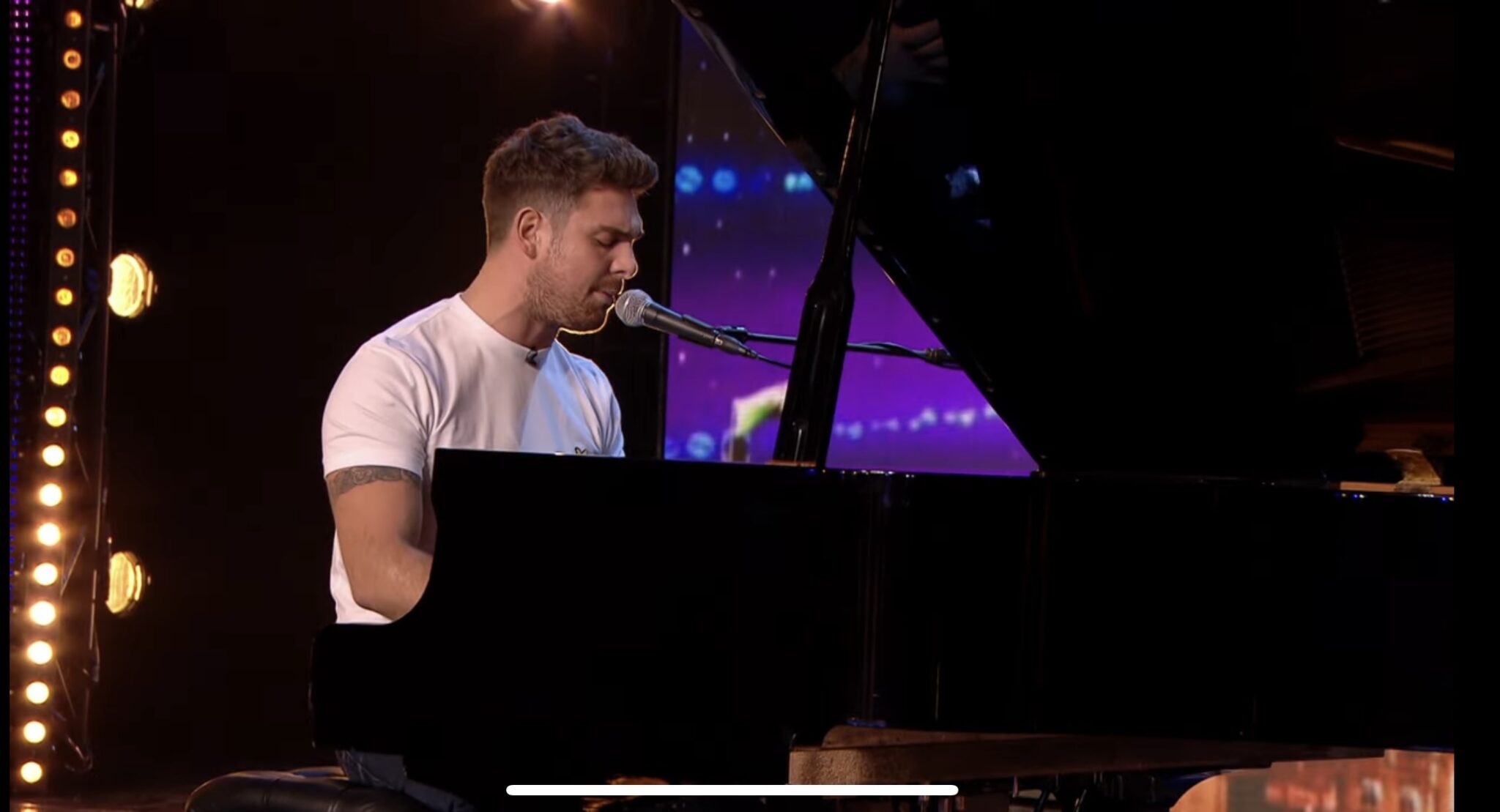
Josh Curnow, a 26-year-old singer-songwriter and guitar player from Cornwall, carried more than just his guitar onto the Britain’s Got Talent stage — he carried a story that explained why this performance meant so much. He had his girlfriend beside him in the wings, a quiet show of support that made the moment feel intimate despite the bright lights and large audience. What began as a simple audition quickly became an emotional statement about perseverance, identity, and the small, pivotal decisions that shape a life.
From an early age Josh knew he learned differently. Diagnosed with dyslexia when he was young, he spent years navigating classrooms where words and instructions sometimes felt like moving targets. Instead of smoothing the rough edges, though, one teacher’s blunt advice left a scar: give up on music and choose a more conventional path. It was intended as practical guidance, the sort of well-meaning but short-sighted counsel that can come from adults who see risk where a child sees a calling. For Josh, the comment could have been a full stop. Instead, it became a challenge.
He didn’t need to build a dramatic backstory to make his point — his playing and songwriting do that for him. Onstage he chose to perform an original piece that captured the fragility and complexity of living with thoughts that don’t always feel trustworthy. The lyrics explored paranoia and intrusive thoughts, the kind of honest, specific detail that makes a song land in the listener’s chest. His voice, a distinct husky timbre, carried those words with an aching clarity. There was a moment in the performance where he shifted a chord and leaned into the line, and it felt less like a singer showing off and more like someone holding up a mirror to his own experience.
Small details made the audition feel real and lived-in: the way he tuned his guitar a beat longer than necessary, the slight nod to his girlfriend when the last note faded, the hush that fell over the studio as people listened instead of clapped. Judges and viewers could sense that this wasn’t a manufactured moment; it was a piece of Josh’s life laid bare. Instead of running from the diagnosis that had framed so much of his schooling, he used it as context, showing how dyslexia hadn’t been a barrier to creativity but rather a part of the landscape he’d learned to navigate.
The teacher’s advice — “give up on music” — is one of those sentences people remember for a lifetime. It’s blunt, reducing an entire possibility to a single line. For Josh, it might have been easier to follow that script: pick a steady job, avoid the late nights and uncertainties, accept a path someone else had thought out for you. But the refusal to abandon music wasn’t merely stubbornness. It was a slow accumulation of decisions — staying after practice, writing another verse when the first felt flat, singing in small pubs and local festivals around Cornwall until his songs fit together the way he wanted them to. Those incremental steps made the Britain’s Got Talent stage less like a risky leap and more like the next step on a road he had been paving for years.
There’s a particular kind of courage in playing your own songs to strangers. Covers are familiar and comforting; originals expose the songwriter’s inner life. Josh’s choice to sing a vulnerable, original track communicated his confidence in his craft and his readiness to be seen as more than a hopeful amateur. He hoped, candidly, that the audition would help him reach the “next level” — not as a boast but as a practical aim: wider audiences, more opportunities to record, and the chance to make music his full-time work.
The reaction was telling. People in the crowd leaned forward; a hush replaced the usual mid-song chatter. When the last note lingered and the applause rose, it felt earned. His girlfriend’s smile said what words might not: pride, relief, and a shared sense that the risk had been worth it. Backstage, the simple act of being supported by someone close can fortify a person more than any critique or accolade. For Josh, that presence was a reminder of why he kept going through years of doubt.
His audition wasn’t just a single performance; it was a message. It said that labels like dyslexia don’t define a person’s potential and that a teacher’s doubt doesn’t have to become a self-fulfilling prophecy. It was a testament to resilience — to the small daily choices that add up to a life shaped by passion instead of fear. For anyone who has been told they aren’t suited for their dreams, Josh’s story is a quiet encouragement: keep writing, keep playing, keep showing up. You might just change your life, one chord at a time.