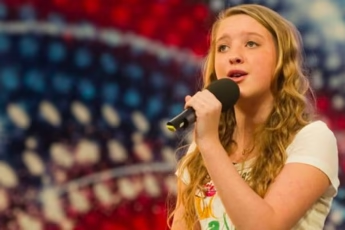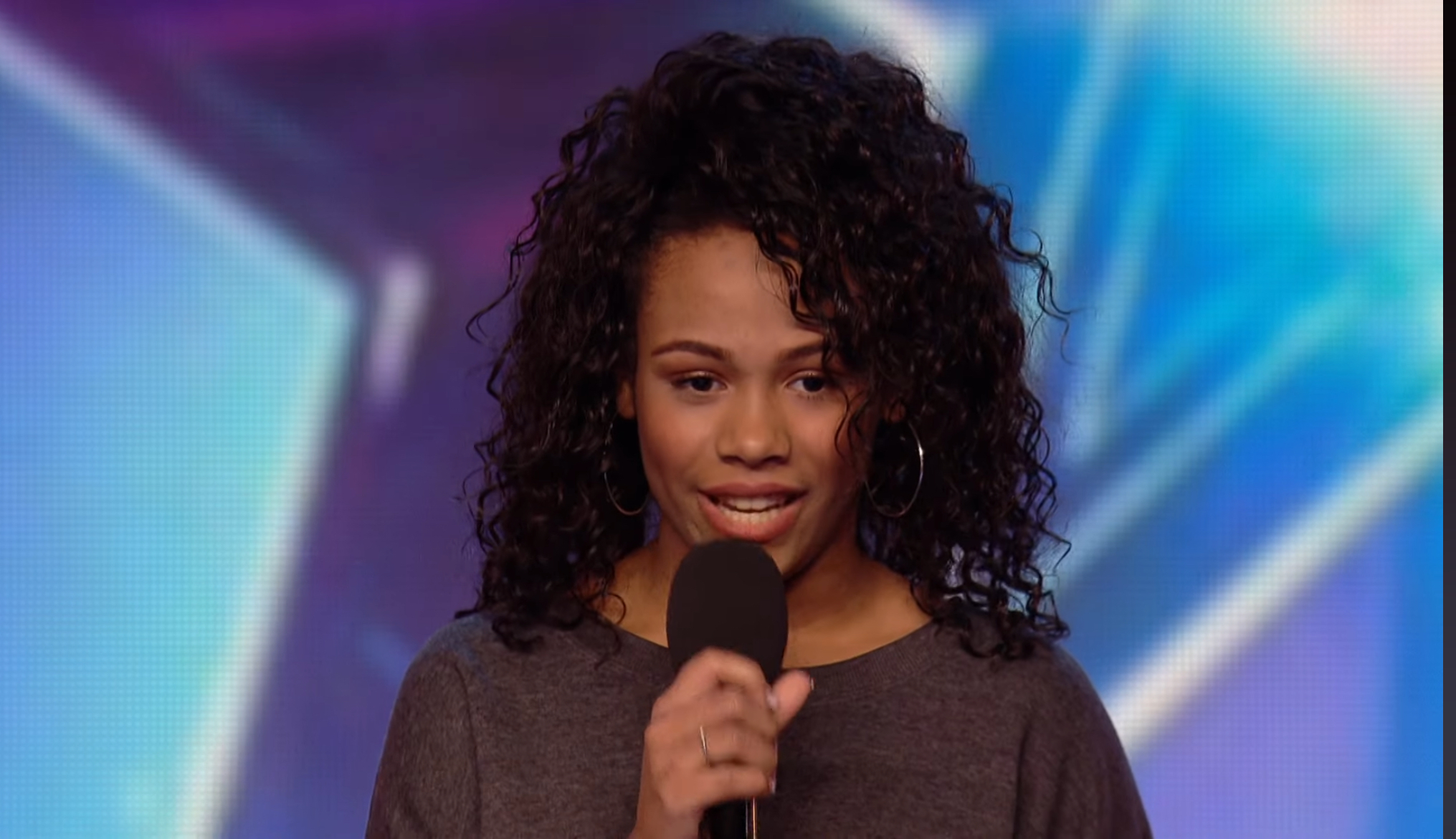
Fifteen-year-old Morgan Smith from Watford walked onto the Britain’s Got Talent stage with a calm determination that masked the nerves she admitted to feeling. For someone so young, her ambition was strikingly clear: she dreamed of one day singing for the Royal Family, a goal that sounded lofty but sincere when she spoke about how much music meant to her. She confessed she feared freezing on stage — a worry that made her hesitant as she took her first breath — but the show was a chance she felt she had to take. With that fragile bravery, she launched into Jennifer Hudson’s “Spotlight,” a contemporary powerhouse choice meant to showcase range and presence.
The first few bars revealed solid technique, but the judges seemed unconvinced the song was revealing Morgan’s best self. It’s a risky thing to open with such a big number when you’re still settling into the lights, and the initial performance felt a touch cautious rather than fully inhabited. Simon Cowell, ever attentive to not just what contestants sang but how they connected to a song, decided to step in. He stopped the music politely and asked Morgan to try something different — not as a rebuke, but as a nudge toward a deeper truth. He suggested she sing “I’d Rather Go Blind,” the classic Etta James ballad, and urged her to find the heart and the spirit in her delivery. Simon’s message was simple: be strong, believe in yourself, and let us feel you.
What followed was a masterclass in composure and adaptability. Asked to shift emotional gears mid-audition, Morgan didn’t crumble; she recalibrated. She closed her eyes, took a breath that seemed to center her, and began the slow, aching opening of “I’d Rather Go Blind.” The transformation was immediate. Rather than demonstrating vocal fireworks, she chose honesty: a softer approach at first, tiny inflections that made the lyric feel like a personal confession, swelling gradually into full, sustained lines. The studio quieted as if everyone had leaned forward to catch every nuance — a tribute to how she leaned into the vulnerability the song demands.
Morgan’s control and phrasing became the story of the performance. Where “Spotlight” had been about showing off power, “I’d Rather Go Blind” required emotional truth, and she supplied it. She let notes breathe, lingered on certain words, used her lower register to convey pain and restraint, and then opened into more expansive, anguished peaks at the right moments. The contrast between restraint and release made the audition feel like a dramatic arc: a frightened girl finding voice, line by line. Small details — the catch in her throat on an especially raw lyric, the slight tilt of her head as she delivered a particularly intimate line — added texture that connected with listeners beyond pure technique.
The judges’ reactions mapped that shift. David Walliams admitted he was “actually really glad you’ve come on this show,” a comment that reflected both relief and recognition; he could see a performer who could be shaped into something larger with the right guidance. Alesha Dixon praised Morgan’s untapped potential, insisting she hadn’t yet realized how truly remarkable her voice could be. Simon, whose earlier intervention had set the stage for the breakthrough, offered praise that was as measured as it was significant: he called her one of the “better singers we’ve heard on the show this year.” His words underscored the magnitude of her turnaround — from a tentative opening to a performance that convinced seasoned judges she had star quality.
Beyond the compliments, there was a sense among the panel that Morgan had discovered a pathway for herself. The audition wasn’t just about winning a round; it was about learning what repertoire suits you, how putting your heart on display can alter an audience’s response, and how confidence grows when you let emotion lead. For Morgan, the quick change of song was a crash course in those lessons. She had moved from technique-first to truth-first, and the result was a connection that felt immediate and real.
When the votes came in, Morgan secured a unanimous four “yeses,” her rocky start forgotten in the wake of a soul-stirring second performance. Walking off that stage, she carried more than a ticket to the next round; she carried an important affirmation. For a teenager who once feared freezing under the spotlight, the experience offered proof that courage and adaptability — and a willingness to be vulnerable — can turn a shaky moment into a defining one. The judges had seen a glimpse of the Royal Family performer she aspired to be, and the audience had witnessed the beginning of a young artist learning to trust her own voice.