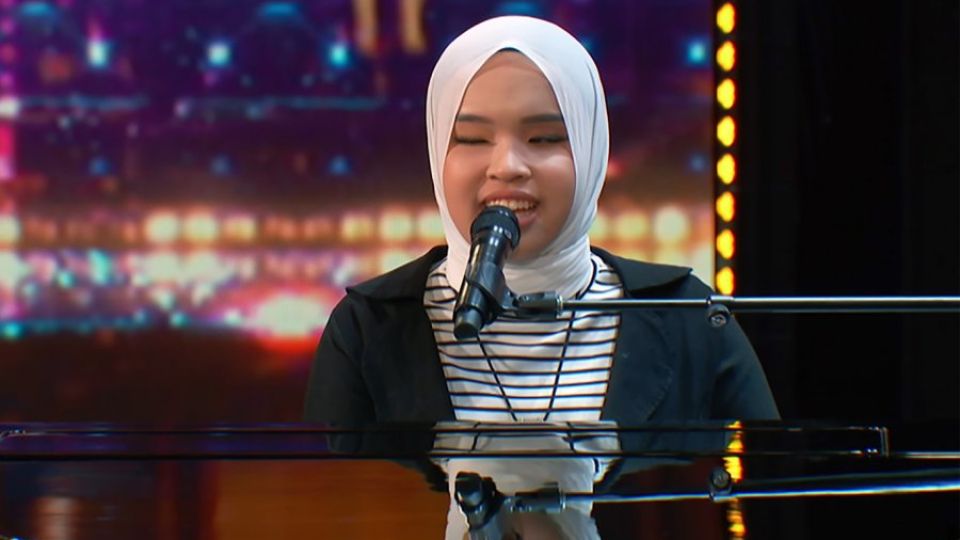
When Putri Ariani stepped onto the America’s Got Talent stage, there was an immediate sense that something special was about to unfold. At 17, she carried herself with a mix of youthfulness and quiet determination that felt both endearing and mature. She spoke openly about her dreams — ambitions that seemed to contain worlds within them: to become a globally recognized diva, to emulate the powerhouse vocal legacy of Whitney Houston, and to study at the Juilliard School of Music. These were not casual hopes; they were carefully-held goals, spoken with a calm conviction that made the audience sit up a little straighter. Her blindness, far from defining her, appeared only as one facet of a larger, fiercer identity: an artist with vision.
When she sat at the piano, the lights softened, and the room leaned in. There was a hush, not manufactured but earned, as if everyone present recognized they were about to witness the beginning of something rare. Putri began with an original composition — a brave choice for such a high-pressure moment. Original songs demand more from both performer and listener because they offer no familiar shelter. Yet she navigated that risk with the poise of someone who had spent countless hours inside music, learning how to shape phrases and tug at emotional seams. Her fingers found the keys effortlessly; small, precise movements translated into sweeping, evocative accompaniment that underpinned her vocals without overpowering them.
Her voice was the revelation. From the first line, it carved out a space of its own: bright, assured, and saturated with emotional color. There was a natural phrasing to her delivery, a way she elongated notes and softened consonants that suggested an intuitive understanding of storytelling through song. When she hit the higher runs, she did so with crystalline clarity and a maturity that belied her age. Yet she never prioritized flashiness over feeling. Instead, every technical decision seemed in service of the emotion — a gentle crescendo here, a held breath there — so that when a chorus swelled, it landed like a tide pulling the audience in.
Small details amplified the effect. A subtle tilt of her head when she lingered on a particularly vulnerable lyric. The way her shoulders relaxed in moments of musical release. The brief, almost imperceptible smile she gave when a passage landed exactly as she intended. These things made her performance human and intimate, the kind of artistry that invites the listener into a private world rather than placing them in the role of a distant spectator.
As the song wound down, applause began as polite and then swelled quickly into something more profound. The judges, often stoic and reserved, showed that they were being moved. For many viewers, the standout moment wasn’t just the technical competency — though that was extraordinary — but the sense of authenticity she brought to the stage. Here was a young woman who had poetry in her fingertips and in her throat, whose dream of Juilliard and admiration for Whitney Houston felt less like fantasy and more like a roadmap she was already walking.
Then came the moment that crystallized the performance into an unforgettable television instant. Simon Cowell, known for his crisp critiques and rarely lavish praise, rose from his seat and stepped onto the stage. He didn’t call her back for a planned encore or request a prepared reprise. Instead, moved by what he’d just heard, he asked Putri to sing a second, un-rehearsed song on the spot — an unusual and bold invitation that underscored the profound effect of her first piece. It was a gesture that carried both professional recognition and human curiosity: he wanted to see more, to know if this brilliance was consistent or merely a beautiful accident.
Putri didn’t falter. She accepted the challenge with the same calm confidence she’d shown at the outset, and what followed felt like watching an artist reveal another layer of themselves. The second song bore the spontaneity of the moment but retained the control and emotional depth that had defined her opener. She navigated transitions as if she’d been born inside them, delivering runs with taste, bending phrases for expressive effect, and inhabiting the lyrics with a clarity that made the judge’s request feel entirely justified.
The audience responded with a fervor that grew louder and more sustained, and the judges’ reactions moved through amazement to visible admiration. That evening’s performance did more than earn applause; it shifted perceptions. For viewers at home and in the theater, Putri’s audition became a vivid reminder that talent can arrive in forms society sometimes underestimates. Here was ambition matched with craft, dreams named aloud and pursued with relentless focus — a blind teenager from Indonesia who had the poise of someone already well on her way.
As she left the stage, the buzz lingered. Conversations didn’t center only on the spectacle but on what it represented: courage, preparation, and the thrilling possibility of seeing a dream take flight. Putri Ariani had not only sung beautifully; she had announced herself as an artist to watch, someone whose voice and presence could carry her toward Juilliard, global stages, and the kind of legendary status she so clearly admired.