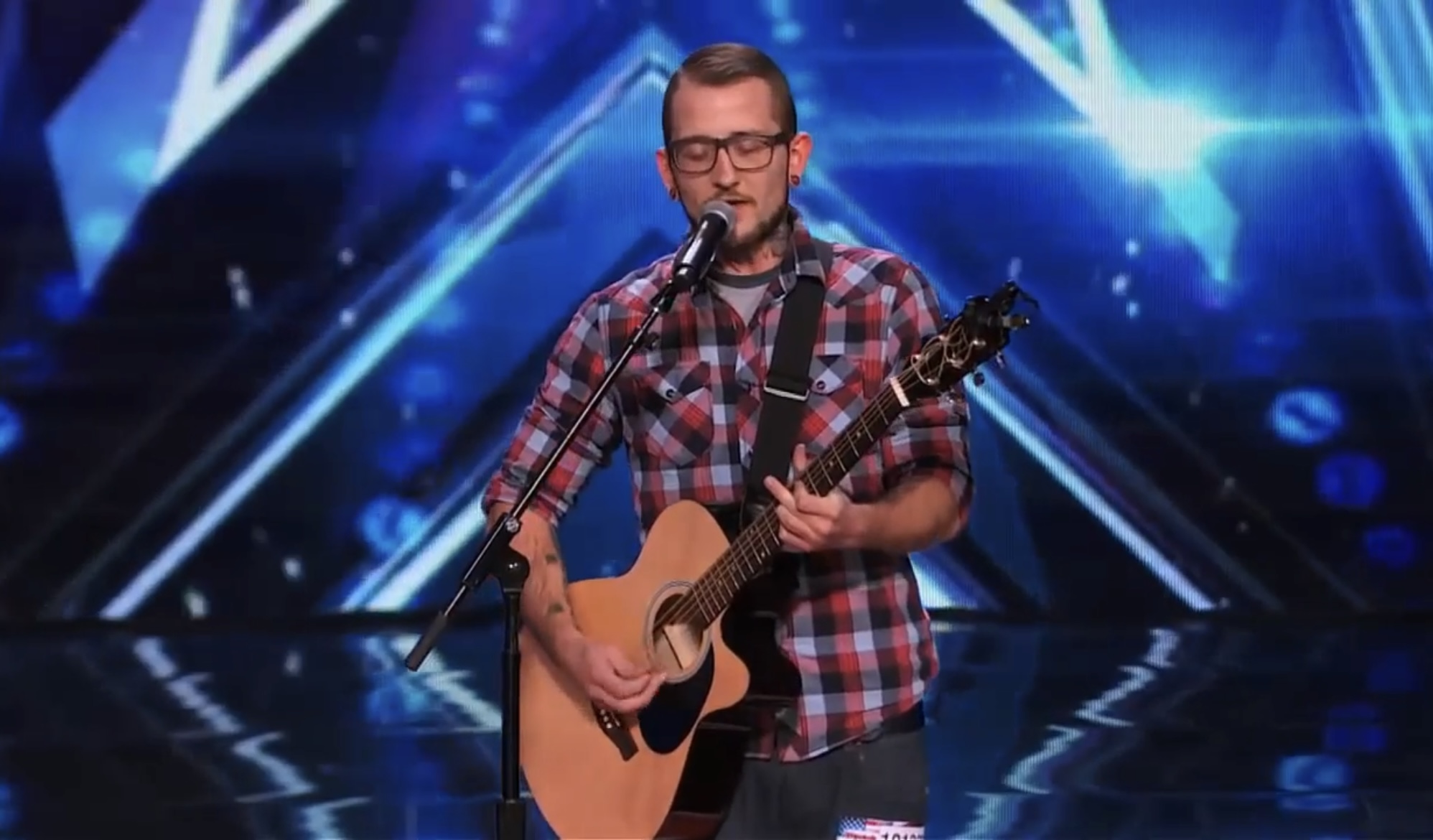
Johnny Shelton, a 25-year-old singer-songwriter from Knoxville, Tennessee, walked onto the America’s Got Talent stage carrying more than just a microphone and a guitar. He carried a story so personal and raw that you could feel the room lean in with him. Johnny didn’t come to audition for fame or a record deal that night; he came to tell the world about a love that survived the unthinkable. He explained, in a voice both steady and fragile, that his young son had died of rhabdomyosarcoma — an aggressive form of cancer — on the child’s fifth birthday. The way he said it made the air in the auditorium thin, as if everyone there had been handed a sudden, shared sorrow.
For Johnny, the loss left what he called an “empty hole” — an absence that swallowed days and words. He told the judges that after his son died, he stopped performing altogether. Music, which had once been the blood that fed him creatively and emotionally, fell silent. He described months of drifting, of living inside a quiet that felt permanent, where even simple things like stepping onto a stage seemed irrelevant. But two months before his audition, something shifted. He began to sing again, tentatively at first, as if testing the water. Those first few notes felt like reaching across a gulf; he said it was the closest he had felt to his son since the funeral. That fragile reconnection is what brought him to AGT: not to chase applause, but to fill that empty place with something positive, something his son could be proud of.
When Johnny introduced his original song, “That’s Love,” the audience already understood they were about to witness more than a performance. The song itself is simple in structure but vast in emotional reach. The lyrics speak plainly about love’s stubborn endurance — that love is not a transaction, not something you can put a price on — and, importantly, that it outlasts even death. He sings about small, human moments: how love shows up in a hand held during a hospital night, in the quiet of early mornings when the house still remembers a child’s laughter, in the way a parent keeps telling stories that keep a small life alive in memory. Those lines landed like small, honest truths, the kind that make you nod even through a lump in your throat.
Johnny’s delivery was what made the song land so hard. There’s a difference between a technically good performance and one that comes from the center of someone’s life; Johnny’s voice carried the latter. He didn’t over-sing or try to manipulate emotion. Instead, he sang like a man recounting what he’d lost and what he still had — the unbreakable thread of love. You could see the audience hanging onto each phrase, watching his hands for the little tells that betrayed a father’s grief and pride. The judges, usually reserved and measured, visibly softened. Some wiped their eyes. A hush fell over the auditorium, not the silence of awkwardness but the reverent silence of people witnessing something true.
Small details made the moment even more intimate: the way Johnny adjusted his grip on the guitar as if steadying more than his instrument, the tiny catch in his breath between lines, the fact that he introduced the song by saying it was for his son, not for sympathy. Those specifics turned the performance from an act into a shared, human moment. You could imagine late-night songwriting sessions where he scribbled lyrics on napkins, or the quiet courage it took to pick up a guitar again after months of silence. The song didn’t demand spectacle; it asked only for honesty, and in return it gave the room a mirror where everyone could see their own loves and losses reflected.
After the final chord faded, the reaction was immediate and unmistakable. The judges and the audience rose, not because they had to, but because they wanted to honor what he’d given them — a piece of himself, a testimony that grief and love can coexist. Conversations afterward centered less on technical prowess and more on bravery. People spoke about the healing power of music, how a melody can act as a bridge when words fall short, how art can keep someone’s memory present in ways nothing else can. Johnny had come with the hope of filling his void with something positive; he left having filled not just his own space but the room’s, too.
That night, “That’s Love” wasn’t just a song on a talent stage. It was a small, bright testament to the things that endure. It reminded everyone who heard it that love, even when laced with sorrow, remains an unshopppable, unstoppable force — one that survives birthdays, funerals, and the dull, long stretches in between. Johnny’s story and his song didn’t just move people; they connected them, briefly and beautifully, to the universal truth that love, in its honest form, is worth singing about.