
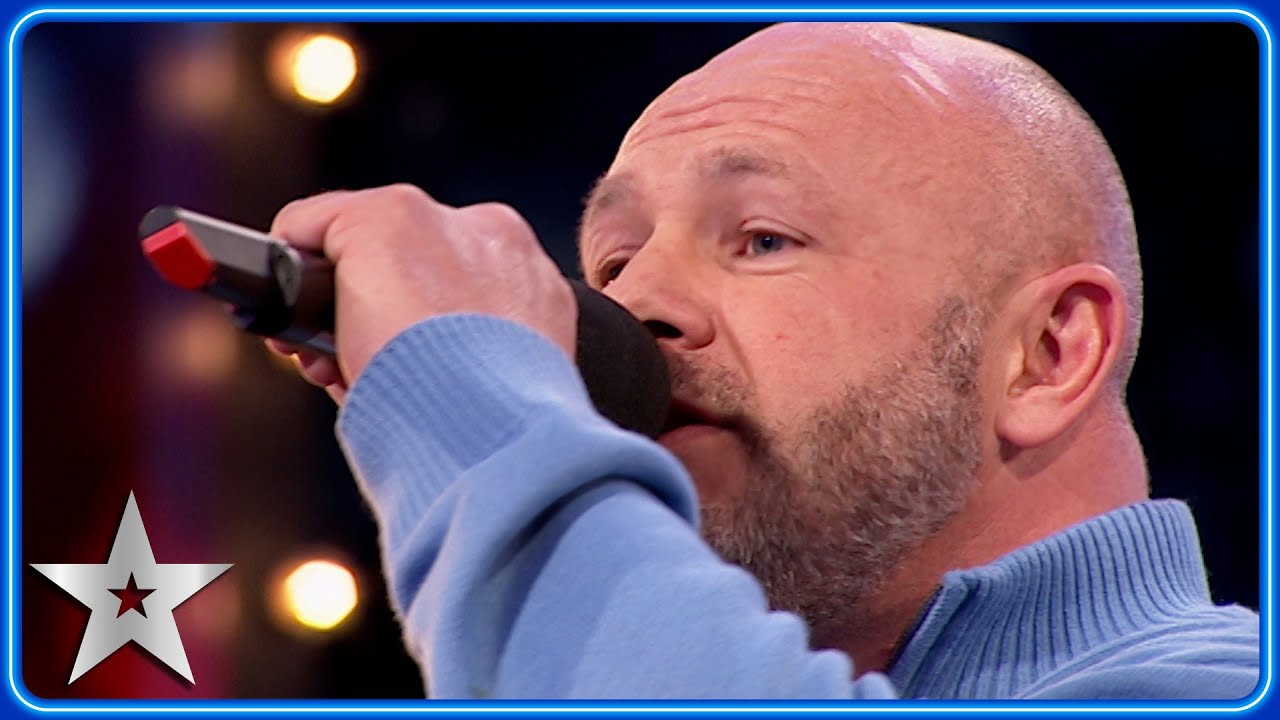
Neil Fullard’s audition on Britain’s Got Talent felt like one of those rare television moments when a quiet life briefly intersected with a long-held dream. At forty-two, Neil arrived with the humble, slightly embarrassed energy of someone who had never imagined himself in the spotlight. He admitted up front that he had never sung publicly—that his performances had been confined to the privacy of his home, the echo of the shower, or the solitude of a car. For more than twenty years he’d worked nights as a doorman, a job he described plainly as putting “bread and butter on the table.” Yet beneath that practical exterior was a musical passion kept mostly to himself and a few coworkers who knew he liked to sing but had never actually heard him perform.
When asked what he would sing, Neil chose a classic that invites elegance and suave delivery: Frank Sinatra’s “Come Fly With Me.” The selection was bold in its own right; Sinatra’s repertoire is notoriously tricky because it demands not just a good voice but a confident persona. As the opening notes began, something remarkable happened—the nerves visibly melted away. The man who had shuffled onto stage with uncertain shoulders straightened, and his voice landed with the kind of ease and sophistication you might expect from someone who’d been touring with a big band for years rather than standing on a BGT stage for the first time.
Neil’s tone is rich and warm, with that unmistakable velvet grain that suits the Rat Pack style. He didn’t attempt to mimic Sinatra so much as embody the spirit of the song: playful, inviting, and effortlessly stylish. There were little touches—slightly swinging phrasing, an easygoing timing on certain lines—that suggested an intuitive grasp of jazz-inflected pop rather than textbook technique. He navigated the melody with a relaxed command, turning what could have been a nervous rendition into a polished, swinging performance that had the audience clapping along and smiling as if transported to a smoky nightclub for a few minutes.
Small, human moments made the performance even more affecting. At the start he glanced toward the wings where his friends and fellow doormen sat, a quick look that seemed to ask for quiet encouragement. As the song unfolded, his expression shifted from concentration to joy; you could see him genuinely enjoying the music in a way that was contagious. When a particularly confident phrase landed, a ripple of applause rose up mid-song—a rare sign that the room had already decided to trust him. By the final lines, the audience was on its feet, cheering for someone who had revealed a side of himself that his nightly shift never required him to show.
The judges’ reactions captured the stark contrast between expectation and reality. Simon Cowell, notorious for his tough exterior, admitted surprise—saying he “did not expect it to be this good.” Piers Morgan, who often trades in dramatic pronouncements, called Neil’s voice “one of the best” he’d heard, words that carried genuine weight. Amanda Holden used words like “sexy” and “charming,” drawing attention to a charisma that Neil had perhaps always possessed but rarely needed in his day-to-day work. Their feedback didn’t just praise his vocal ability; it highlighted how his confidence and presentation could be refined to match the quality of his sound. Practical comments—get a tuxedo, perform with a big band—felt less like criticism and more like a map for how he could translate this moment into a new career trajectory.
There was an obvious poignancy to the audition. Here was a man who had spent decades ensuring others’ safety and comfort as they entered venues, quietly nurturing a talent that, until that night, had been mostly private. The juxtaposition—doorman by night, Sinatra-esque crooner by surprise—made the moment resonate beyond the usual talent-show thrill. It suggested that talents can simmer unseen for years, waiting for circumstances and courage to align. For Neil, the performance offered more than applause; it offered possibility. Three enthusiastic yeses meant he advanced to the next round and, perhaps more importantly, it signaled to him and to everyone watching that a different life might be within reach.
After the show, the image of Neil—the slightly nervous doorman who revealed a polished, world-class voice—stuck with viewers. The audition became less about one great song and more about what it represents: the vision that ordinary people can carry extraordinary talents, and that opportunities can arrive at any age. For Neil Fullard, the BGT stage wasn’t just a one-off triumph; it was a doorway to imagine life beyond the job that had sustained him. The standing ovation, the judges’ praise, and the unanimous sense of wonder all combined into a single, transformative moment—proof that sometimes the most surprising stars are hiding in plain sight.