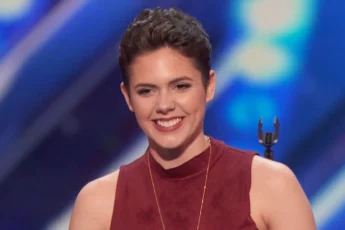
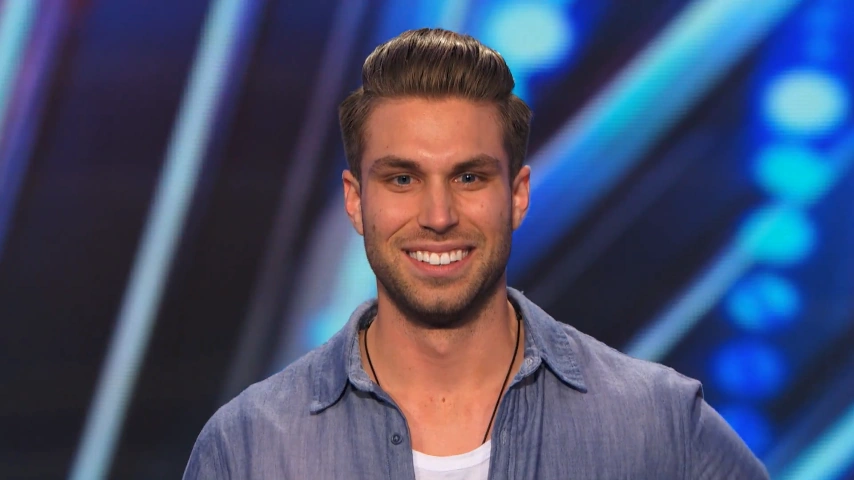
Justin Rhodes’ audition on America’s Got Talent was far more than just a musical performance; it unfolded as a deeply personal story of redemption, reconciliation, and the healing power of music. When Justin walked onto the stage, it was clear he wasn’t there only to impress the judges or the audience—he was there to close a chapter of his life and to let his father see the man he had become. That context made every note feel heavier, more honest.
Justin, a singer and piano player with a warm, resonant voice, didn’t shy away from telling his truth. He spoke openly about the years he spent in New York City chasing a dream, a period that ultimately steered him into substance abuse. He described that time as the “darkest” of his life, a stretch marked by shame and the gnawing belief that he had let his family down. Those words landed with weight because they weren’t vague or theatrical—Justin shared concrete details about how the addiction had pulled him apart from the people who mattered most and how, for too long, he avoided the one person whose opinion he craved: his father.
That absence was more than physical. Justin admitted his father hadn’t seen him perform since he was a child. For a musician, that kind of distance can feel like a wound—especially when the person you most want to impress is the one who raised you. The father-son relationship was threaded through Justin’s story, and you could sense that the audition was as much for his dad as it was for the show. Adding to the emotional stakes, his father had made the trip to be in the audience despite ongoing health issues that made travel difficult. That effort, small in practical terms but huge emotionally, transformed the room: this wasn’t just a performance; it was a reunion.
When Justin began to play Avicii’s “Wake Me Up,” his determination was tangible. He sat at the piano and let the first chords fill the theater, then introduced his voice—clear, soulful, and confessional. He didn’t try to prove a range or show off vocal acrobatics; instead, he inhabited the song, bringing texture to each line and letting the lyrics breathe. His piano accompaniment mirrored his voice: simple but expressive, grounding the song in raw feeling rather than production gloss. It was the kind of performance where you could hear the history between the notes—the late nights, the regret, the recovery—and that honesty translated into a connection with everyone watching.
The judges noticed immediately. They used words like “sexy” and “beautiful” to describe his tone, praise that underscored the technical skill behind the emotion. But beyond the sonic compliments, the moment that reverberated through the theater came from Howie Mandel. Watching the exchange between Justin and his father, Howie was visibly moved; he wiped away tears and spoke about the rare, powerful sight of a parent seeing their child “blossom” in real time. His reaction, heartfelt and unguarded, mirrored what many audience members were feeling: this was more than entertainment, it was human life unfolding under bright lights.
Small, tender moments made the audition linger. There was the way Justin glanced toward his father during the bridge, a look that mixed vulnerability and resolve. The father, for his part, leaned forward in his seat as if to drink in every measure, eyes fixed on the son he hadn’t seen perform in years. In that instant, the applause and the cameras melted away—what mattered was the exchange between two people trying to bridge lost time. After the final chord, the room erupted not just in cheers but in a sense of collective relief and joy, as if everyone had been allowed to witness a private reconciliation.
What made this audition resonate wasn’t only the comeback story or the polished vocals—it was the authenticity. Justin didn’t craft a narrative to win sympathy; he offered a piece of himself and let the audience judge it on its merits. His performance suggested that redemption isn’t a single moment but a series of choices: showing up, being honest, and sharing the work of recovery with others. The fact that he chose a song with lyrics about waking up and moving forward added another layer of meaning, turning a familiar pop hit into a personal anthem.
By the time the judges finished their comments and the crowd gave a standing ovation, it felt like more than a good audition. It was a turning point—for Justin, for his father, and for viewers who saw that vulnerability and resilience can coexist onstage. In an era of manufactured reality, moments like this remind us why live performance still matters: it can make strangers feel like witnesses to something real, tender, and, ultimately, hopeful.