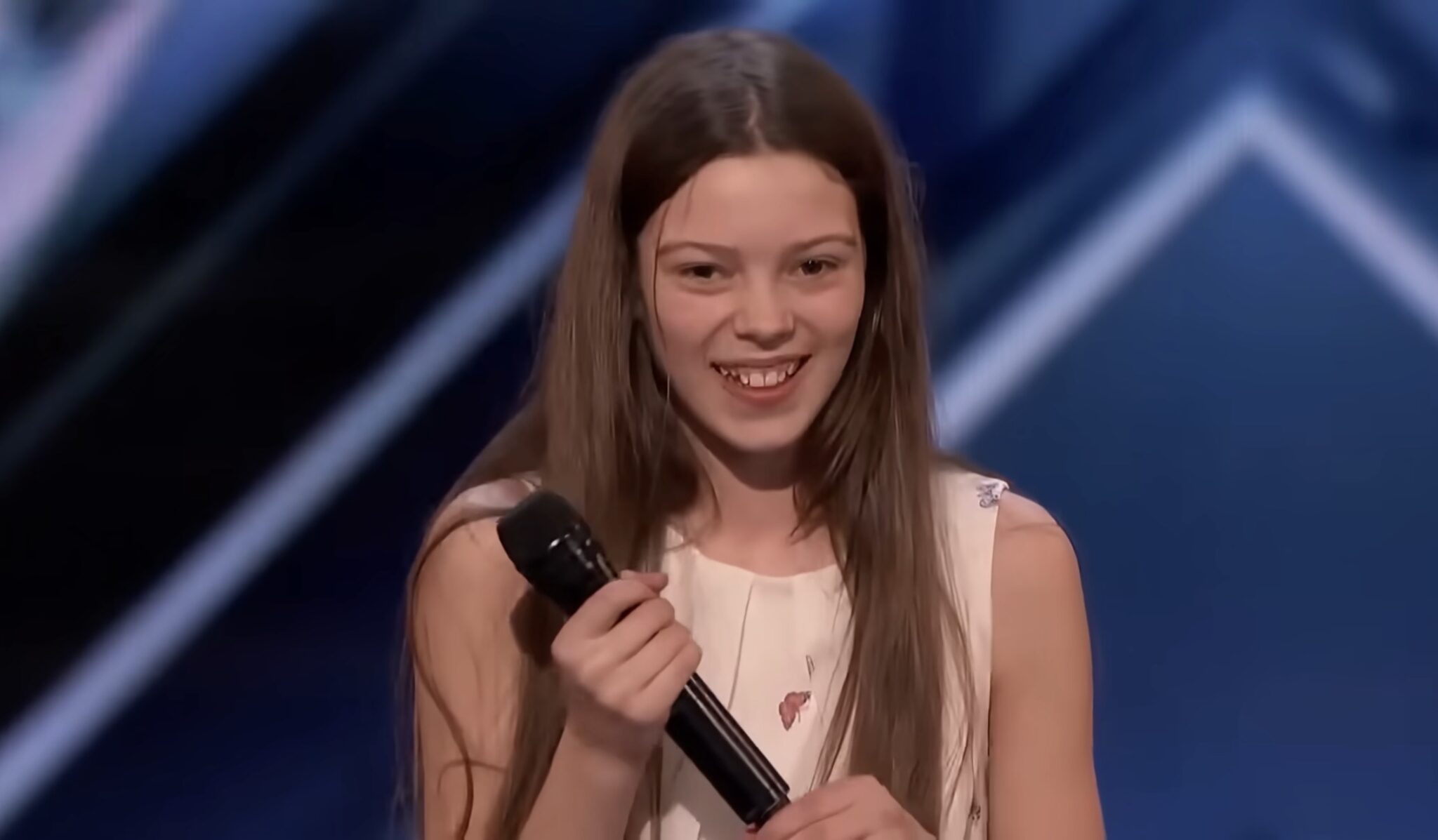
When thirteen-year-old Courtney Hadwin stepped onto the America’s Got Talent stage, she looked every bit the nervous schoolgirl the judges and audience expected to meet. Her answers to the panel were short and timid; she glanced down at her hands, spoke in a soft voice, and seemed as if she might shrink away from the spotlight entirely. Mel B leaned forward and offered gentle encouragement, sensing that this was a child who needed a moment of reassurance before she sang. That small, human exchange only made people in the room lean in more—there was a collective curiosity in the air: could someone who barely managed a sentence really command a stage?
The first moments of her audition felt fragile, like the hush before a storm. Courtney introduced herself modestly, mentioned where she was from, and the audience applauded politely, protective rather than expectant. But as the music cued and the opening bars of Otis Redding’s “Hard to Handle” lifted, something remarkable happened. The timid facade dropped away as if it had been a costume she no longer needed. In an instant, she transformed into a raw, electrifying performer. Her shoulders squared, a grin creased her face, and she launched into the song with a force that seemed far beyond her years.
Courtney’s rendition was an act of full-bodied abandon. She didn’t merely sing the lyrics—she inhabited them. The voice that poured out was gritty and raspy, threaded with a fierce soulfulness that evoked comparisons to Janis Joplin and other icons known for singing with their whole selves. Her phrasing carried an old-school blues grit; she bent notes and pushed vowels in a way that made the lyrics land like confessions. At times she leaned into a raw, throaty belt; at others she softened into husky whispers that pulled listeners in. The contrast between the shy girl who’d answered the judges and the unstoppable performer onstage was startling—and utterly enthralling.
Her stage presence matched the vocal intensity. Courtney stomped and spun, throwing herself into wild, kinetic dance moves that felt both spontaneous and utterly natural. Those motions weren’t choreographed showmanship so much as the physical expression of someone liberated by music. She reached for the mic stand with a theatrical flourish, dipped her head, and let out notes that resonated in the theater like stories told from another era. The camera caught close-ups of judges’ faces shifting from skeptical amusement to open-mouthed astonishment; the audience at the back rose to its feet before the final chorus, swept up by the energy that seemed to cascade from the stage.
Small, human details made the moment even more affecting. There were micro-expressions—Courtney’s brief eyes-closed reveries between lines, a quick, almost shy smile when the crowd roared—that reminded everyone watching she was still a teenager experiencing something huge. You could see the delight and disbelief flicker across her face as the song’s momentum built. Those touches kept the performance rooted; it wasn’t a manufactured audition stunt but the genuine outpouring of an artist who had suddenly found her voice.
The judges’ reactions captured the room’s electricity. Simon Cowell, rarely given to effusive comparisons, said she felt “from a different era,” a comment that acknowledged the timeless quality of her delivery. Howie Mandel’s reaction went further: he likened the discovery to the signing of Janis Joplin, a dramatic comparison that underscored how rare and unexpected the moment felt. Their praise was more than celebrity hyperbole; it was the honest response of people who’d just witnessed a teenager channel an unmistakably mature, world-wise vocal persona.
Then came the ultimate validation: Howie hit the Golden Buzzer. The confetti exploded, and the theater erupted into cheers as Courtney was sent straight through to the live shows. The moment was cinematic—judges and audience members stood, some with tears in their eyes, others shouting in disbelief at the dramatic turnaround. For Courtney, the buzzer wasn’t only a ticket forward; it was a dramatic affirmation that the risks she’d taken—stepping onto a stage despite visible fear—had been worth it.
Beyond the spectacle, the audition carried a quieter message about overcoming nerves and the hidden depths people can harbor. It reminded viewers that external shyness can cloak inner ferocity, and that a single performance can reveal layers of a person that casual conversation never could. Courtney’s journey in those few minutes—from hesitant teen to unrestrained powerhouse—was a testament to the alchemy of music: its ability to transform and to unshackle.
When the lights dimmed and the last confetti fell, the image that lingered was of a young girl who had startled the world by daring to let go. Her audition became one of those moments television loves to replay: raw, unexpected, and utterly magnetic. It proved that talent can arrive wrapped in modesty and that sometimes the most commanding stars are the ones who surprise us when they finally speak—then sing—with everything they have.