
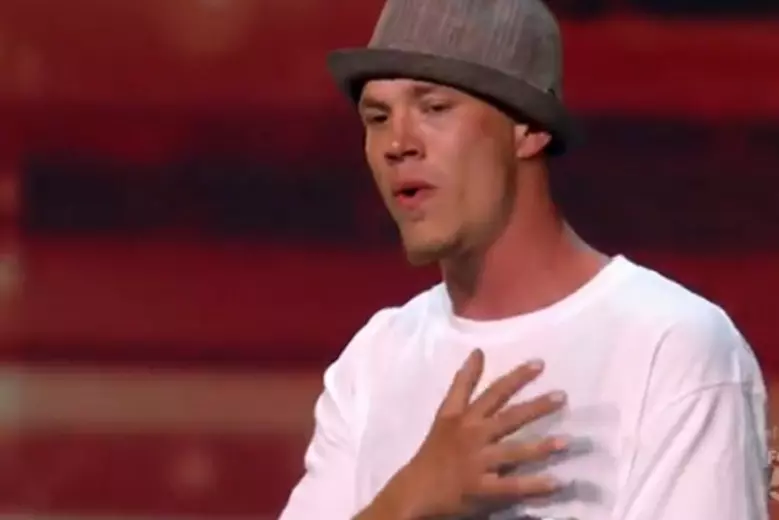
Chris Rene, a 28-year-old trash collector from Santa Cruz, California, walked into The X Factor audition room carrying a simplicity that felt remarkably honest. He didn’t arrive with a manufactured backstory or a flashy entourage; instead he brought the quiet weight of real life — a recent struggle with addiction, the hard work of recovery, and the steady responsibility of being a father. Before he sang a single note, he told the judges he’d been sober for just 70 days. That number hung in the air like both a confession and a promise: fragile, but brave. The admission shifted the mood in the room. Viewers could sense that this audition wasn’t just about a moment of fame; it was about a crossroads, a chance to stake a claim on a different future.
Chris’s demeanor was disarmingly humble. He spoke about his work collecting trash not as punishment but as a job he’d done to keep food on the table — a practical, grounded explanation that made him instantly relatable. He talked about his son in a way that revealed his priorities: not as a prop for sympathy, but as the real reason he wanted to change. The combination of vulnerability and responsibility made the audience sit up. Here was a man who’d been through a lot, who wasn’t asking for pity but instead offering a story of accountability and redemption. It’s the kind of personal truth that gives performances extra resonance, because the song becomes a continuation of the conversation he’d just started.
Choosing to perform an original song — “Young Homie” — was a gutsy move. Originals can be unpredictable in an audition setting; they require confidence in both writing and delivery. But this choice allowed Chris to speak in his own voice, literally and figuratively. The track blended rap and melody in a way that felt natural to him: verses that communicated hard-earned lessons and a chorus that carried a hopeful, singable hook. Lyrically, the song charted his journey — the nights he’d lost, the mornings he’d chosen, the people he hoped to be for his son. That narrative gave the performance a spine; audiences aren’t just responding to timbre and range, they’re responding to narrative integrity, and Chris had that in spades.
From the first beat, his authenticity was palpable. He didn’t try to mask the rough edges in his voice; he used them. There was a lived-in texture to his delivery that made the lyrics land with weight. When he rapped about temptations and mistakes, the cadence was conversational and raw; when he sang the chorus, there was a soulful uplift that suggested someone finding his footing. The arrangement — a sparse beat that left room for his voice and words — reinforced the intimacy. It wasn’t a studio polish moment; it was a man with a story stepping into a room and asking to be heard.
Small details made the performance feel even more immediate. Chris’ hands moved the way people’s do when they’re telling something true: small gestures, pointing here or there, an occasional clutch to the chest on a particularly honest line. His eyes scanned the room in those brief beats between lines, as if checking that the people listening were following him, not just his melody but his life. The camera cut to his son’s name scrawled on a poster in the crowd, a quiet reminder that this wasn’t abstract — a real child was watching his father choose to change. These human touches made viewers feel less like spectators and more like witnesses.
The audience reaction built slowly and then swelled into an undeniable wave. People who might have come with skepticism were won over by the sincerity of his delivery. The standing ovation at the end didn’t feel manufactured; it felt like a communal recognition that someone had taken a risk and offered their true self. For the judges, the moment was both musical and moral. They praised not only the songcraft — the clever hook, the ear for melody married to rhythmic flow — but also the courage it took to stand there sober and honest. Comments centered on how his story amplified his artistry; his recovery wasn’t merely a backdrop, it gave the song an emotional trajectory that couldn’t be faked.
What made Chris’s audition stick with people was the combination of grit and hope. He had the rough edges of someone who’d been through hardship, but he also had a palpable optimism that wasn’t naive — it was the kind of hope earned by work and by small, daily victories. That made his music feel like a map rather than a fantasy: a set of directions for how to move forward. The performance suggested that his talent wasn’t just in a pleasing voice or a catchy hook, but in the authenticity that let listeners feel seen.
Walking offstage, Chris wore relief and a cautious joy. The applause followed him, but so did the sense that something more meaningful had happened: a man in recovery had been publicly recognized for his gift and his effort to change. Whether the competition would lead to record deals or long-term fame was uncertain; what was clear was that the audition provided a platform for transformation. In those few minutes on stage, a trash collector from Santa Cruz translated his struggle into art, gave his son a powerful example, and reminded viewers that second chances, when paired with talent and honesty, can be truly electrifying.