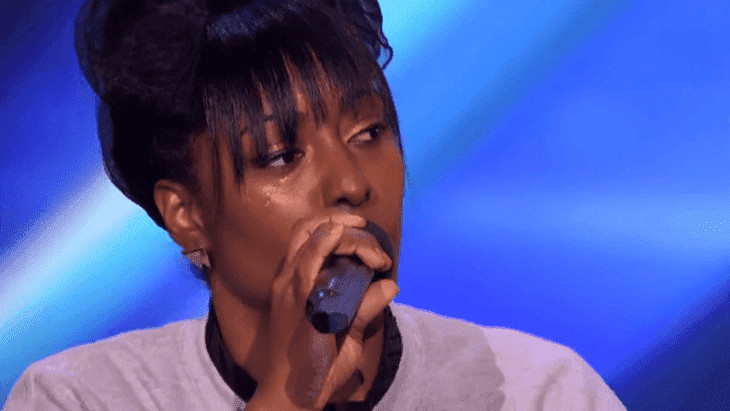
Ashly Williams, a soulful singer who auditioned for The X Factor USA in 2013, walked into the room carrying a weight that was impossible to ignore. In her pre-performance interview she spoke with a brittle kind of bravery about a trauma that had shaped much of her life: her mother had been murdered when Ashly was just 14. She explained that she’d chosen to dedicate her audition to her mother, whose birthday was approaching, and that the memory of her loss had become a spur — painful, but motivating — to finally chase the dream they had once shared. Even before a note was sung, the air felt charged; you could tell this wasn’t simply another audition, it was a private ceremony made public.
Ashly’s demeanor mixed sorrow and steely determination. She didn’t wear sadness as a showpiece; it sat quietly in her eyes, a presence that informed every small movement. When she talked about her mother, her voice would crack with the kind of honest emotion that makes strangers feel connected, and the judges leaned in. There was no melodrama, only an aching sincerity: she wanted to honor her mother’s memory on that stage and, in doing so, to claim a sliver of light for herself. That context made what followed feel less like entertainment and more like an act of personal reckoning.
Choosing Whitney Houston’s “I Will Always Love You” was a bold, almost audacious decision. The song is a gauntlet of technical demands and emotional high stakes — a piece where every run, breath, and pause carries meaning. For Ashly, the choice felt right: it’s a song about love and letting go, about holding someone close even as you release them. Those themes matched her intention perfectly. From the first, quiet opening lines she offered more than technique; she offered the shape of her grief, the memory of a mother’s lullabies translated into a grown woman’s plea.
The performance began softly, with Ashly placing each phrase like a careful footprint across fragile terrain. Her lower register held a rounded, honeyed tone that made the early verses feel intimate, as though she were telling the lyrics directly to the woman who’d raised her. That intimacy drew the audience in; you could hear a pin drop. As the arrangement swelled, Ashly moved through the song’s arcs with a natural sense of pacing — never rushing, always attuned to the emotional architecture of the piece. When the chorus approached, she didn’t simply aim for volume; she aimed for meaning. Each sustained note was colored by a lived experience, not by technical showmanship alone.
What made the audition so devastatingly effective was the way Ashly converted private pain into shared feeling. There were raw edges in her voice — a crack here, a breath-catching moment there — but rather than concealing those imperfections, she used them. In those tiny flaws listeners found honesty. Kelly Rowland’s later comment that Ashly “spilled her heart out” captured this precisely: the performance read like a literal outpouring, one that bypassed artifice and landed in the collective chest of everyone listening. When a singer can make a room feel that intimately involved, it’s less about hitting the note and more about making listeners hold their breath with you.
Small gestures heightened the sense of authenticity. Ashly closed her eyes for long stretches, as if she were seeing a memory rather than the stage. Her hands sometimes trembled at her sides before settling into expressive, quiet movements that matched the song’s phrasing. When she reached the climactic passages, she didn’t attempt extravagant acrobatics; instead she allowed the melody to rise from a place of genuine feeling, and the judges watched with visible tenderness. The production — tasteful lighting and a subdued backing track — never attempted to dramatize her story; it simply framed it, letting her voice be the central storyteller.
By the time the song reached its final, aching notes, the theater had changed. Initial curiosity had given way to an almost reverent silence, and as Ashly released the last phrase a wave of emotion swept through the room. People were crying openly; some were already standing. The standing ovation began before the final high note had fully faded — a spontaneous, unforced response to having witnessed something beyond technical virtuosity: a human being using art to process loss and transform grief into beauty. That reaction said as much about the audience as it did about Ashly; they recognized the courage it takes to expose a wound and turn it into song.
The judges’ feedback reflected an appreciation that went deeper than applause. They praised her vocal control, but they praised, too, her honesty and the bravery of her choice. Kelly Rowland’s observation about Ashly spilling her heart out was echoed by others who remarked on the way she allowed vulnerability to be her strength. For Ashly, the moment was more than validation; it was a public acknowledgment of a private labor — the days and nights of work, the therapy of music, and the ongoing dialogue with memory that singing had given her. Walking offstage, she carried not just applause but a sense that she had honored her mother in the most direct way she could imagine.
In the end, Ashly Williams’ audition stands as a reminder that songs can be vessels: a way to transport love, grief, and remembrance across time. Her rendition of “I Will Always Love You” remains lodged in people’s memories not because it replicated an original perfectly, but because it was utterly, devastatingly real.