
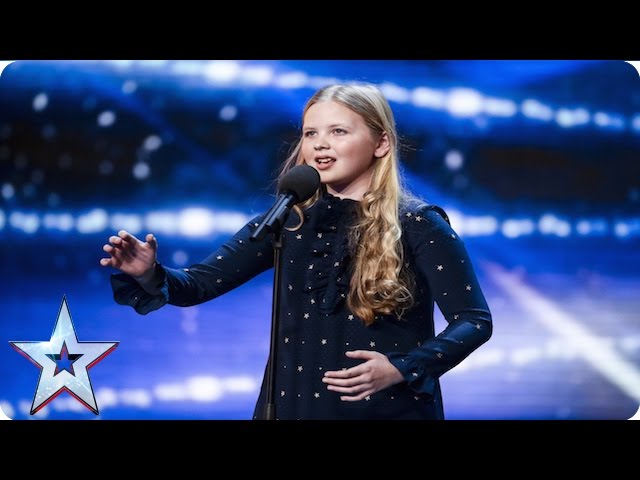
When Beau Dermott stepped onto the Britain’s Got Talent stage in 2016, there was an immediate sense that something special might be about to happen. The 13-year-old stood with a shy, steady composure, and when asked what she planned to sing, her calm response—“Defying Gravity” from Wicked—briefly electrified the room. That choice alone set the tone: the song is notoriously demanding, full of soaring runs and theatrical intensity, and to tackle it at thirteen is itself an act of daring. You could feel a ripple of anticipation move through the audience and the judges, an unspoken question about whether this young performer could meet such a big moment.
From the very first line, Beau answered that question with a voice that seemed far older than her years. What was immediately striking was not only the power of her tone but the control behind it. She began with measured restraint, allowing the piano to breathe with her, and then gradually expanded into fuller sound without ever losing clarity. There was a musical intelligence in the way she paced each phrase—knowing when to hold back, when to lean into the emotion, and when to let a high note bloom. Those choices made the performance feel less like a showcase of technique and more like a lived dramatic moment.
Beau’s ability to marry technique with storytelling made the audition feel cinematic. She didn’t merely hit notes; she inhabited the lyrics. When she sang about breaking free and soaring beyond limits, it felt as though she were embodying that exact journey: a young performer pushing against confinement and reaching toward possibility. Small theatrical details amplified that feeling—an intentional step forward at a key lyric, a focused gaze into the crowd—that turned the song into an honest narrative rather than a mere vocal exercise. Her stagecraft hinted at an older performer’s instincts, the kind of awareness that comes from listening to stories and practicing not just singing but communicating.
The theater’s reaction was telling. As Beau climbed into the song’s big moments, you could see people lean forward, some with hands to their mouths, others with eyes wide. The final phrase hung in the air a heartbeat longer than expected; silence snapped into a roar of applause so immediate and complete that it felt like the room was exhaling together. All four judges stood, not as a ritual but as an instinctive response to what they had just witnessed. It was one of those rare audition moments when the applause feels less like noise and more like collective recognition.
Amanda Holden’s response crystallized the performance’s impact. She reached for the Golden Buzzer without hesitation, sending a cascade of gold confetti down onto the stage and securing Beau a direct route to the semi-finals. Amanda’s tearful declaration—simple, ecstatic praise and a prediction that the girl’s future would be “brilliant”—was both a personal reaction and a public endorsement. Her act of pressing the buzzer felt like an acknowledgment that Beau’s audition had achieved something rare: it moved a judge to act on feeling as much as on talent.
Looking back, what made Beau’s audition endure in people’s memories wasn’t just the technical accomplishment. Plenty of talented singers tackle big songs; what set her apart was the completeness of the moment. There was a seamless blend of vocal maturity, emotional honesty, and theatrical presence, and those elements combined to create an experience that felt authentic rather than manufactured. Viewers weren’t only impressed by the high notes; they were touched by the sincerity behind them—that sense that a young girl had, in a few minutes, risked vulnerability and offered something true.
Beyond the immediate spectacle, the audition also sparked conversations about potential and preparation. Commentators and viewers pointed to Beau’s evident training and her ability to channel such a demanding piece without it feeling beyond her. Parents watching saw a brave kid stepping into a huge spotlight; performers saw the payoff of discipline and emotional connection; casual viewers saw an unforgettable moment of joy and surprise. The universal response was a mixture of awe and affection—an appreciation for a performance that reminded people why live auditions can still produce unrepeatable magic.
In the end, Beau Dermott’s “Defying Gravity” was more than an audition—it was an announcement. It introduced a young artist with both the vocal instrument and the theatrical instincts to sustain a career, and it proved that, sometimes, talent arrives precociously and fully formed. The Golden Buzzer confirmed what the audience had already intuited: this was a defining moment, one that transformed a nervous teenager into a performer who, for a few suspended minutes, genuinely seemed to be defying gravity.