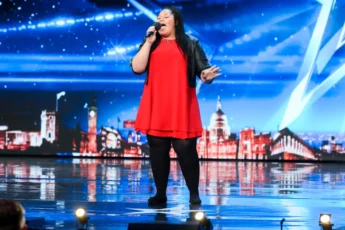
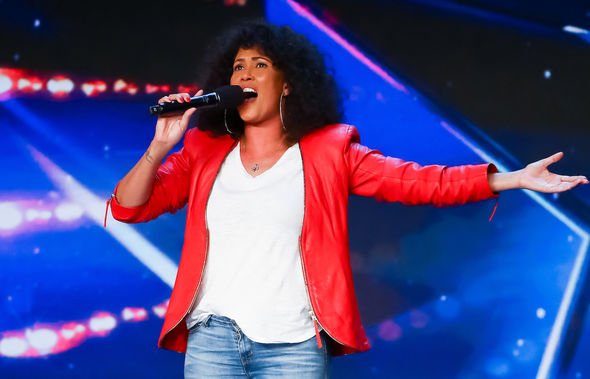
When Belinda Davids, a 43-year-old mother from South Africa, walked onto the stage, she looked every bit the person wrestling with a moment much bigger than herself. You could see it in the way she kept touching her chest, in the tremor in her voice when she admitted, almost apologetically, that “my heart is pretty much up here in my throat.” The physical shaking was plain to see — not the confident composure of a seasoned TV contestant, but the vulnerable honesty of someone for whom this performance meant everything. That vulnerability made her instantly relatable; here was a real person with real stakes, a mom who had come to represent not just her own dream but the hopes of her family.
Belinda didn’t hide the fact that she was already known for singing Whitney Houston songs. That admission raised the bar in everyone’s mind. Whitney’s voice has become a yardstick for vocal excellence, and anyone who tackles her repertoire invites immediate comparison. It’s a risky choice, the sort of move that could either cement a performer’s credibility or expose insecurities. For Belinda, though, the song she chose had personal meaning beyond the challenge. She selected “One Moment in Time” because it reminded her of her two boys — a song about aspiration, achievement and making someone proud. That backstory added a quiet emotional current to the audition; this was more than a technical display, it was an attempt to communicate love and dedication through music.
The moment the backing track began, something shifted in Belinda. The trembling eased and her posture straightened as if she had found an anchor in the opening notes. It was one of those metamorphic moments performers live for: when nervous energy is channeled into focus rather than fear. From the first sustained note, her voice carried a tone and control that surprised everyone who had seen her earlier anxiety. There was a gravitas to her timbre, a richness that matched the weight of the song. She didn’t try to mimic Whitney slavishly; instead, she brought her own phrasing and subtle inflections, honoring the original while making it undeniably hers.
Technically, the performance was impressive in ways that revealed deep preparation. The song demands breath control, dynamic shading, and the ability to move from delicate pianissimos to thunderous crescendos without losing pitch or emotion. Belinda handled those transitions seamlessly. When the chorus climbed, she met it with power but not force — the kind of controlled intensity that suggests years of disciplined practice. Her high notes were secure and full-bodied, landing cleanly and resonating long after they were sung. But it wasn’t just the notes that captivated; it was the emotional through-line. At key moments she softened, letting vulnerability show; at others she swelled with conviction, as if insisting that this moment mattered not just to her but to everyone listening.
The reaction in the theater was immediate and telling. What began as tentative applause swelled into a standing ovation so enthusiastic it felt like the whole room rose at once. Audience members who had been watching with sympathetic smiles were now cheering, wiped of skepticism by the sheer sincerity of the delivery. Those who had come expecting a good imitation left with a story about a woman who had found her own voice on a big stage. It’s rare to see the kind of unanimous response Belinda provoked — the sort that makes producers and viewers alike sit up and take notice.
The judges’ responses captured the mood perfectly. David Walliams, struck by the performance’s polish and emotional resonance, described it as “a class act,” and said he wanted to see Belinda’s name “in lights.” There was a sense in his words of someone recognizing both the talent and the work behind it. Alesha Dixon echoed that sentiment, calling the audition “a fantastic end to a fantastic tour.” She praised Belinda’s ability to move the audience, highlighting how a song can transform into a shared emotional experience when performed with honesty. Their comments felt more than complimentary; they were acknowledgments that Belinda had transcended a mere cover and delivered something theatrical and affecting.
In the end, the judges’ votes were unanimous. The four enthusiastic “yeses” she received were less a formality and more a celebration. One judge summed up the sentiment that had rippled through the studio: “That was the moment we’ve been waiting for, 100%.” For Belinda, that moment validated years of dedication — the late nights of practice, the small gigs, the balancing of motherhood and artistry. More than that, it proved that immense nervousness doesn’t have to be a barrier; when met with preparation and purpose, it can become the fuel for a truly unforgettable performance.
As she left the stage, still slightly breathless and with a soft, relieved smile, it was clear this audition would not be forgotten. Belinda Davids had come to sing a song about seizing one life-changing moment, and in doing so she created one of her own. The performance was a reminder that talent, when combined with heart, can quiet fear and turn a trembling voice into something transcendent.