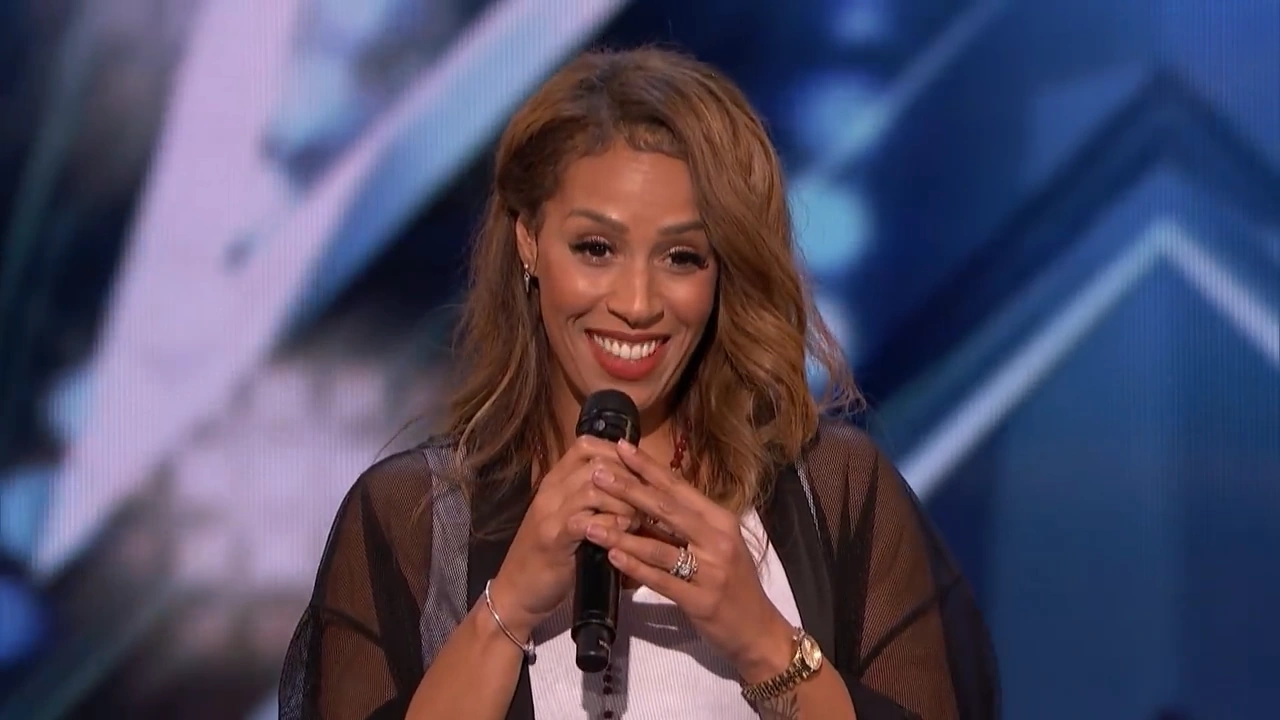
Thirty-nine-year-old Glennis Grace walked onto the America’s Got Talent stage with a quiet determination that felt both familiar and fresh. She spoke plainly about her career — she had been singing for years, honing her craft and performing wherever the chance arose — but she also admitted that her dream hadn’t changed: to be heard by more people and to take her music to the next level. Sitting in the audience that night was her most ardent supporter, her 11-year-old son Anthony, whose encouragement had helped push her toward this giant American stage. There was something immediately sympathetic about that image: a devoted mother chasing a dream, buoyed by a child’s belief. The judges listened with interest; here was a singer with experience and a personal stake, not just someone seeking a fast break.
When Glennis announced she would sing Whitney Houston’s “Run to You,” the choice felt bold and risky. Whitney’s catalog is a gauntlet of demanding vocal runs, emotional peaks, and a legacy so towering that any comparison could feel unfair. But Glennis approached the song not with bravado but with a respectful confidence. From the very first note, it was clear she had thought deeply about how to honor the material while letting her own voice speak. The opening line unfurled with remarkable control — a tone so rich and polished it almost felt familiar in the way the crowd shifted and leaned in. There was an immediate sense that this was not a mere imitation; it was a heartfelt tribute delivered by a vocalist who understood the song’s emotional architecture.
Small moments in the performance revealed why Glennis’s rendition resonated so strongly. She paced the song carefully, allowing quieter, intimate lines to breathe before building into the big Whitney-style climaxes. Her phrasing was precise; she shaped each syllable with care so the lyrics landed with meaning rather than mere vocal acrobatics. When she reached the soaring parts, her power was evident but never gratuitous — a controlled force that lifted the audience rather than blasting them into applause. Watching her, you could see the connection she had to the music: the eyes softened at the vulnerable moments, the jaw clenched at the intense ones, and at the end of a phrase she would hold a note just long enough for the emotion to settle into the room.
The reaction was immediate. The auditorium, already hushed by the opening lines, swelled into a standing ovation by the time Glennis hit the song’s more triumphant passages. People rose to their feet not simply because of a technical feat but because they felt moved. You could spot familiar signs of a truly great audition: husbands and wives exchanging astonished looks, some audience members wiping their cheeks, others shouting encouragement. For the judges, the performance had a particular sting — this was precisely the kind of moment talent shows are built to capture, where an artist’s lived experience and vocal ability converge to create something transcendent.
Their responses were as emphatic as the applause. Simon Cowell, known for his blunt assessments, offered perhaps the most striking endorsement: “I feel like I’m looking at a star already, I’m going to be honest with you.” Coming from him, that wasn’t mere flattery; it was a statement about potential on a very large scale. Mel B, who often reacts viscerally to vocal power, said, “You do sound so much actually like Whitney, it’s unbelievable,” acknowledging the uncanny similarity in tone and delivery while also celebrating Glennis’s ability to channel that spirit without losing herself. Howie Mandel captured the audition’s bittersweet truth with an empathetic observation: “The only reason why you’re not a star yet is because we haven’t seen you and we haven’t heard you.” In that comment was both critique and consolation — a recognition that the industry’s machinery, not her talent, had been the missing ingredient.
When the four “yes” votes came through, the finality felt less like a competition result and more like confirmation. Glennis’s dream, carefully tended for years, suddenly seemed within reach. The applause that followed wasn’t only for the moment but for the possibility that the show might be the bridge between local stages and an international career. Backstage, you could imagine the relief and joy washing over her — the relief of validation, the joy of hearing her son’s belief reflected back by a national audience.
Beyond the immediate drama, Glennis’s audition carried a tender subtext. It reminded viewers that talent doesn’t always unfold on a predictable timeline. There are artists who toil for years in relative obscurity, motivated by family, passion, or the sheer love of music. Glennis embodied that slow-burn ascent: practiced, patient, and finally ready for broader recognition. Her performance of “Run to You” paid tribute to Whitney while staking a claim of its own, proving that a singer with both technical mastery and emotional sincerity can still stop a room. For Glennis Grace and her son Anthony, the AGT stage was more than a spotlight — it was an affirmation that dreams deferred can still ignite into something very real.