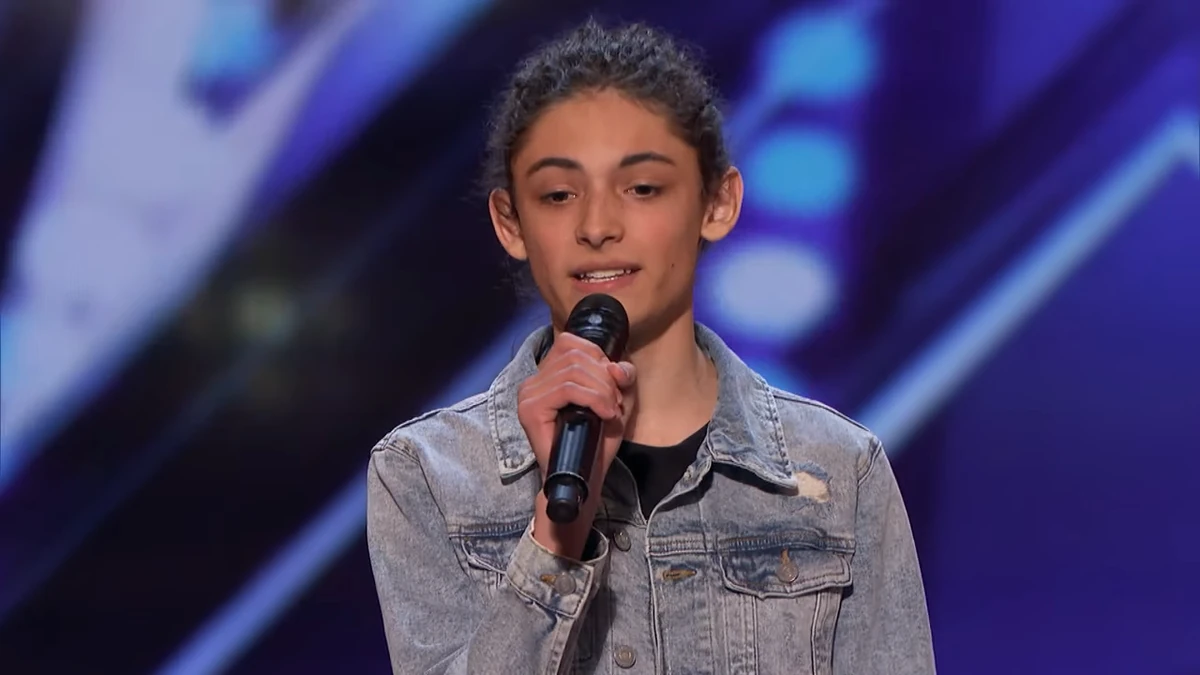
When Benicio Bryant walked onto the America’s Got Talent stage, you could almost see the anxiety written across his face: hunched shoulders, a hesitant smile, eyes that scanned the room as if searching for an escape route. At just 14 and quietly from Washington, he looked like any nervous teenager about to take a big test. What happened next erased that image in a single, unforgettable song. Choosing Brandi Carlile’s “The Joke,” a piece already loaded with emotional heft, Benicio began softly, voice trembling just slightly at first, as if testing the air. Within moments, the room had shifted from polite curiosity to rapt attention; every ear leaned in.
There was something quietly cinematic about the way his performance unfolded. He started intimate, conversational almost, letting the lyric’s empathy settle naturally into the space. You could tell this wasn’t a kid trying to mimic a viral style or chase applause — he was telling a story. The early lines felt like a private confession shared in public, and that vulnerability made what came after all the more powerful. As the song built, Benicio didn’t rush. He layered emotion with restraint, choosing to place each note with care. That control is rare in performers his age: many young singers throw everything at the climaxes and lose nuance along the way. Benicio, however, used quiet as a tool, so that when he expanded into the song’s soaring passages, the contrast felt earned and genuinely moving.
Technical skill was evident, but it never overshadowed the feeling. His breath control supported long, sustained phrases that shimmered rather than strained. There were moments of unexpected grit and husk in his higher register that added an old-soul weight to the lyrics, suggesting a maturity beyond his years. Small choices made the performance feel lived-in: a held vowel that made the line ache, a slight bend on a final syllable that suggested pain and resolve, the way his eyes closed briefly as if he were stepping through the memory behind the song. Those details made the audience respond not just to notes, but to a person revealing himself on stage.
The family thread in Benicio’s story deepened the impact. He grew up in a household where his father’s late-blooming passion for rock music provided the soundtrack — not polished lessons, but records, garage rehearsals, and an infectious love for honest singing. Benicio has reportedly been singing since he was two, and that history came through in the ease of his phrasing and the distinct personality of his voice. There’s a lineage there: a son carrying forward a father’s musical curiosity, but shaping it into something uniquely his own. That backstory made the audition feel like more than a performance; it became a quiet passing of a torch, a family moment amplified for the world to see.
Judges’ reactions captured the room’s astonishment. Gabrielle Union praised his authenticity, noting how he allowed the song to speak for him rather than perform for the cameras. Her comments reflected what many viewers felt: Benicio’s strength was not posturing but truthfulness. Simon Cowell, rarely lavish in praise, drew a striking comparison, likening Benicio’s magnetic presence to a young Harry Styles during his first audition. That’s not a throwaway compliment — it highlights the ineffable charisma that can’t be taught. For a shy teenager to conjure that degree of stage presence the moment a microphone is in his hands is the kind of thing talent shows are built to reveal.
The emotional arc of the audition was masterfully constructed. The quiet opening made the middle tender; the middle fed the crescendo; and the crescendo landed with a force that felt both surprising and inevitable. When Benicio reached the climactic passages, his voice expanded into a resonant, full-bodied sound that filled the theater and seemed to ripple through the judges’ panel. The room’s initial hush gave way to shouts and standing ovation as the last note faded — a collective release of the tension that had built throughout the performance.
Beyond the immediate applause, the audition sparked a larger moment of connection. Viewers online responded not only to the vocal fireworks but to the human story: a shy teenager facing fear and choosing to share his inner world through music. That resonance helped secure him unanimous approval from the judges — four emphatic “yes” votes and a fast track to the next round. But even more than progression in the competition, the moment felt like a declaration. It was proof that raw talent, when combined with emotional honesty and a lifetime of informal practice, can rise above nerves.
Benicio’s audition is a reminder that artistry doesn’t always present itself with bravado. Sometimes it arrives wrapped in shyness, and what looks like timidity is actually the quiet before something transcendent. For one nervous teenager, a single song transformed the air around him and revealed a voice that, once heard, is hard to forget. If this was his first step into the public eye, it was already a powerful one — an introduction that left the world waiting to hear what he’ll do next.